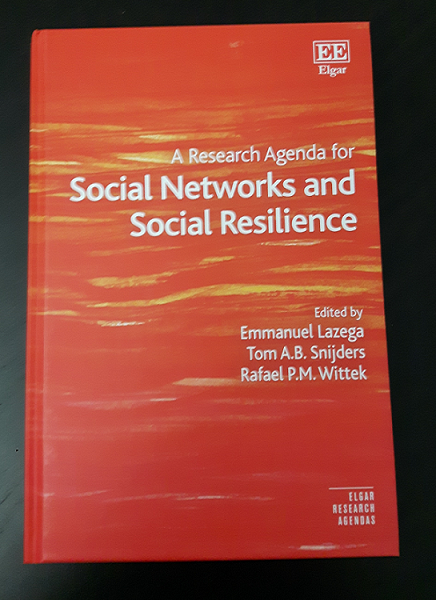
I have just received my copy of the new book edited by Emmanuel Lazega, Tom Snijders and Rafael Wittek on Social Networks and Social Resilience.
It has been an amazing journey that has brought all of us as chapter authors to share ideas, learn from each other, and reflect together, both with the whole group and in smaller cliques. It’s been one of my best experiences of collaboration toward an edited volume – perhaps because of the network-minded leadership we had!
The result is an incredibly high-quality book that is up-to-date, well documented, and at the same time accessible to all, especially students.
My contribution is a chapter on ‘Social networks and resilience in emerging labor markets’. Its premise is that the recent emergence of digital platforms as labor market intermediaries disrupts collective work practices, fostering fragmentation and individualized sub-contracting. I therefore discuss how social networks operate, and how they support social resilience, in these environments where isolation dominates. Most importantly I ask how we, as researchers, can apprehend them. To address these questions, my chapter reviews insights from socio-economic studies of networks, discusses their applicability to platforms, compares and contrasts them to existing evidence on platform work. The analysis confirms that overall, technology-enabled platform intermediation restrains sociability and limits interactions, but specific cases where networking has been possible highlight the fundamental advantages it may have for workers, and suggest directions for future research and policy action.
More information about the book is here.
The full text of the chapter is available here.

 Data Big and Small