I am attending a faboulous Sunbelt conference, taking place this year in Paris. I am deeply grateful to Emmanuel Lazega who made gigantic efforts to bring this important conference to France, after a failed attempt in 2020 when the Covid-19 pandemic brought everything online.
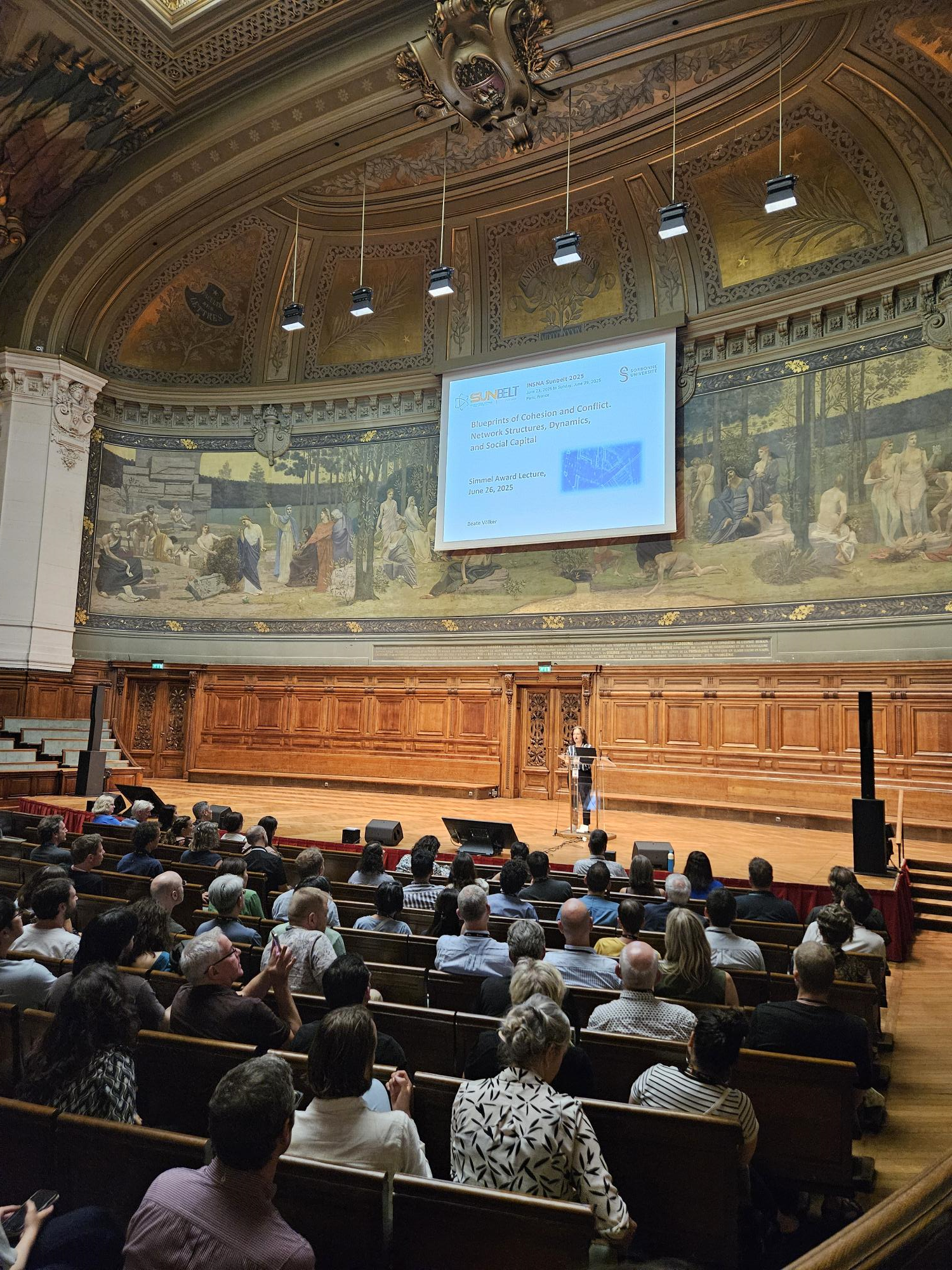
Yesterday, a very inspiring keynote by Beate Völker reminded us of the importance of weak ties and even absent ties – not only to smoothen the functioning of job markets but also, more surprisingly, to achieve social cohesion. The keynote took place in the historical Grand Amphithéâtre de la Sorbonne.
I am pleased to have contributed to a set of initiatives in honour of great network sociologist Harrison White, one year after his death. With Elise Penalva-Icher and Fabien Eloire, we presented a paper on digital platforms in White-like producer markets shaped by networks (more on it soon!). The paper was part of a dedicated session on the legacy of Harrison White. There was also a plenary in memoriam, where his former students and friends shared thoughts and stories. (Another plenary honoured Barry Wellman).
I was also honoured to be invited, today, to join a plenary panel on social networks and the study of social inequalities, organized by Gianluca Manzo. While most research on inequalities is attribute-based, social network approaches provide a powerful alternative (or perhaps, complement), highlighting how interpersonal, relational mechanisms generate patterns that over time, lock categorical differences into durable gaps in wealth, status, or other outcomes. We discussed complementarities and differences between these two approaches, the advantages of a network-oriented perspective, but also the methodological challenges that come with it.
On Sunday, I’ll present a paper that also deals with inequalities, in the specific case of online platform workers. We define an index of ‘vulnerability’ to unveil inequalities within this worker population in two countries, France and Spain. The paper develops and deeps results of a previous work, whose first outputs served to inform policy decisions in France.
Another paper to which I have contributed, and which will be presented at this Sunbelt, is more methodological and is the result of a collective effort. We analyze over 20 years of publications in the journal REDES and highlight how researchers have reported relational data from both personal and complete networks. We identify key challenges in the consistency and transparency of reporting and propose 7 practical recommendations to improve clarity, comparability, and replicability in social network research. This paper is already published in REDES.

 Data Big and Small