The Millennium Institute for Authority and Social Regulation (ASOR), recently created in Chile, aims to conduct cutting-edge interdisciplinary research on the decline and reconfiguration of authority relationships in contemporary society and their impacts on social regulation. Authority, claim the founders of the Institute, is a pervasive social mechanism that is in place whenever there are power asymmetries. How people manage authority – in the family, school, workplace etc. – affects social cohesion and the extent to which (un)healthy relations of domination may arise.
The rise of algorithmic management, especially AI-supported, is widely thought to affect labour relationships, endowing our bosses with new tools or even – as in the exemplary book by Aloisi and De Stefano) that algorithms actually are our new bosses. At the same time, the rise of platform labour – also closely linked to the AI boom – has promoted the model of independent workers who have no boss. Authority in the workplace changes gets more fragmented, disrupting traditional relational models, not only vertically (the hierarchical chain of command), but also horizontally (team composition, collegial work). What are the effects?
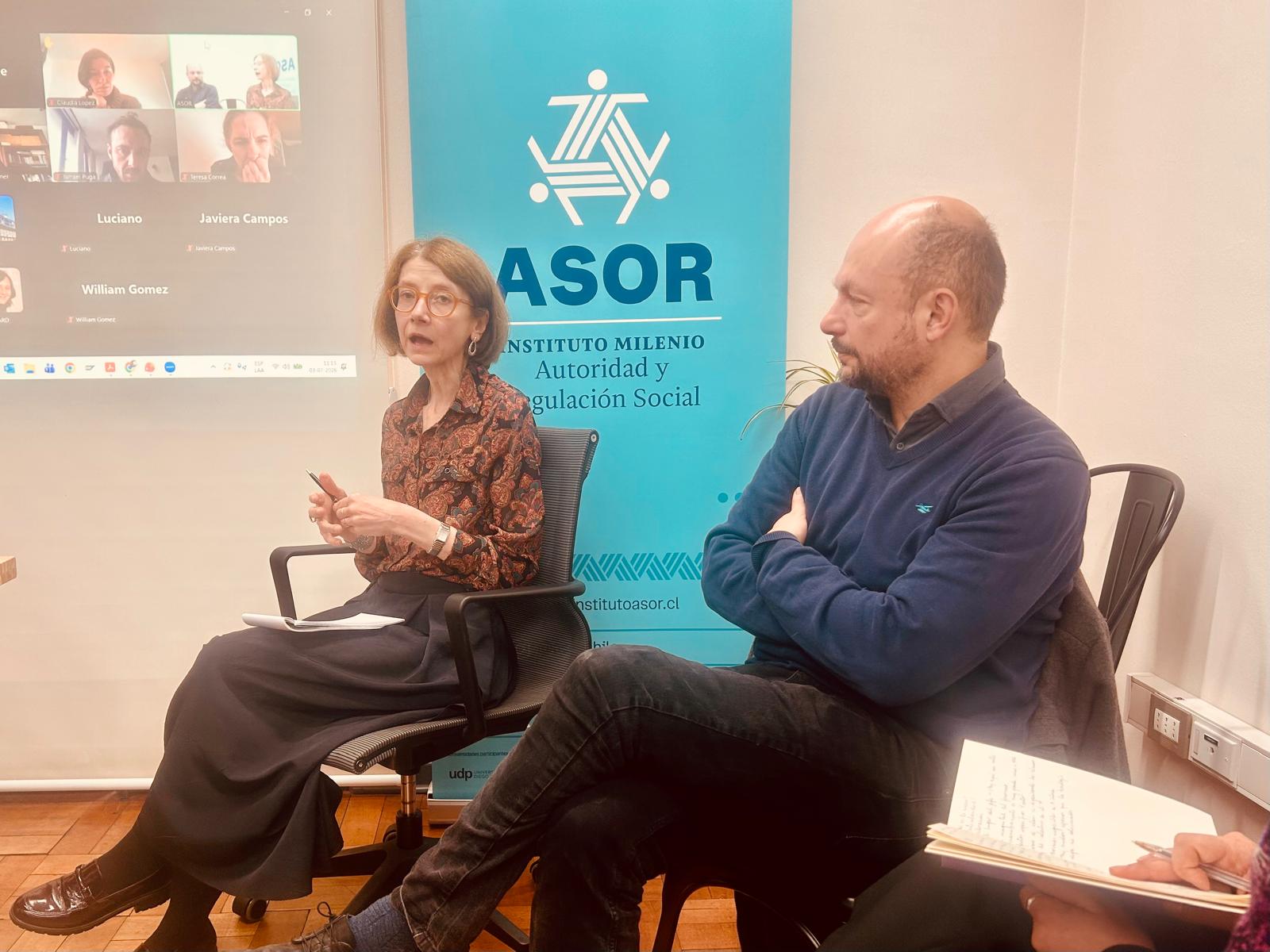
I was invited to give a talk at the ASOR Institute in Santiago in early July, and had the pleasure of sharing some results of my research in order to deepen dialogue on these important topics. I discussed how algorithmic management comes with a promise of higher productivity, but also increases surveillance in companies, while the apparent autonomy of self-employed workers on platforms—from Rappi delivery drivers to Workana designers—proves to be illusory. My presentation, largely though not exclusively based on this open-access book chapter, analyzed the consequences of these transformations on job quality at two key stages of the AI life cycle: its production through human labor (so-called “data work”) and its deployment in workplaces across various sectors, from logistics to healthcare. Taken together, they reveal how AI accelerates preexisting trends in the global economy: the outsourcing of business functions while maintaining control over production – a phenomenon studied by D. Weil as the “fissured workplace” – and a “regime of dispersion”, first theorized by C. Datchary, in which workers manage multiple disconnected tasks. To protect job quality, corporate strategies and labor regulations must address the cognitive overload associated with fissuring, develop worker-centered organizational models, and implement safeguards for all users.

