The dual footprint of AI, in the green-digital transition

I am delighted to be part of a broad reflection, initiated and promoted by Edemilson Paraná, that critically interrogates the convergence of environmental sustainability and digitalization, in a special issue just published in the journal Globalizations. Governments and multi-lateral institutions frame the “twin transition” as a strategy to foster economic growth and durable social prosperity at the same time. However, Paraná argues in his introductory article (co-authored with Rodrigo Santaella-Gonçalves), this agenda is shaped by market logics and geopolitical competition, in ways that ultimately contradict the social and ecological goals it supposedly supports. The special issue has been designed to offer a systemic political-economy perspective on this inconsistency, grounded in critical social sciences and heterodox economics. Overall, it shows how the structural drivers of digitalisation can constrain its green potential and identifies pathways for redirecting the transition towards socially equitable and ecologically sustainable transformations.

Ulysse Gerkens & FARI / “Server Pool” / https://betterimagesofai.org / https://creativecommons.org/licenses/by/4.0/ This image subverts the swimming pool of the Villa Empain, a Brussels contemporary art venue. The pool is drained of its water and filled with computer servers. The image makes visible the massive water consumption required to cool data centers, but also questions the allocation of resources: when enormous budgets shift toward digital infrastructure, what remains for culture?

My own article within this special issue aims to reconcile two separate trends in the study of the impacts of artificial intelligence (AI), one focused on the natural and the other on the social surroundings that supply resources for its production and use. I introduce the concept of the ‘dual footprint’ as a heuristic device to capture the commonalities and interdependencies between them. Originally borrowed from ecology, the concept denotes here the total impacts on the environment and society generated by AI’s production and use. It is an indicator of sustainability insofar as it grasps the degree to which the AI industry is failing to ensure the maintenance of the socio-economic systems and environmental conditions necessary to its production. To develop the concept in this way, it is necessary to (provisionally) renounce some of the accounting flavour of extant footprint measures, allowing for a more descriptive interpretation. In my article, the dual footprint serves as a mapping tool, linking impacts to specific locations and to the people and groups that inhabit them.

I use two in-depth case studies, each illustrating international flows of raw materials (nature) and of labour services (society). Case studies are a preliminary illustration of a broader idea, that will need to be developed further: that the AI industry is a value chain that spans national boundaries and perpetuates inherited global inequalities. Specifically, I use the case of Argentina as a provider to the United States and Madagascar as a provider to France, Japan and South Korea. It appears that the countries that drive AI development (here, the United States, France, Japan and South Korea) generate a massive demand for inputs and trigger social costs that, through the value chain, largely fall on more peripheral actors (here, Argentina and Madagascar). While Argentina and Madagascar differ under many respects, in both cases initial hopes of jobs and prosperity have failed to materialise as predominant outsourcing arrangements reinforce informality and precariousness without preventing environmental damage. Put differently, the arrangements in place distribute the costs and benefits of AI unequally, resulting in unsustainable practices and preventing the upward mobility of relatively more disadvantaged countries. The concept of the dual footprint is useful because it grasps how the environmental and social dimensions of the dual footprint emanate from similar underlying socio-economic processes and geographical trajectories.

A prior presentation of this idea can be found here.

A pre-print version of the article (green open access) can be found here.

The dual footprint of AI

The impacts of artificial intelligence (AI) on the natural and social surroundings that supply resources for its production and use have been studied separately so far. In a new article, part of a forthcoming special issue of the journal Globalizations, I introduce the concept of the ‘dual footprint’ as a heuristic device to capture the commonalities and interdependencies between them. Originally borrowed from ecology, the concept denotes in my analysis the total impacts on the natural and social surroundings that supply the resources necessary for AI’s production and use. It is an indicator of sustainability insofar as it grasps the degree to which the AI industry is failing to ensure the maintenance of the social systems, economic structures, and environmental conditions necessary to its production. To develop the concept in this way, it is necessary to (provisionally) renounce some of the accounting flavour of extant footprint measures, allowing for a more descriptive interpretation. In my article, the dual footprint primarily serves as a mapping tool, linking impacts to specific locations and to the people and groups that inhabit them.

Gloria Mendoza / ‘The Environmental Impact of Data Centers in Vulnerable Ecosystems’ / https://betterimagesofai.org / https://creativecommons.org/licenses/by/4.0/

My analysis draws on recent research that challenges idealized narratives of AI as the sole result of mathematics and code, or as the fancied machinic replacement of human brains. The production of AI relies on global value chains which, like those of textiles and electronics, take shape within the broader context of globalization, its long-standing trends of outsourcing and offshoring, and the cross-country disparities on which it thrives.

The argument is based on two case studies, each illustrating AI-induced cross-country flows of natural resources and data labour. The first involves Argentina as a supplier to the United States, while the second includes Madagascar and its primary export destinations: Japan and South Korea for raw materials, France for data work. These two cases portray the AI landscape as an asymmetric structure, where the countries that lead the tech race generate a massive demand for imports of raw materials, components, and intermediate goods and services. Core AI producers trigger the footprint and therefore should bear responsibility for it, but the pressure on (natural and social) resources and the ensuing impacts occur predominantly elsewhere. Cross-country value chains shift the burden toward more peripheral players, obscuring the extent to which AI is material- and labour-intensive.

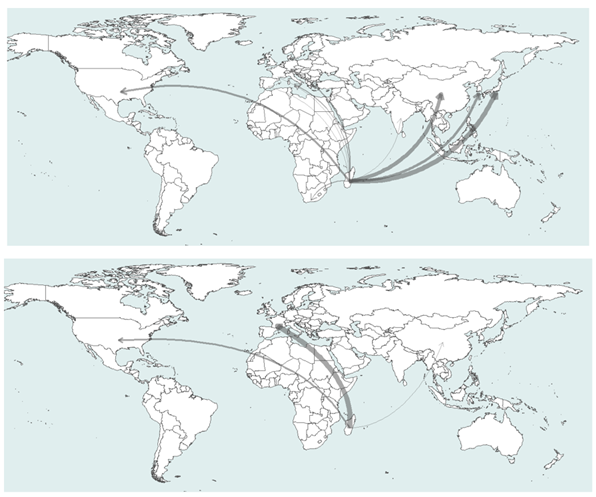
Flows of raw materials (mainly nickel and cobalt from the Ambatovy mining project) from Madagascar to East Asia and, to a lesser extent, Europe and North America (top); flows of data work services from Madagascar to France, followed by North America and to a lesser extent, East Easia (bottom). Madagascar, one of the poorest countries in the world, contributes to state-of-the-art AI production without managing to move up the value chain.

This drain of resources toward AI engenders adverse effects in peripheral countries. Mining notoriously generates conflicts, and data work conditions are so poor that other segments of society – from local employers to workers’ families and even informal-economy actors – must step in to cover part of the costs. The current arrangements thus fail to ensure their own sustainability over time. Additionally, the aspirations of these countries to leverage their participation to the AI value chain as a development opportunity, and to transition toward leading positions, remain unfulfilled.

The dual footprint can fruitfully dialogue with the critical literature that leverages the concepts of extractivism (for example, Cecilia Rikap‘s concept of “twin” extractivism) and dependency (as theorised for example by Jonas Valente and Rafael Grohmann). Its contribution lies mainly in the effort to operationalise the ideas of more abstract social theories, while also facilitating mutual enrichment between different literatures.

Read the full paper: subscription-protected or open-access preprint.

The paper was developed as part of an initiative on ‘The Political Economy of Green-Digital Transition‘, organised by Edemilson Paraná in 2024 at LUT University in Finland. Further, the idea that the environmental and social dimensions of AI production emanate from similar underlying socio-economic processes and geographical trajectories constitutes the foundation of SEED – Social and Environmental Effects of Data Connectivity, a new DiPLab project that investigates how data extraction and material extraction are deeply interconnected. It stems from a collaboration with Núcleo Milenio FAIR at the Pontificia Universidad Católica de Chile and compares data and material infrastructures in Europe and South America.

Credits: FAIR