Where does AI come from?

I am thrilled to announce that an important article has just seen the light. Entitled ‘Where does AI come from? A global case study across Europe, Africa, and Latin America’, it is part of a special issue of New Political Economy on ‘Power relations in the digital economy‘. It is the result of joint work that I have done with members of the Diplab team (A.A. Casilli, M. Cornet, C. Le Ludec and J. Torres Cierpe) on the organisational and geographical forces underpinning the supply chains of artificial intelligence (AI). Where and how do AI producers recruit workers to perform data annotation and other essential, albeit lower-level supporting tasks to feed machine-learning algorithms? The literature reports a variety of organisational forms, but the reasons of these differences and the ways data work dovetails with local economies have remained for long under-researched. This article does precisely this, clarifying the structure and organisation of these supply chains, and highlighting their impacts on labour conditions and remunerations.

Framing AI as an instance of the outsourcing and offshoring trends already observed in other globalised industries, we conduct a global case study of the digitally enabled organisation of data work in France, Madagascar, and Venezuela. We show that the AI supply chains procure data work via a mix of arm’s length contracts through marketplace-like platforms, and of embedded firm-like structures that offer greater stability but less flexibility, with multiple intermediate arrangements that give different roles to platforms. Each solution suits specific types and purposes of data work in AI preparation, verification, and impersonation. While all forms reproduce well-known patterns of exclusion that harm externalised workers especially in the Global South, disadvantage manifests unevenly depending on the structure of the supply chains, with repercussions on remunerations, job security, and working conditions.

Marketplace- and firm-like platforms in the supply chains for data work in Europe, Africa, and Latin America. Dark grey countries: main case studies, light grey countries: comparison cases. Organisational modes range from almost totally marketplace oriented (darker rectangle, Venezuela) to almost entirely firm oriented (lighter rectangle, Madagascar). AI preparation (darker circle) is ubiquitous, but AI verification (darker triangle) and AI impersonation (darker star) tend to happen in ‘deep labour’ and firm-like organisations where embeddedness is higher.

We conclude that responses based only on worker reclassification, as attempted in some countries especially in the Global North, are insufficient. Rather, we advocate a policy mix at both national and supra-national levels, also including appropriate regulation of technology and innovation, and promotion of suitable strategies for economic development.

The Version of record is here, while here is an open access preprint.

Micro-work and the outsourcing industry in Madagascar

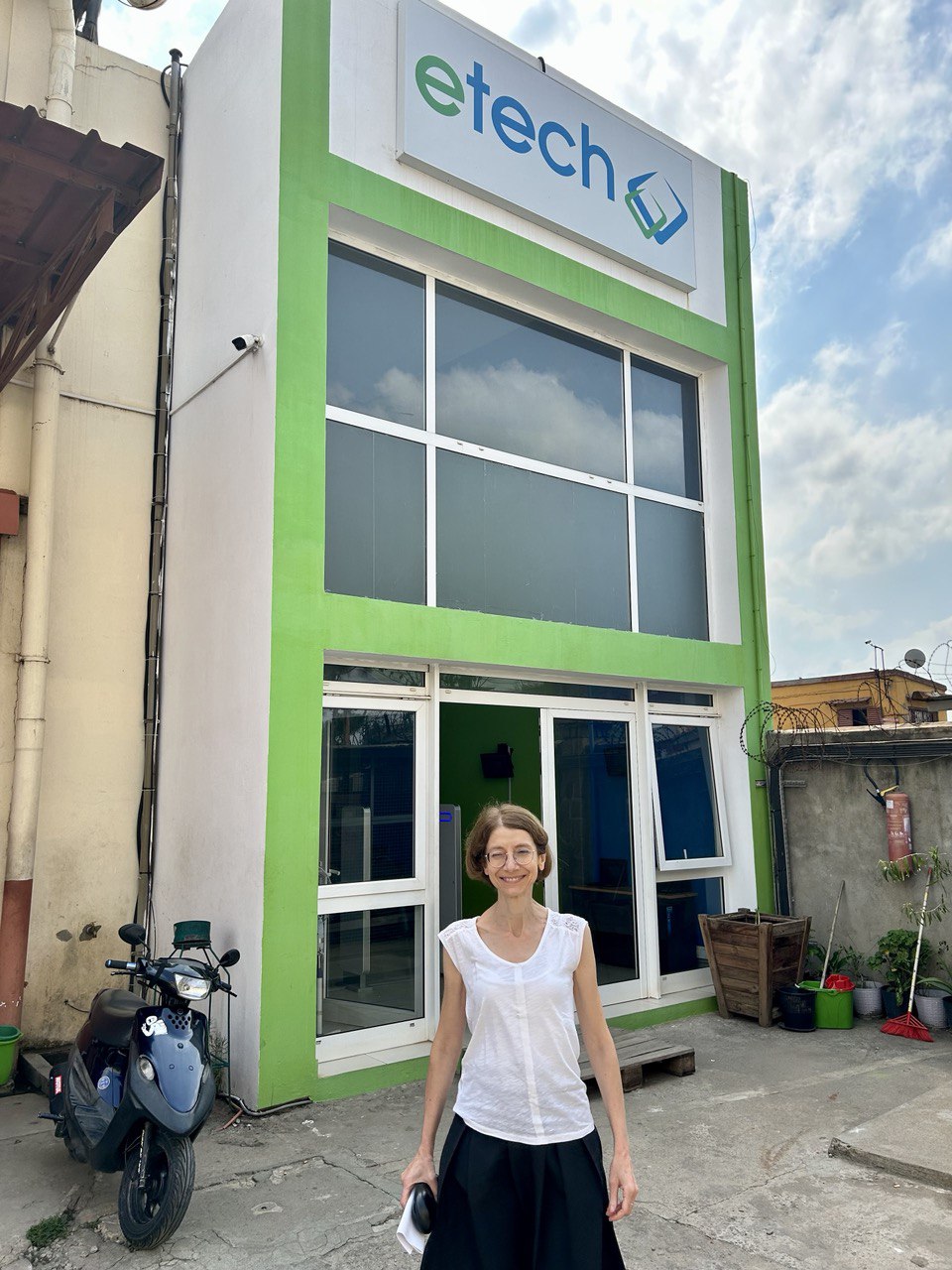
I had the privilege and pleasure to visit Madagascar in the last two weeks. I had an invitation from Institut Français where I participated in a very interesting panel on “How can Madagascar help us rethink artificial intelligence more ethically?”, with Antonio A. Casilli, Jeremy Ranjatoelina et Manovosoa Rakotovao. I also conducted exploratory fieldwork by visiting a sample of technology companies, as well as journalists and associations interested in the topic.

A former French colony, Madagascar participates in the global trend toward outsourcing / offshoring which has shaped the world economy in the past two decades. The country harnesses its cultural and linguistic heritage (about one quarter of the population still speak French, often as a second language) to develop services for clients mostly based in France. In particular, it is a net exporter of computing services – still a small-sized sector, but with growing economic value.

Last year, a team of colleagues has already conducted extensive research with Madagascan companies that provide micro-work and data annotation services for French producers of artificial intelligence (and of other digital services). Some interesting results of their research are available here. This time, we are trying to take a broader look at the sector and include a wider variety of computing services, also trying to trace higher-value-added activities (like computer programming, website design, and even AI development).

It is too early to present any results, but the big question so far is the sustainability of this model and the extent to which it can push Madagascar higher up in the global technology value chain. Annotation and other lower-level services create much-needed jobs in a sluggish economy with widespread poverty and a lot of informality; however, these jobs attract low recognition and comparatively low pay, and have failed so far to offer bridges toward more stable or rewarding career paths. More qualified computing jobs are better paid and protected, but turnover is high and (national and international) competition is tough.

At policy level, more attention should be brought to the quality of these jobs and their longer-term stability, while client tech companies in France and other Global North countries should take more responsibility over working conditions throughout their international supply chains.

Artificial Intelligence and Globalization: Data Labor  and Linguistic Specificities (AIGLe)

We organized the one-day conference AIGLe on 27 October 2022 to present the outcomes of interdisciplinary research conducted by our DiPLab teams in French-speaking African countries (ANR HuSh Project) and Spanish-speaking countries in Latin America (CNRS-MSH TrIA Project). Both initiatives study the human labor necessary to generate and annotate the data needed to produce artificial intelligence, to check outputs, and to intervene in real time when algorithms fail. Researchers from economics, sociology, computer science, and linguistics shared exciting new results and discussed them with the audience.

AIGLe is part of the project HUSh (The HUman Supply cHain behind smart technologies, 2020-2024), funded by ANR, and the research project TRIA (The Work of Artificial Intelligence, 2020-2022), co-financed by the CNRS and the MSH Paris Saclay. This event, under the aegis of the Institut Mines-Télécom, was organized by the DiPLab team with support of ANR, MSH Paris-Saclay and the Ministry of Economy and Finance.

PROGRAM
9:00 – 9:15 Welcome session

9:15 – 10:40 – Session 1 – Maxime Cornet & Clément Le Ludec (IP Paris, ANR HUSH Project): Unraveling the AI Production Process: How French Startups Externalise Data Work to Madagascar. Discussant: Mohammad Amir
Anwar (U. of Edinburgh)

10:45 – 11:00 Coffee Break

11:00 – 12:30 – Session 2 – Chiara Belletti and Ulrich Laitenberger (IP Paris, ANR HUSH Project): Worker Engagement and AI Work on Online Labor Markets. Discussant: Simone Vannuccini (U. of Sussex)

12:30 – 13:30 Lunch Break

13:30 – 15:00 Session 3 – Juana-Luisa Torre-Cierpe (IP Paris, TRIA Project) & Paola Tubaro (CNRS, TRIA Project): Uninvited Protagonists: Venezuelan Platform Workers in the Global Digital Economy. Discussant:
Maria de los Milagros Miceli (Weizenbaum Institut)

15:15 – 15:30 Coffee Break

15:30 – 17:00 Session 4 – Ioana Vasilescu (CNRS, LISN, TRIA Project), Yaru Wu (U. of Caen, TRIA Project) & Lori Lamel (LISN CNRS): Socioeconomic profiles embedded in speech : modeling linguistic variation in
micro-workers interviews
. Discussant: Chloé Clavel (Télécom Paris, IP Paris)