The dual footprint of AI

The impacts of artificial intelligence (AI) on the natural and social surroundings that supply resources for its production and use have been studied separately so far. In a new article, part of a forthcoming special issue of the journal Globalizations, I introduce the concept of the ‘dual footprint’ as a heuristic device to capture the commonalities and interdependencies between them. Originally borrowed from ecology, the concept denotes in my analysis the total impacts on the natural and social surroundings that supply the resources necessary for AI’s production and use. It is an indicator of sustainability insofar as it grasps the degree to which the AI industry is failing to ensure the maintenance of the social systems, economic structures, and environmental conditions necessary to its production. To develop the concept in this way, it is necessary to (provisionally) renounce some of the accounting flavour of extant footprint measures, allowing for a more descriptive interpretation. In my article, the dual footprint primarily serves as a mapping tool, linking impacts to specific locations and to the people and groups that inhabit them.

Gloria Mendoza / ‘The Environmental Impact of Data Centers in Vulnerable Ecosystems’ / https://betterimagesofai.org / https://creativecommons.org/licenses/by/4.0/

My analysis draws on recent research that challenges idealized narratives of AI as the sole result of mathematics and code, or as the fancied machinic replacement of human brains. The production of AI relies on global value chains which, like those of textiles and electronics, take shape within the broader context of globalization, its long-standing trends of outsourcing and offshoring, and the cross-country disparities on which it thrives.

The argument is based on two case studies, each illustrating AI-induced cross-country flows of natural resources and data labour. The first involves Argentina as a supplier to the United States, while the second includes Madagascar and its primary export destinations: Japan and South Korea for raw materials, France for data work. These two cases portray the AI landscape as an asymmetric structure, where the countries that lead the tech race generate a massive demand for imports of raw materials, components, and intermediate goods and services. Core AI producers trigger the footprint and therefore should bear responsibility for it, but the pressure on (natural and social) resources and the ensuing impacts occur predominantly elsewhere. Cross-country value chains shift the burden toward more peripheral players, obscuring the extent to which AI is material- and labour-intensive.
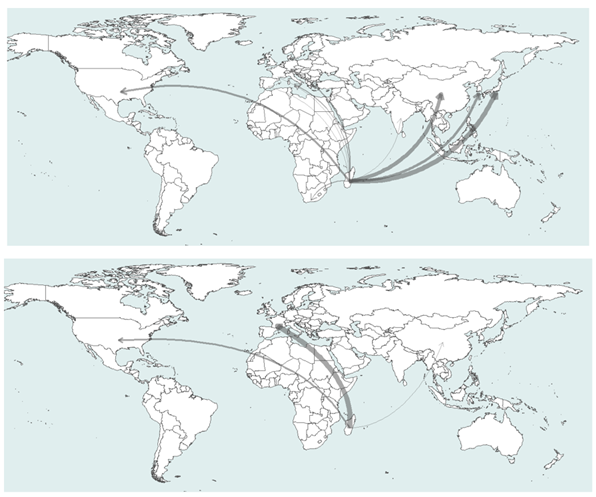
Flows of raw materials (mainly nickel and cobalt from the Ambatovy mining project) from Madagascar to East Asia and, to a lesser extent, Europe and North America (top); flows of data work services from Madagascar to France, followed by North America and to a lesser extent, East Easia (bottom). Madagascar, one of the poorest countries in the world, contributes to state-of-the-art AI production without managing to move up the value chain.

This drain of resources toward AI engenders adverse effects in peripheral countries. Mining notoriously generates conflicts, and data work conditions are so poor that other segments of society – from local employers to workers’ families and even informal-economy actors – must step in to cover part of the costs. The current arrangements thus fail to ensure their own sustainability over time. Additionally, the aspirations of these countries to leverage their participation to the AI value chain as a development opportunity, and to transition toward leading positions, remain unfulfilled.

The dual footprint can fruitfully dialogue with the critical literature that leverages the concepts of extractivism (for example, Cecilia Rikap‘s concept of “twin” extractivism) and dependency (as theorised for example by Jonas Valente and Rafael Grohmann). Its contribution lies mainly in the effort to operationalise the ideas of more abstract social theories, while also facilitating mutual enrichment between different literatures.

Read the full paper: subscription-protected or open-access preprint.

The paper was developed as part of an initiative on ‘The Political Economy of Green-Digital Transition‘, organised by Edemilson Paraná in 2024 at LUT University in Finland. Further, the idea that the environmental and social dimensions of AI production emanate from similar underlying socio-economic processes and geographical trajectories constitutes the foundation of SEED – Social and Environmental Effects of Data Connectivity, a new DiPLab project that investigates how data extraction and material extraction are deeply interconnected. It stems from a collaboration with Núcleo Milenio FAIR at the Pontificia Universidad Católica de Chile and compares data and material infrastructures in Europe and South America.

Credits: FAIR

Women in the loop: the gendered contribution of data workers to AI

I presented today, at the WORK2025 conference in Turku, Finland, a paper on the human-in-the-loop systems that integrate human labor into the production of Artificial Intelligence (AI). Beyond engineers who design models, myriad “data workers” prepare training data, verify outputs, and correct errors. Their role is crucial but undervalued, with low pay and poor working conditions. Shaped by outsourcing and offshoring practices, the market for such services has grown steadily over time, with digital platforms acting as the main intermediaries between AI producers and workers. In their communication with clients, these platforms often emphasize that human workers provide nuanced judgment in complex tasks.

The three main functions of micro-work in the development of data-intensive, machine-learning based AI solutions. Source: https://doi.org/10.1177/2053951720919776

But who are the humans in the loop, and whose contributions count? Here, I focus on women’s participation and its evolution as the market expanded. Data work is theoretically well-suited for women, since it can be performed remotely from home. Besides, platforms generally do not share gender information, thereby limiting direct discrimination. One might thus expect women’s representation to be high. However, the statistical evidence is mixed. Across studies, the proportion of women data workers exceeds 50% only in four cases. Besides, reports sometimes differ for the same country, across platforms or at different moments in time. Looking at the lowest reported shares, then in no country except the US do women represent more than 40% of all data workers. Even in the US, recent data indicate that women constitute about half of the data workforce, down from 57-58% some years ago. Why are women underrepresented, and why does the pattern vary across countries?

Highest proportion of women data workers reported in existing studies (incl. own datasets). Source: author’s elaboration, created with MapChart.
Lowest proportion of women data workers reported in existing studies (incl. own datasets). Source: author’s elaboration, created with MapChart.

The earliest explanation comes from P. Ipeirotis (2010), who analyzed Amazon Mechanical Turk, then the dominant platform. Most workers were from the US and India. In the US, data work paid too little to sustain a household and was often taken up by un- and under-employed women seeking supplementary income. In India, dollar-based pay was more attractive and often a main household income, drawing more men into the activity. Later, as the market expanded, this explanation appeared insufficient: the above maps show that not all rich countries have many female data workers, and some lower-income countries do. Yet, my data show a negative correlation: the larger the share of workers for whom data work is the main income source, the smaller the proportion of women. Ipeirotis’s hypothesis still holds but requires updating to today’s more competitive and globalized platform economy.

Proportion of workers for whom data work is the main source of income vs. proportion of women, by country. Source: own survey data (from projects TRIA and ENCORE, 2020-24).

Platforms fragment work into tasks and assign them to individuals framed as independent contractors competing for access. Unlike traditional firms, workers do not collaborate but face intense competition. Outcomes vary by national context. In countries facing stagnation or crisis, such as Venezuela, international platforms offer a rare source of income for highly qualified workers. Competition becomes fierce, and “elite” workers – often young men with STEM backgrounds – dominate. Women are disadvantaged, either due to fewer technical qualifications or because care responsibilities limit their ability to invest in building strong platform profiles and reputations. By contrast, in more dynamic economies such as Brazil, local job markets absorb highly skilled professionals, leaving platform work to more disadvantaged groups. Here, women with family duties are more visible. Thus, platform demographics reflect national conditions: in poorer or crisis-stricken countries, men from the educational elite seek career advancement, while in richer countries, women (especially mothers) take on such work primarily to supplement household income. Women may be equally educated, but they often lack the time to cultivate advanced STEM skills. As platforms demand longer and more specialized tasks, men increasingly gain the upper hand, crowding women out—even in countries where they were once the majority.

Platform design ignores these dynamics. Workers are treated as abstract entities, stripped of the socio-economic and cultural contexts that shape real inequalities. Competition, combined with local conditions, deepens gender gaps. Interventions must therefore consider gender disparities. Otherwise, they risk reinforcing inequalities. Supporting women’s access to data work—particularly those constrained by family responsibilities—can contribute to more balanced labor participation and ensure that AI benefits from a broader diversity of human input.

AI, labour and natural resources in Santiago

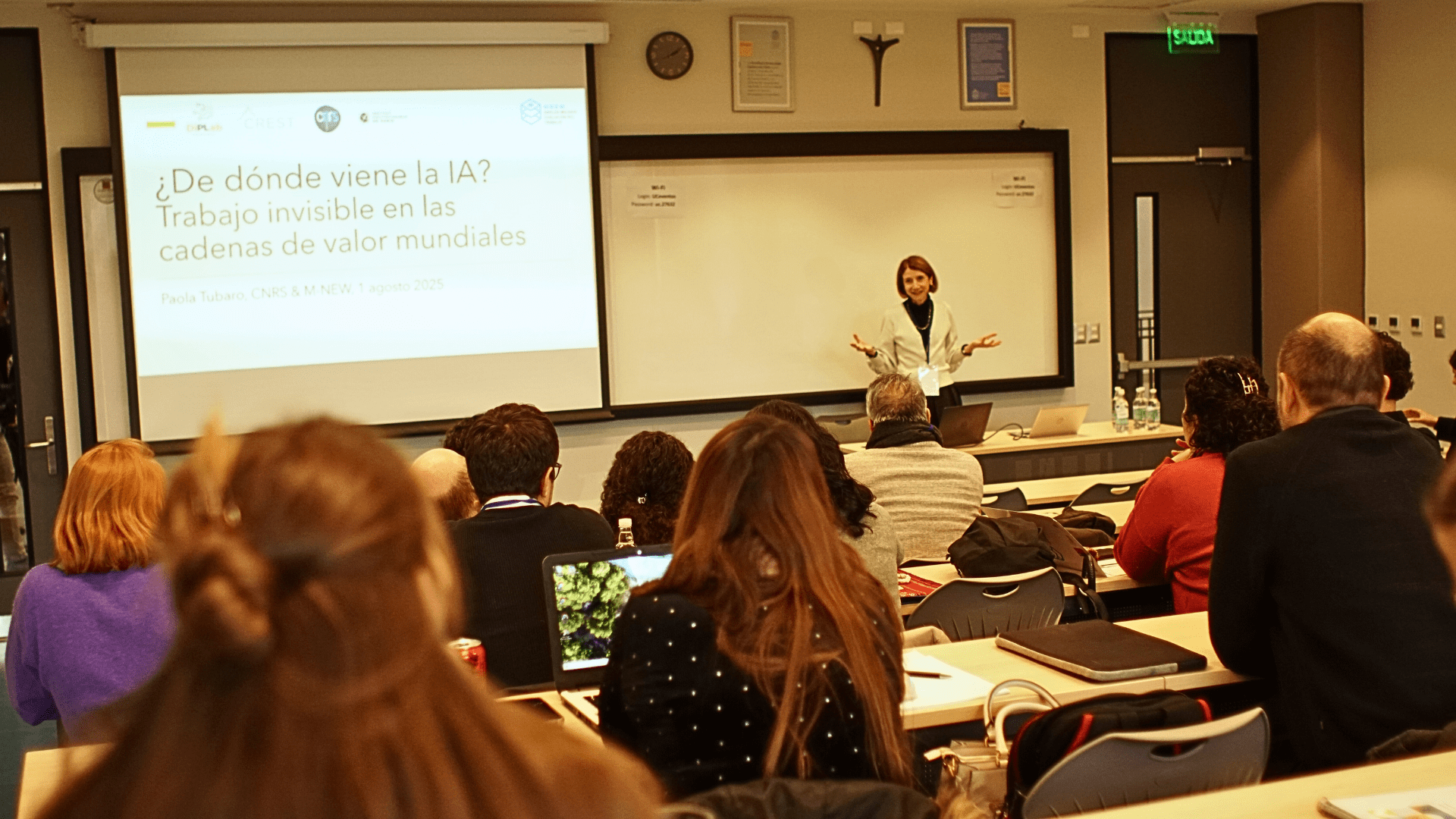
Last week in Santiago, Chile, I had the tremendous opportunity to give a keynote speech at the 4th annual workshop of the Millennium Nucleus on the Evolution of Work (M-NEW), of which I am also a senior international member. This interdisciplinary workshop brought together labour scholars from various parts of Latin America and beyond. I really liked the inspiring talks and the friendly and stimulating interactions with colleagues.

Credits: M-NEW

My own talk drew on my multi-year research programme on the crucial yet invisible human labor behind the global production of artificial intelligence. I first examined the evolution of this form of work over the last two decades, demonstrating that while its core functions in the development of smart systems have remained consistent, the scope and volume of such tasks have expanded significantly. I then analyzed the organization of this labour at the intersection of three trends in recent globalization: outsourcing, offshoring, and digitalization. These dynamics account for the marginalization of these workers within the tech industry and the relocation of their labor to lower-wage countries. Based on these insights, I described four cases—Venezuela, Argentina, Brazil, and Chile—highlighting the diverse effects of local conditions. I concluded by identifying emerging scientific and policy challenges, particularly concerning the recognition of skills, and the place of the informal economy.

Credits: M-NEW

The following week, still in Santiago, I was excited to participate in the kick-off meeting of the new research project SEED (“Social and Environmental Effects of Data connectivity: Hybrid ecologies of transoceanic cables and data centers in Chile and France”), a collaboration between my research group DiPLab and another Millennium Nucleus, FAIR (“Futures of Artificial Intelligence Research”). SEED received joint funding from the ECOS-SUD programme (France) and ANID (Chile) to analyse the AI value chain, from its production and development to its impact on employment, use and environmental consequences, by studying the Valparaíso-Santiago de Chile and Marseille-Paris axes.

Credits: FAIR

My presentation introduced the concept of the ‘dual footprint’ as a heuristic device to capture the commonalities and interdependencies between the different impacts of AI on the natural and social surroundings that supply resources for its production and use. I framed the AI industry as a value chain that spans national boundaries and perpetuates inherited global inequalities. The countries that drive AI development generate a massive demand for inputs and trigger social costs that, through the value chain, largely fall on more peripheral actors. The arrangements in place distribute the costs and benefits of AI unequally, resulting in unsustainable practices and preventing the upward mobility of more disadvantaged countries. The dual footprint grasps how the environmental and social dimensions of AI emanate from similar underlying socio-economic processes and geographical trajectories.

Brazil in the global AI supply chains: the role of micro-workers

AI is not just a Silicon Valley dream. It relies among other things, on inputs from human workers who generate and annotate data for machine learning. They record their voice to augment speech datasets, transcribe receipts to provide examples to OCR software, tag objects in photographs to train computer vision algorithms, and so on. They also check algorithmic outputs, for example, by noting whether the outputs of a search engine meet users’ queries. Occasionally, they take the place of failing automation, for example when content moderation software is not subtle enough to distinguish whether some image or video is appropriate. AI producers outsource these so-called “micro-tasks” via international digital labor platforms, who often recruit workers in Global-South countries, where labor costs are lower. Pay is by piecework, without any no long-term commitment and without any social-security scheme or labor protection.

In a just-published report co-authored with Matheus Viana Braz and Antonio A. Casilli, as part of the research program DiPlab, we lifted the curtain on micro-workers in Brazil, a country with a huge, growing, and yet largely unexplored reservoir of AI workers.

We found among other things that:

  • Three out of five Brazilian data workers are women, while in most other previously-surveyed countries, women are a minority (one in three or less in ILO data).
  • 9 reais (1.73 euros) per hour is the average amount earned on platforms.
  • There are at least 54 micro-working platforms operating in Brazil.
  • One third of Brazilian micro-workers have no other source of income, and depend on microworking platforms for subsistence.
  • Two out of five Brazilian data workers are (apart from this activity) unemployed, without professional activity, or in informality. In Brazil, platform microwork arises out of widespread unemployment and informalization of work.
  • Three out of five of data workers have completed undergraduate education, although they mostly do repetitive and unchallenging online data tasks, suggesting some form of skill mismatch.
  • The worst microtasks involve moderation of violent and pornographic contents on social media, as well as data training in tasks that workers may find uncomfortable or weird, such as taking pictures of dog poop in domestic environments to train data for “vacuuming robots”.
  • Workers’ main grievances are linked to uncertainty, lack of transparency, job insecurity, fatigue and lack of social interaction on platforms.

To read the report in English, click here.

To read the report in Portuguese, click here.

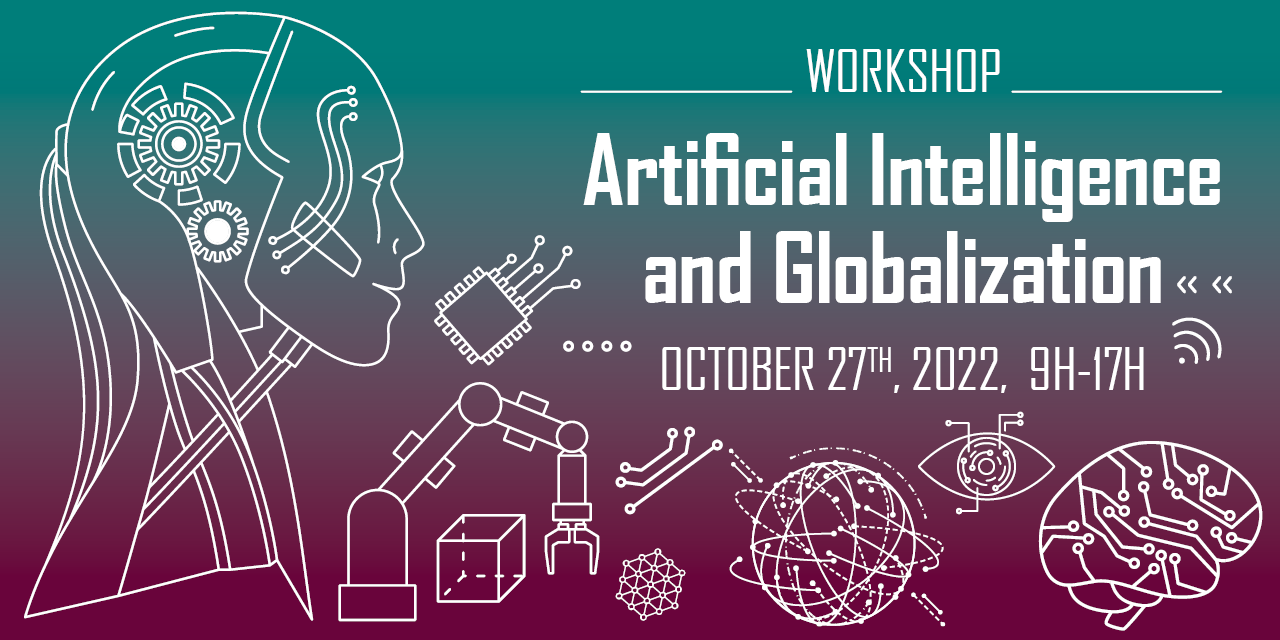
Artificial Intelligence and Globalization: Data Labor  and Linguistic Specificities (AIGLe)

We organized the one-day conference AIGLe on 27 October 2022 to present the outcomes of interdisciplinary research conducted by our DiPLab teams in French-speaking African countries (ANR HuSh Project) and Spanish-speaking countries in Latin America (CNRS-MSH TrIA Project). Both initiatives study the human labor necessary to generate and annotate the data needed to produce artificial intelligence, to check outputs, and to intervene in real time when algorithms fail. Researchers from economics, sociology, computer science, and linguistics shared exciting new results and discussed them with the audience.

AIGLe is part of the project HUSh (The HUman Supply cHain behind smart technologies, 2020-2024), funded by ANR, and the research project TRIA (The Work of Artificial Intelligence, 2020-2022), co-financed by the CNRS and the MSH Paris Saclay. This event, under the aegis of the Institut Mines-Télécom, was organized by the DiPLab team with support of ANR, MSH Paris-Saclay and the Ministry of Economy and Finance.

PROGRAM
9:00 – 9:15 Welcome session

9:15 – 10:40 – Session 1 – Maxime Cornet & Clément Le Ludec (IP Paris, ANR HUSH Project): Unraveling the AI Production Process: How French Startups Externalise Data Work to Madagascar. Discussant: Mohammad Amir
Anwar (U. of Edinburgh)

10:45 – 11:00 Coffee Break

11:00 – 12:30 – Session 2 – Chiara Belletti and Ulrich Laitenberger (IP Paris, ANR HUSH Project): Worker Engagement and AI Work on Online Labor Markets. Discussant: Simone Vannuccini (U. of Sussex)

12:30 – 13:30 Lunch Break

13:30 – 15:00 Session 3 – Juana-Luisa Torre-Cierpe (IP Paris, TRIA Project) & Paola Tubaro (CNRS, TRIA Project): Uninvited Protagonists: Venezuelan Platform Workers in the Global Digital Economy. Discussant:
Maria de los Milagros Miceli (Weizenbaum Institut)

15:15 – 15:30 Coffee Break

15:30 – 17:00 Session 4 – Ioana Vasilescu (CNRS, LISN, TRIA Project), Yaru Wu (U. of Caen, TRIA Project) & Lori Lamel (LISN CNRS): Socioeconomic profiles embedded in speech : modeling linguistic variation in
micro-workers interviews
. Discussant: Chloé Clavel (Télécom Paris, IP Paris)