When we created ENDL (the European Network on Digital Labour), back in 2017, we booked a room with 17 places. A few days ago, the last conference of the network (which in the meantime has become INDL, replacing ‘European’ with ‘International’) hosted about 200 participants. Internationalisation has not only meant numerical growth, but also inclusion of a diverse range of voices: every year, we see more participants from countries that are often under-represented on the scientific scene, from India and South Africa to Argentina and Brazil. Participants have also diversified in another sense, too: if the majority have always been academics, it is a pleasure to see more and more workers, as well as labour organisers. This year, we could for example benefit from the presence of associations of data workers from Kenya, freelancers from France, and content moderators from Spain.
Participants to the INDL-8 conference, Saint-Cristina cloister, Bologna, IT, 10 September 2025.
A conference like this one is meant to give hope – hope of mutual understanding across countries and cultures, hope of dialogue across disciplines and fields, hope of connections between academic research and action. We worked together to ensure a welcoming environment for all, for instance by encouraging constructive comments, rather than sheer criticism, after each paper presentation. We also strived to keep costs down in order to make the conference free of charge, and with the DiPLab research programme, we could give a few small scholarships to promising presenters who might not have been able to travel otherwise.
Two speakers (M Francesco Sinopoli, Fondazione Di Vittorio, and Ms Kauna Malgwi, Uniglobal) at the plenary panel ‘Plenary panel: New Unionism, towards global alliances’, part of the INDL-8 Conference, DAMA Tecnopolo, Bologna, IT, 11 September 2025
Surely, problems remain. A couple potential participants had visa issues, while others had to cancel due to lack of funding. These problems weigh especially hard on people from emerging and lower-income countries outside Europe and North America. The future is also uncertain, as funding sources become increasingly dryer, and visa restrictions tighter. For this reason, the main INDL-9 conference next year (Geneva, ILO, 9-11 September 2026) will be accompanied by the growth of local chapters. The Middle-East and Africa area is preparing its second conference, this time online only, on 25-26 November. In the US, a one-day event will take place at Yale University on 29 April 2026. Colleagues in Chile and Argentina are launching a series of online events.
Closing keynote (Prof. Sandro Mezzadra, chair: Prof. Marco Marrone), Saint-Cristina Aula Magna, Bologna, IT, 12 September 2025
More information on the INDL-8 conference (including the full programme) is available here.
I presented today, at the WORK2025 conference in Turku, Finland, a paper on the human-in-the-loop systems that integrate human labor into the production of Artificial Intelligence (AI). Beyond engineers who design models, myriad “data workers” prepare training data, verify outputs, and correct errors. Their role is crucial but undervalued, with low pay and poor working conditions. Shaped by outsourcing and offshoring practices, the market for such services has grown steadily over time, with digital platforms acting as the main intermediaries between AI producers and workers. In their communication with clients, these platforms often emphasize that human workers provide nuanced judgment in complex tasks.
The three main functions of micro-work in the development of data-intensive, machine-learning based AI solutions. Source: https://doi.org/10.1177/2053951720919776
But who are the humans in the loop, and whose contributions count? Here, I focus on women’s participation and its evolution as the market expanded. Data work is theoretically well-suited for women, since it can be performed remotely from home. Besides, platforms generally do not share gender information, thereby limiting direct discrimination. One might thus expect women’s representation to be high. However, the statistical evidence is mixed. Across studies, the proportion of women data workers exceeds 50% only in four cases. Besides, reports sometimes differ for the same country, across platforms or at different moments in time. Looking at the lowest reported shares, then in no country except the US do women represent more than 40% of all data workers. Even in the US, recent data indicate that women constitute about half of the data workforce, down from 57-58% some years ago. Why are women underrepresented, and why does the pattern vary across countries?
Highest proportion of women data workers reported in existing studies (incl. own datasets). Source: author’s elaboration, created with MapChart.Lowest proportion of women data workers reported in existing studies (incl. own datasets). Source: author’s elaboration, created with MapChart.
The earliest explanation comes from P. Ipeirotis (2010), who analyzed Amazon Mechanical Turk, then the dominant platform. Most workers were from the US and India. In the US, data work paid too little to sustain a household and was often taken up by un- and under-employed women seeking supplementary income. In India, dollar-based pay was more attractive and often a main household income, drawing more men into the activity. Later, as the market expanded, this explanation appeared insufficient: the above maps show that not all rich countries have many female data workers, and some lower-income countries do. Yet, my data show a negative correlation: the larger the share of workers for whom data work is the main income source, the smaller the proportion of women. Ipeirotis’s hypothesis still holds but requires updating to today’s more competitive and globalized platform economy.
Proportion of workers for whom data work is the main source of income vs. proportion of women, by country. Source: own survey data (from projects TRIA and ENCORE, 2020-24).
Platforms fragment work into tasks and assign them to individuals framed as independent contractors competing for access. Unlike traditional firms, workers do not collaborate but face intense competition. Outcomes vary by national context. In countries facing stagnation or crisis, such as Venezuela, international platforms offer a rare source of income for highly qualified workers. Competition becomes fierce, and “elite” workers – often young men with STEM backgrounds – dominate. Women are disadvantaged, either due to fewer technical qualifications or because care responsibilities limit their ability to invest in building strong platform profiles and reputations. By contrast, in more dynamic economies such as Brazil, local job markets absorb highly skilled professionals, leaving platform work to more disadvantaged groups. Here, women with family duties are more visible. Thus, platform demographics reflect national conditions: in poorer or crisis-stricken countries, men from the educational elite seek career advancement, while in richer countries, women (especially mothers) take on such work primarily to supplement household income. Women may be equally educated, but they often lack the time to cultivate advanced STEM skills. As platforms demand longer and more specialized tasks, men increasingly gain the upper hand, crowding women out—even in countries where they were once the majority.
Platform design ignores these dynamics. Workers are treated as abstract entities, stripped of the socio-economic and cultural contexts that shape real inequalities. Competition, combined with local conditions, deepens gender gaps. Interventions must therefore consider gender disparities. Otherwise, they risk reinforcing inequalities. Supporting women’s access to data work—particularly those constrained by family responsibilities—can contribute to more balanced labor participation and ensure that AI benefits from a broader diversity of human input.
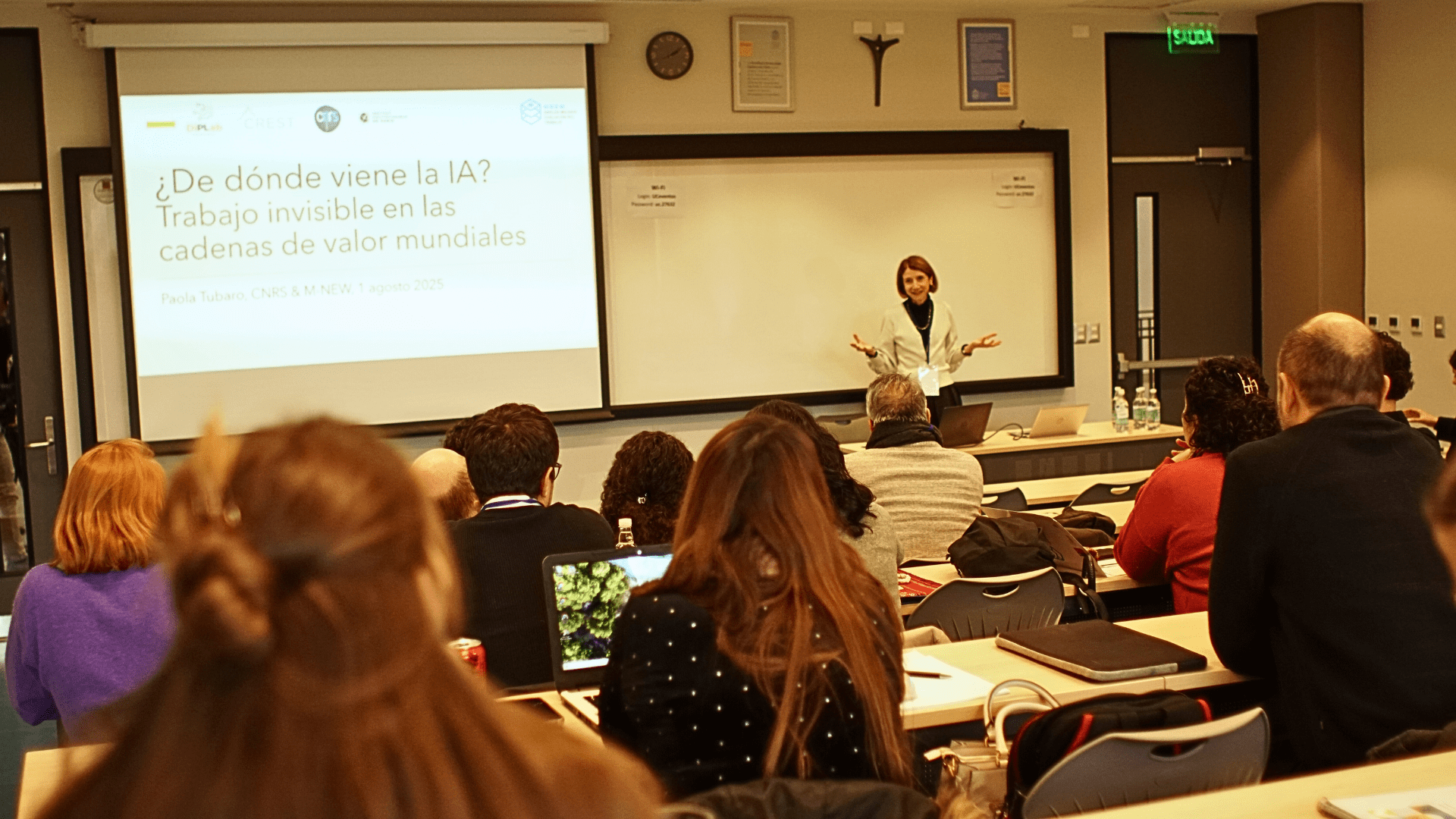
Last week in Santiago, Chile, I had the tremendous opportunity to give a keynote speech at the 4th annual workshop of the Millennium Nucleus on the Evolution of Work (M-NEW), of which I am also a senior international member. This interdisciplinary workshop brought together labour scholars from various parts of Latin America and beyond. I really liked the inspiring talks and the friendly and stimulating interactions with colleagues.
Credits: M-NEW
My own talk drew on my multi-year research programme on the crucial yet invisible human labor behind the global production of artificial intelligence. I first examined the evolution of this form of work over the last two decades, demonstrating that while its core functions in the development of smart systems have remained consistent, the scope and volume of such tasks have expanded significantly. I then analyzed the organization of this labour at the intersection of three trends in recent globalization: outsourcing, offshoring, and digitalization. These dynamics account for the marginalization of these workers within the tech industry and the relocation of their labor to lower-wage countries. Based on these insights, I described four cases—Venezuela, Argentina, Brazil, and Chile—highlighting the diverse effects of local conditions. I concluded by identifying emerging scientific and policy challenges, particularly concerning the recognition of skills, and the place of the informal economy.
Credits: M-NEW
The following week, still in Santiago, I was excited to participate in the kick-off meeting of the new research project SEED (“Social and Environmental Effects of Data connectivity: Hybrid ecologies of transoceanic cables and data centers in Chile and France”), a collaboration between my research group DiPLab and another Millennium Nucleus, FAIR (“Futures of Artificial Intelligence Research”). SEED received joint funding from the ECOS-SUD programme (France) and ANID (Chile) to analyse the AI value chain, from its production and development to its impact on employment, use and environmental consequences, by studying the Valparaíso-Santiago de Chile and Marseille-Paris axes.
Credits: FAIR
My presentation introduced the concept of the ‘dual footprint’ as a heuristic device to capture the commonalities and interdependencies between the different impacts of AI on the natural and social surroundings that supply resources for its production and use. I framed the AI industry as a value chain that spans national boundaries and perpetuates inherited global inequalities. The countries that drive AI development generate a massive demand for inputs and trigger social costs that, through the value chain, largely fall on more peripheral actors. The arrangements in place distribute the costs and benefits of AI unequally, resulting in unsustainable practices and preventing the upward mobility of more disadvantaged countries. The dual footprint grasps how the environmental and social dimensions of AI emanate from similar underlying socio-economic processes and geographical trajectories.
Acabo de regresar de un viaje muy lindo a Argentina, donde fui invitada por el Instituto francés para participar en varios eventos.
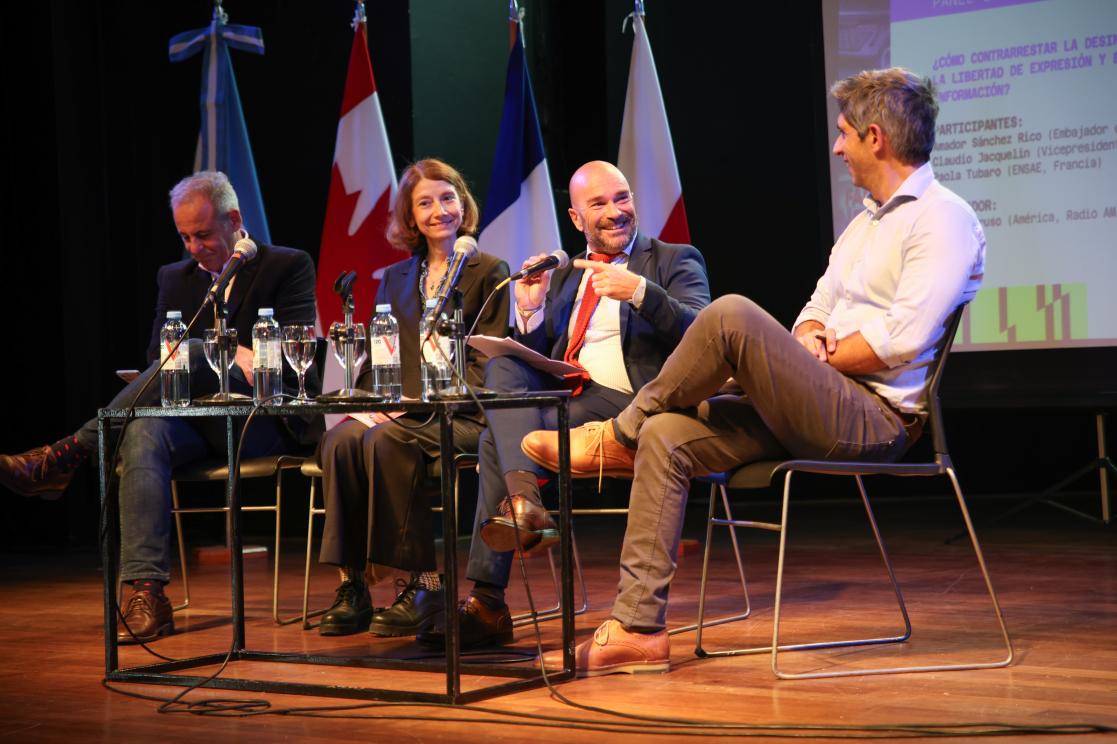
El 12 de mayo, participé en la conferencia “Manipulación Informativa e Injerencia Extranjera: Desafíos Globales y Respuestas Democráticas”, organizada por la Delegación de la Unión Europea en Argentina y por varias embajadas (como la de Francia). En el panel “Cómo contrarrestar la desinformación respetando la libertad de expresión y el derecho a la información”, hablé de cómo la desinformación se financia a través del mercado publicitario que sustenta toda la web, y de la necesidad de regular este mercado. También destaqué la importancia de fortalecer la investigación científica sobre este tema – como en el proyecto AI4TRUST, financiado por la propia UE.
Al día siguiente, tuve dos encuentros con estudiantes de periodismo, en la Universidad Nacional de Avellaneda y en la Universidad Abierta Interamericana, también sobre temas relacionados con la desinformación en internet. Fue un honor y un placer ver, en cada caso, la sala llena y mucho interés. Los/as estudiantes hicieron muchas preguntas y demostraron una gran disposición a aprender y progresar.
Los días 16 y 17 de mayo participé en tres paneles organizados en el marco de la Noche de las Ideas, una iniciativa del Instituto francés que se organiza todos los años y esta vez tuvo lugar en el famoso Teatro Colón de Buenos Aires. Fui en la sesión inaugural sobre el tema de este año, “El poder de actuar”. Además, participé como ponente en un debate muy interesante sobre el trabajo en plataformas digitales que se titulaba provocativamente ¿Nuevas servidumbres voluntarias? Jóvenes y precariedad y en otro sobre la inteligencia artificial: “In A.I. we trust?”. Actuar con y en contra de las nuevas tecnologías.
El 20 de mayo, di una charla sobre “El futuro del trabajo y la IA” como parte del ciclo UBA Digital, en la Universidad de Buenos Aires. Presenté algunos resultados de mi investigación sobre el trabajo digital y su papel en la producción de IA, desarrollada en el marco del programa de investigación DiPLab. Una vez más, me alegró ver a muchos participantes con preguntas muy interesantes. Fuimos acogidos por la facultad de odontología y también tuvimos la extraordinaria oportunidad de visitar la clínica.
Workers in Venezuela are powering AI production, often under tough conditions. Sanctions and a deep political-economic crisis have pushed them to work for platforms that pay in US dollars, albeit at low rates. They constitute a large reservoir for technology producers from rich countries. But they are not passive players.
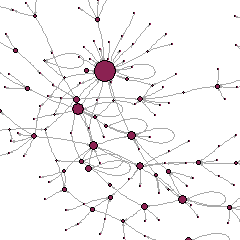
They build resilience, rework their environment, and sometimes engage in acts of resistance, with support from different segments of their personal networks. From strong local ties to loose online connections, these informal webs help them cope, adapt, and occasionally push back. Their diversified relationships comprise an unofficial and often hidden, albeit largely digitised relational infrastructure that sustains their work and shapes collective action.
These findings invite to rethink agency as embedded in workers’ personal networks. To respond to adversities, one must liaise with equally affected peers, with family and friends who offer support, etc. Social ties ultimately determine who is enabled to respond, and who is not; whether any benefits and costs are shared, and with whom; whether any solution will be conflictual or peaceful. Social networks are not accessory but constitute the very channel through which Venezuelan data workers cope with hardship.
Not all relationships play the same role, though. Venezuelans discover online data work through their strong ties with family, close friends, and neighbours. To convert their online earnings into local currency, they rely on their broader social networks of relatives and friends living abroad and indirect relationships with intermediaries. For managing their day-to-day activities, Venezuelans expand their social networks through online services like Facebook, WhatsApp, and Telegram, connecting with diverse and less-close peers within and outside the country. Different social ties affect the various stages of the data working experience.
Overall, no Venezuelan could work alone – and the networked interactions that sustain each of them against hardship have made them massively present, as ‘uninvited protagonists,’ in international platforms. Their massive presence in the planetary data-tasking market is a supply rather than demand-driven phenomenon.
This analysis also sheds light on the reasons why mobilisation is uncommon among platform data workers. Other studies noted diverging orientations of workers, unclear goals, lack of focus, and insufficient leadership. Another powerful reason hinges upon the predominance of weak ties in building up online group membership: indeed, distant acquaintances are insufficient to prompt people to action if their intrinsic motivations are low.
The conference reaches Italy this year. It will take place in the most ancient University in the western world, Bologna, on 10-12 September 2025.
The overarching topic of this year’s conference is ‘Contesting Digital Labor: Resistance, counteruses, and new directions for research’. The goal is to explore how platform workers navigate, challenge, and reshape algorithmic management systems while forging innovative forms of solidarity and collective action. We also aim to explore the perspectives that technological developments open for workers in order to escape everyday surveillance, to resist top-down control and to organise to defend their rights.
In addition to presentations that directly address these questions, we welcome proposals that analyse a broader range of issues related to digital labour.
Another article has just been published! Another one that is based on a DiPLab-based group collaboration (with A.A. Casilli, M. Fernández Massi, J. Longo, J. Torres Cierpe and M. Viana Braz) and that uses data from multiple countries. It is entitled ‘The digital labour of artificial intelligence in Latin America: a comparison of Argentina, Brazil, and Venezuela’ and is part of a special issue of Globalizations on ‘The Political Economy of AI in Latin America’. This article lifts the veil on the precarious and low-paid data workers who, from Latin America, engage in AI preparation, verification, and impersonation, often for foreign technology producers. Focusing on three countries (Argentina, Brazil, and Venezuela), we use original mixed-method data to compare and contrast these cases in order to reveal common patterns and expose the specificities that distinguish the region.
The analysis unveils the central place of Latin America in the provision of data work. To bring costs down, AI production thrives on countries’ economic hardship and inequalities. In Venezuela and to a lesser extent Argentina, acute economic crisis fuels competition and favours the emergence of ‘elite’ (young and STEM-educated) data workers, while in more stable but very unequal Brazil, this activity is left to relatively underprivileged segments of the workforce. AI data work also redefines these inequalities insofar as, in all three countries, it blends with the historically prevalent informal economy, with workers frequently shifting between the two. There are spillovers into other sectors, with variations depending on country and context, which tie informality to inequality.
Our study has policy implications at global and local levels. Globally, it calls for more attention to the conditions of AI production, especially workers’ rights and pay. Locally, it advocates solutions for the recognition of skills and experience of data workers, in ways that may support their further professional development and trajectories, possibly also facilitating some initial forms of worker organization.
The version of record is here, while an open-access preprint is available here.
I am thrilled to announce that an important article has just seen the light. Entitled ‘Where does AI come from? A global case study across Europe, Africa, and Latin America’, it is part of a special issue of New Political Economy on ‘Power relations in the digital economy‘. It is the result of joint work that I have done with members of the Diplab team (A.A. Casilli, M. Cornet, C. Le Ludec and J. Torres Cierpe) on the organisational and geographical forces underpinning the supply chains of artificial intelligence (AI). Where and how do AI producers recruit workers to perform data annotation and other essential, albeit lower-level supporting tasks to feed machine-learning algorithms? The literature reports a variety of organisational forms, but the reasons of these differences and the ways data work dovetails with local economies have remained for long under-researched. This article does precisely this, clarifying the structure and organisation of these supply chains, and highlighting their impacts on labour conditions and remunerations.
Framing AI as an instance of the outsourcing and offshoring trends already observed in other globalised industries, we conduct a global case study of the digitally enabled organisation of data work in France, Madagascar, and Venezuela. We show that the AI supply chains procure data work via a mix of arm’s length contracts through marketplace-like platforms, and of embedded firm-like structures that offer greater stability but less flexibility, with multiple intermediate arrangements that give different roles to platforms. Each solution suits specific types and purposes of data work in AI preparation, verification, and impersonation. While all forms reproduce well-known patterns of exclusion that harm externalised workers especially in the Global South, disadvantage manifests unevenly depending on the structure of the supply chains, with repercussions on remunerations, job security, and working conditions.
Marketplace- and firm-like platforms in the supply chains for data work in Europe, Africa, and Latin America. Dark grey countries: main case studies, light grey countries: comparison cases. Organisational modes range from almost totally marketplace oriented (darker rectangle, Venezuela) to almost entirely firm oriented (lighter rectangle, Madagascar). AI preparation (darker circle) is ubiquitous, but AI verification (darker triangle) and AI impersonation (darker star) tend to happen in ‘deep labour’ and firm-like organisations where embeddedness is higher.
We conclude that responses based only on worker reclassification, as attempted in some countries especially in the Global North, are insufficient. Rather, we advocate a policy mix at both national and supra-national levels, also including appropriate regulation of technology and innovation, and promotion of suitable strategies for economic development.
The Version of record is here, while here is an open access preprint.
What shapes differences in how people get paid, are deemed productive, or receive respect? Alongside traditional explanations of social inequalities such as class, gender, age, disability, race, migration status, rural vs. urban residence, and others, a recent literature highlights the effects of digital divides. The digitally resourced have more opportunities across all life spheres, from consumption to education, work, and health. Ironically, though, digital technologies also generate new vulnerabilities by generalizing low-paid and contingent work. Digital labour platforms like Uber, Deliveroo and Upwork use data and algorithms to match clients with workers, construed as independent contractors, for one-off ‘gigs’ without any long-term commitment. These workers are largely exposed to the vagaries of the market and have limited or no social protection, although increasing efforts aim to bring labour law to bear on platforms.
Growing concerns that platform workers compare unfavourably to conventional employees have already attracted significant research and policy attention. But more remains to be done to fully understand how the recent rise of labour platforms has undermined the relationship between digitization and inequalities, adding a layer of complexity. Scattered, but growing evidence indeed suggests that platforms may be accelerating transmission to digital worlds of ’legacy’ inequalities for example vis-à-vis race and gender, while also fostering the proliferation of ’emerging’ inequalities that diminish users’ agency and augment the power of technology creators and big-tech multinationals. Especially platforms for remote online-only labour change the geographical scale at which these questions arise, projecting workers toward a competitive planetary market that relentlessly selects winners and losers.
To tackle these questions, I’m happy and honoured to announce that I have just been awarded a major grant (almost 570k euros, at marginal cost) by the French National Agency for Research (ANR) for a new 4-year study called VOLI: Voices from Online Labour. As a team effort that builds on a solid record of interdisciplinary collaborations, VOLI innovatively combines hypotheses and methods from sociology and neighbouring disciplines, notably large-scale corpus linguistics (I’ll explain why below), and relies on speech technology and artificial intelligence to tackle the rising economic risks that coalesce around the nexus between online platform labour, digitization, and social inequalities. The project leverages the power and potential of the very digital tools whose societal effects it studies, to develop an original and potentially transferable methodology.
The innovative idea that underpins the project is to tackle the problem through language, benefiting from recent advances in linguistics research and its capacity to recast methods and tools from artificial intelligence in a broad sense – including speech and language technology and machine learning techniques – to capture features and processes that used to escape its traditional methods. Despite the importance of linguistic tasks (such as translation, transcription, writing, and editing) in online labour platforms, linguistic methods have never been applied to the study of these workers before, and thus are best positioned to bring fresh insight. To this end, we have assembled a team composed of speech technology scientists, computational linguists specialized in multilingual and large-scale corpora analysis, and computational, digital, and labour sociologists. Expected results sustain our ambition to devise policy solutions to mitigate the effects of inequalities, and to support the individuals and groups that accumulate multiple sources of disadvantage.
To harness our previous research experience and ensure continuity, we focus on so-called ’micro-work’, the necessary but inconspicuous contribution of low-paid masses who annotate, tag, label, correct and sort data to fuel the digital economy, especially artificial intelligence. Because it is performed remotely and can be allocated to providers worldwide, micro-work differs from location-based platform ’gigs’ such as delivery and transport. It also differs from online-only jobs for freelancers, for example in computer programming and design, insofar as its extreme segmentation and standardization allow dispersing tasks to an undefined crowd instead of a selected individual (whence the alternative denomination of ’crowdwork’). Micro-tasks include, for example, recording one’s voice while reading aloud a sentence, labelling files, translating short bits of text, classifying contents in an image or webpage. They perform essential functions in the development of machine learning and artificial intelligence, from data generation and enrichment to quality controls of automated outputs. We give voice to these workers, often invisibilized by the automation narratives popular in the technology industry, in that we interview them about their lived experience, aspirations, motivations and perhaps regrets; and we rely on their voices as data for the simultaneous development of sociology, linguistics, and artificial intelligence (specifically, speech recognition) itself.
Indeed while bringing to the next level our sociological knowledge of the linkages between micro-work and digital inequalities, the methods that will be developed within this highly interdisciplinary project advance the study of the factors driving speech variation within the discipline of linguistics, augmenting language corpora with rich sets of metadata from sociological surveys, while also building and testing new and improved tools for automated transcription, with potential commercial applications.
I am the PI of the VOLI project which involves four research centres within France:
AI is not just a Silicon Valley dream. It relies among other things, on inputs from human workers who generate and annotate data for machine learning. They record their voice to augment speech datasets, transcribe receipts to provide examples to OCR software, tag objects in photographs to train computer vision algorithms, and so on. They also check algorithmic outputs, for example, by noting whether the outputs of a search engine meet users’ queries. Occasionally, they take the place of failing automation, for example when content moderation software is not subtle enough to distinguish whether some image or video is appropriate. AI producers outsource these so-called “micro-tasks” via international digital labor platforms, who often recruit workers in Global-South countries, where labor costs are lower. Pay is by piecework, without any no long-term commitment and without any social-security scheme or labor protection.
In a just-published report co-authored with Matheus Viana Braz and Antonio A. Casilli, as part of the research program DiPlab, we lifted the curtain on micro-workers in Brazil, a country with a huge, growing, and yet largely unexplored reservoir of AI workers.
We found among other things that:
Three out of five Brazilian data workers are women, while in most other previously-surveyed countries, women are a minority (one in three or less in ILO data).
9 reais (1.73 euros) per hour is the average amount earned on platforms.
There are at least 54 micro-working platforms operating in Brazil.
One third of Brazilian micro-workers have no other source of income, and depend on microworking platforms for subsistence.
Two out of five Brazilian data workers are (apart from this activity) unemployed, without professional activity, or in informality. In Brazil, platform microwork arises out of widespread unemployment and informalization of work.
Three out of five of data workers have completed undergraduate education, although they mostly do repetitive and unchallenging online data tasks, suggesting some form of skill mismatch.
The worst microtasks involve moderation of violent and pornographic contents on social media, as well as data training in tasks that workers may find uncomfortable or weird, such as taking pictures of dog poop in domestic environments to train data for “vacuuming robots”.
Workers’ main grievances are linked to uncertainty, lack of transparency, job insecurity, fatigue and lack of social interaction on platforms.



 El 12 de mayo, participé en la conferencia “

 Los días 16 y 17 de mayo participé en tres paneles organizados en el marco de la
  El 20 de mayo, di una charla sobre “