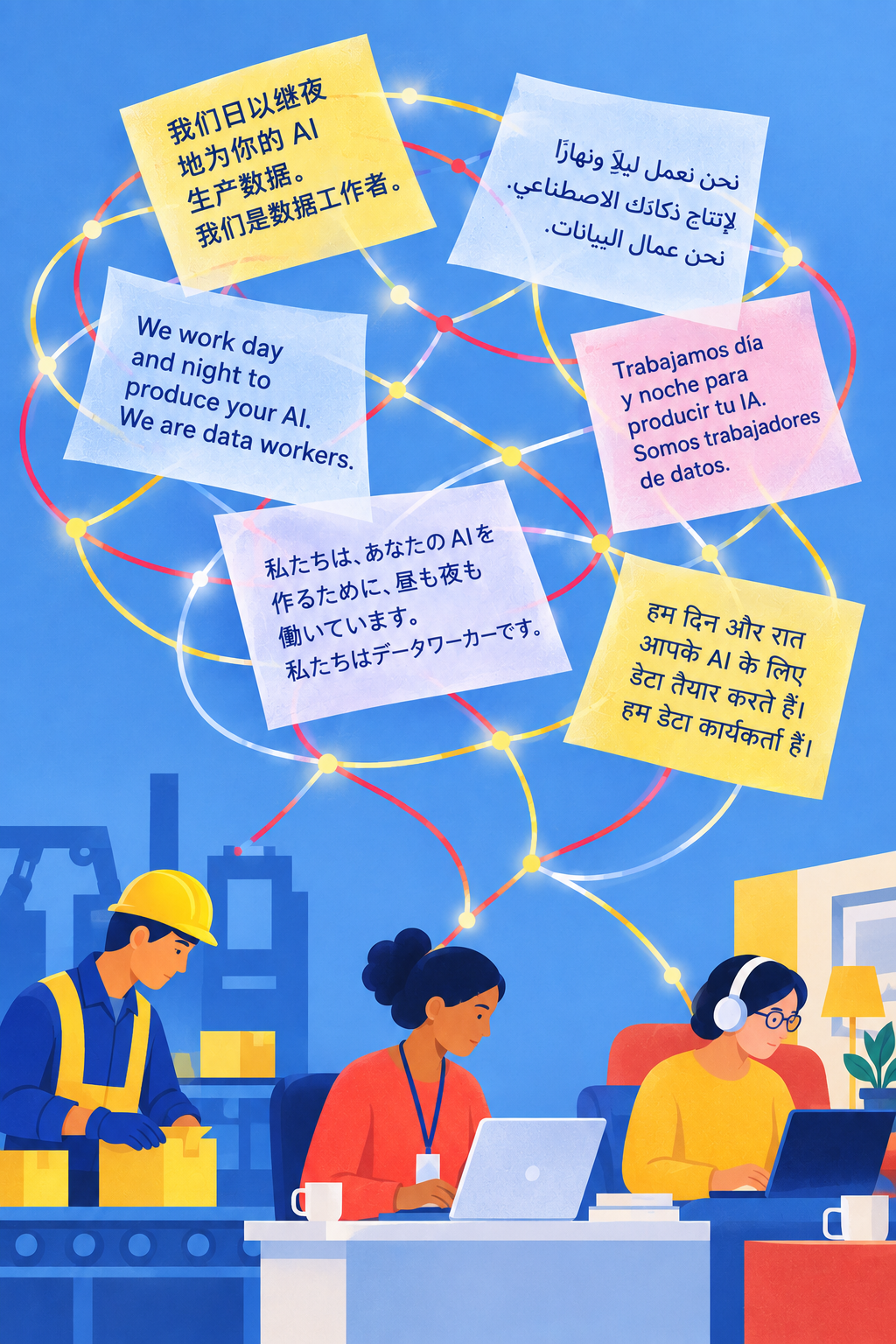
Voices from Online Labour: Inequalities in digital earning activities across countries (VOLI) is a research project that I have been leading since 2024, with funding from ANR. VOLI gives a voice to the often overlooked, yet essential data workers who power the global production of artificial intelligence (AI). Mostly recruited through international digital platforms for short-term “gigs,” these workers transcribe audio, label images, or refine prompts. As in prior waves of globalization, this outsourced and delocalized form of labor triggers new vulnerabilities, especially in already marginalized Global South countries. At the same time, long-standing inequalities tied to gender, social class, or ethnic origin persist in these environments. VOLI aims to unpack the complex interplay between these factors at the intersection of online platform work, global AI supply chains, and social inequality. Focus is on the ramifications of this phenomenon in Latin America, home to a vast pool of data workers.
This project earned PRIME recognition (CNRS’s label that characterizes the teams’ commitment to interdisciplinarity) for its approach that combines sociology and large-scale corpus linguistics, supported by speech technology and AI itself. We collect oral narrations from data workers, and we analyse them sociologically and linguistically. We expect language use to reflect their professional roles in AI and to reveal nuances that traditional socioeconomic variables may miss. We thereby aim to draw a detailed typology of data workers, while simultaneously advancing linguistic research on spoken language variation in Spanish and Portuguese. For example, we explore the effects of linguistic contact beyond migration and reexamine the link between linguistic and social inequalities in highly educated but economically disadvantaged workers.
This project addresses three key sets of challenges. From a social science perspective, VOLI tackles open questions in two areas: digital inequality and online labor. While inequality research focuses on the divide between digitally connected and disconnected groups, it often ignores the risks of platform work. Labor studies highlight precarity and the erosion of traditional employment but overlook disparities among workers, risking their reinforcement. VOLI compares workers within platforms to reveal how class, gender, education, or location shape their conditions.
On the linguistic front, VOLI advances the study of language variation tied to sociodemographic traits. It enables analysis of hard-to-define populations (geographically dispersed or without a shared workplace) by leveraging rich data: interviews converted into speech databases, supplemented by questionnaires that provide metadata.
Finally, the project helps improve automated speech recognition systems for social research. By providing diverse data and precise descriptions of speech variation, it allows developing cleaner transcriptions—free of hesitations or disfluencies, with proper punctuation—making them suitable for broad use.

