Sunbelt 2025 in Paris: inequalities, weak ties, and networked markets

I am attending a faboulous Sunbelt conference, taking place this year in Paris. I am deeply grateful to Emmanuel Lazega who made gigantic efforts to bring this important conference to France, after a failed attempt in 2020 when the Covid-19 pandemic brought everything online.

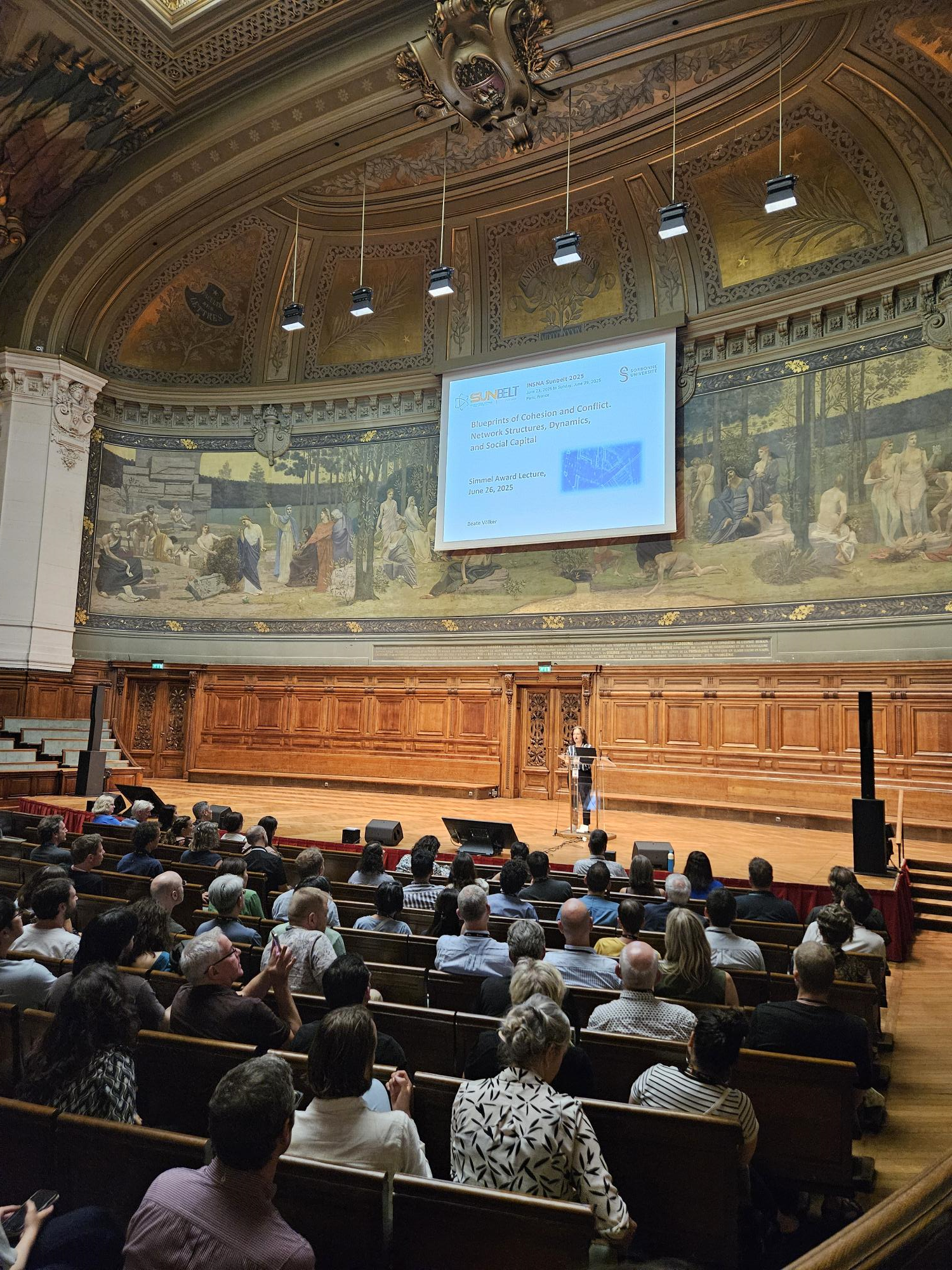
Yesterday, a very inspiring keynote by Beate Völker reminded us of the importance of weak ties and even absent ties – not only to smoothen the functioning of job markets but also, more surprisingly, to achieve social cohesion. The keynote took place in the historical Grand Amphithéâtre de la Sorbonne.
I am pleased to have contributed to a set of initiatives in honour of great network sociologist Harrison White, one year after his death. With Elise Penalva-Icher and Fabien Eloire, we presented a paper on digital platforms in White-like producer markets shaped by networks (more on it soon!). The paper was part of a dedicated session on the legacy of Harrison White. There was also a plenary in memoriam, where his former students and friends shared thoughts and stories. (Another plenary honoured Barry Wellman).

I was also honoured to be invited, today, to join a plenary panel on social networks and the study of social inequalities, organized by Gianluca Manzo. While most research on inequalities is attribute-based, social network approaches provide a powerful alternative (or perhaps, complement), highlighting how interpersonal, relational mechanisms generate patterns that over time, lock categorical differences into durable gaps in wealth, status, or other outcomes. We discussed complementarities and differences between these two approaches, the advantages of a network-oriented perspective, but also the methodological challenges that come with it.

On Sunday, I’ll present a paper that also deals with inequalities, in the specific case of online platform workers. We define an index of ‘vulnerability’ to unveil inequalities within this worker population in two countries, France and Spain. The paper develops and deeps results of a previous work, whose first outputs served to inform policy decisions in France.

Another paper to which I have contributed, and which will be presented at this Sunbelt, is more methodological and is the result of a collective effort. We analyze over 20 years of publications in the journal REDES and highlight how researchers have reported relational data from both personal and complete networks. We identify key challenges in the consistency and transparency of reporting and propose 7 practical recommendations to improve clarity, comparability, and replicability in social network research. This paper is already published in REDES.
Uninvited protagonists: the social networks of Venezuelan AI data workers

After years of work, the long-awaited good news: my article ‘Uninvited Protagonists: The Networked Agency of Venezuelan Platform Data Workers‘, co-authored with Juana Torres-Cierpe, has just been published in New Technology, Work and Employment!

Workers in Venezuela are powering AI production, often under tough conditions. Sanctions and a deep political-economic crisis have pushed them to work for platforms that pay in US dollars, albeit at low rates. They constitute a large reservoir for technology producers from rich countries. But they are not passive players.

They build resilience, rework their environment, and sometimes engage in acts of resistance, with support from different segments of their personal networks. From strong local ties to loose online connections, these informal webs help them cope, adapt, and occasionally push back. Their diversified relationships comprise an unofficial and often hidden, albeit largely digitised relational infrastructure that sustains their work and shapes collective action.

These findings invite to rethink agency as embedded in workers’ personal networks. To respond to adversities, one must liaise with equally affected peers, with family and friends who offer support, etc. Social ties ultimately determine who is enabled to respond, and who is not; whether any benefits and costs are shared, and with whom; whether any solution will be conflictual or peaceful. Social networks are not accessory but constitute the very channel through which Venezuelan data workers cope with hardship.

Not all relationships play the same role, though. Venezuelans discover online data work through their strong ties with family, close friends, and neighbours. To convert their online earnings into local currency, they rely on their broader social networks of relatives and friends living abroad and indirect relationships with intermediaries. For managing their day-to-day activities, Venezuelans expand their social networks through online services like Facebook, WhatsApp, and Telegram, connecting with diverse and less-close peers within and outside the country. Different social ties affect the various stages of the data working experience.

Overall, no Venezuelan could work alone – and the networked interactions that sustain each of them against hardship have made them massively present, as ‘uninvited protagonists,’ in international platforms. Their massive presence in the planetary data-tasking market is a supply rather than demand-driven phenomenon.

This analysis also sheds light on the reasons why mobilisation is uncommon among platform data workers. Other studies noted diverging orientations of workers, unclear goals, lack of focus, and insufficient leadership. Another powerful reason hinges upon the predominance of weak ties in building up online group membership: indeed, distant acquaintances are insufficient to prompt people to action if their intrinsic motivations are low.

The article is available in open access here.

The socio-contextual basis for disinformation

Within the Horizon-Europe project AI4TRUST, we published a first report presenting the state of the art in the socio-contextual basis for disinformation, relying on a broad review of extant literature, of which the below is a synthesis.

What is disinformation?

Recent literature distinguishes three forms:

  • misinformation’ (inaccurate information unwittingly produced or reproduced)
  • disinformation’ (erroneous, fabricated, or misleading information that is intentionally shared and may cause individual or social harm)
  • malinformation’ (accurate information deliberately misused with malicious or harmful intent).

Two consequences derive from this insight. First, the expression ‘fake news’ is unhelpful: problematic contents are not just news, and are not always false. Second, research efforts limited to identifying incorrect information alone, without capturing intent, may miss some of the key social processes surrounding the emergence and spread of problematic contents.

How does mis/dis/malinformation spread?

Recent literature often describes the characteristics of the process of diffusion of mis/dis/malinformation in terms of ‘cascades’, that is, the iterative propagation of content from one actor to others in a tree-like fashion, sometimes with consideration of temporality and geographical reach. There is evidence that network structures may facilitate or hinder propagation, regardless of the characteristics of individuals: therefore, relationships and interactions constitute an essential object of study to understand how problematic contents spread. Instead, the actual offline impact of online disinformation (for example, the extent to which online campaigns may have inflected electoral outcomes) is disputed. Likewise, evidence on the capacity of mis/dis/malinformation to spread across countries is mixed. A promising perspective to move forwards relies on hybrid approaches mixing network and content analysis (‘socio-semantic networks’).

What incentivizes mis/dis/malinformation?

Mis/dis/malinformation campaigns are not always driven solely by political tensions and may also be the product of economic interest. There may be incentives to produce or share problematic information, insofar as the business model of the internet confers value upon contents that attract attention, regardless of their veracity or quality. A growing, shadow market of paid ‘like’, ‘share’ and ‘follow’ inflates the rankings and reputation scores of web pages and social media profiles, and it may ultimately mislead search engines. Thus, online metrics derived from users’ ratings should be interpreted with caution. Research should also be mindful that high-profile disinformation campaigns are only the tip of the iceberg, low-stake cases being far more frequent and difficult to detect.

Who spreads mis/dis/malinformation?

Spreaders of mis/dis/malinformation may be bots or human users, the former being increasingly controlled by social media companies. Not all humans are equally likely to play this role, though, and the literature highlights ‘super-spreaders’, particularly successful at sharing popular albeit implausible contents, and clusters of spreaders – both detectable in data with social network analysis techniques.

How is mis/dis/malinformation adopted?

Adoption of mis/dis/malinformation should not be taken for granted and depends on cognitive and psychological factors at individual and group levels, as well as on network structures. Actors use ‘appropriateness judgments’ to give meaning to information and elaborate it interactively with their networks. Judgments depend on people’s identification to reference groups, recognition of authorities, and alignment with priority norms. Adoption can thus be hypothesised to increase when judgments are similar and signalled as such in communication networks. Future research could target such signals to help users in their contextualization and interpretation of the phenomena described. 

Multiple examples of research in social network analysis can help develop a model of the emergence and development of appropriateness judgements. Homophily and social influence theories help conceptualise the role of inter-individual similarities, the dynamics of diffusion in networks sheds light on temporal patterns, and analyses of heterogeneous networks illuminate our understanding of interactions. Overall, social network analysis combined with content analysis can help research identify indicators of coordinated malicious behaviour, either structural or dynamic.  

Social networks and social resilience

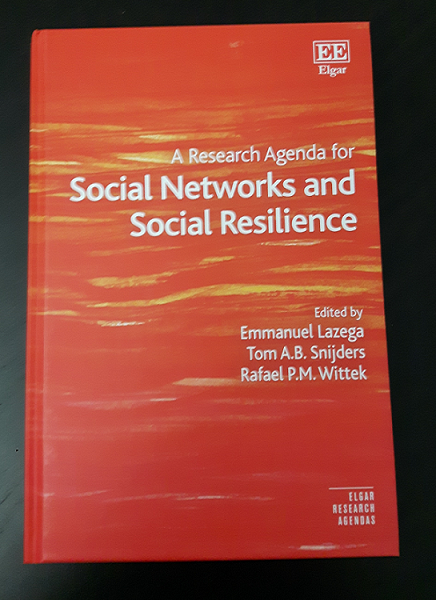
I have just received my copy of the new book edited by Emmanuel Lazega, Tom Snijders and Rafael Wittek on Social Networks and Social Resilience.

It has been an amazing journey that has brought all of us as chapter authors to share ideas, learn from each other, and reflect together, both with the whole group and in smaller cliques. It’s been one of my best experiences of collaboration toward an edited volume – perhaps because of the network-minded leadership we had!

The result is an incredibly high-quality book that is up-to-date, well documented, and at the same time accessible to all, especially students.


My contribution is a chapter on ‘Social networks and resilience in emerging labor markets’. Its premise is that the recent emergence of digital platforms as labor market intermediaries disrupts collective work practices, fostering fragmentation and individualized sub-contracting. I therefore discuss how social networks operate, and how they support social resilience, in these environments where isolation dominates. Most importantly I ask how we, as researchers, can apprehend them. To address these questions, my chapter reviews insights from socio-economic studies of networks, discusses their applicability to platforms, compares and contrasts them to existing evidence on platform work. The analysis confirms that overall, technology-enabled platform intermediation restrains sociability and limits interactions, but specific cases where networking has been possible highlight the fundamental advantages it may have for workers, and suggest directions for future research and policy action.

More information about the book is here.

The full text of the chapter is available here.

Pathways in Network Science

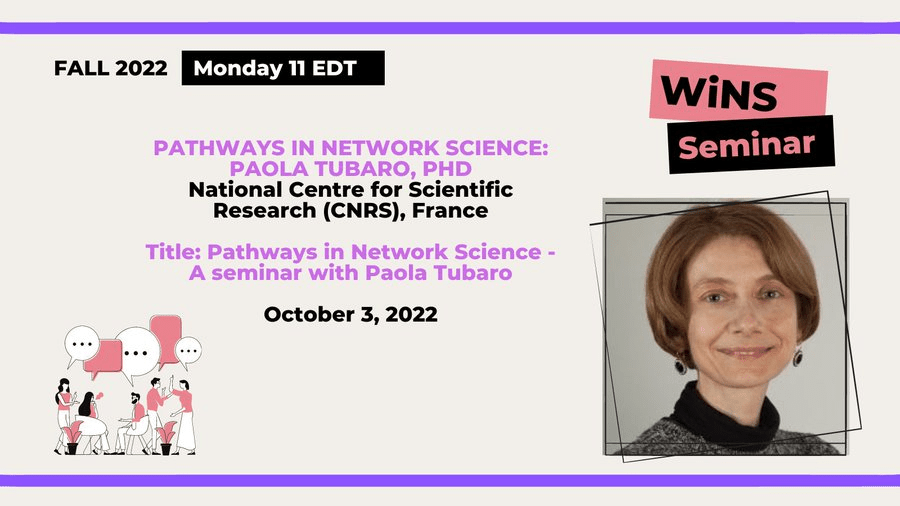
I’m happy and honoured to speak today at the “Pathways in Network Science” online seminar of the Women in Network Science (WiNS) group.

Pathways in Network Science aims to give the stage to women and nonbinary researchers in network science to share their career paths or some pertinent aspects of it. Presentations can be a summary of the research topics explored along a speaker’s career path or even an autobiographical presentation about how opportunities and challenges influenced her aspirations and impacted her career path. It can also include discussing gender-related challenges and experience with individual strategies and/or systemic changes.

I’ll talk about myself in terms of mobility – both geographic and disciplinary – and the challenges and opportunities it represented. I’ll also talk about resilience – or how network science helped me to make true my dream of devoting my life to research. I’ll mention impact – or how to think of the place of science in society, and how network research can lead to positive change. I’ll conclude with the challenges ahead – and how they are not only scientific, but also deeply human and social.

Hidden inequalities: the gendered labour of women on micro-tasking platforms

Around the world, myriad workers perform data tasks on online labour platforms to fuel the digital economy. Mostly short, repetitive and little paid, these so-called ‘micro-tasks’ include for example labelling objects in images, classifying tweets, recording utterances, and transcribing audio files – notably to satisfy the data appetite of today’s fast-growing artificial intelligence industry. While casualization of labour and low pay have attracted sharp criticisms against these platforms, they appear gender-blind and accessible even to people with basic skills. Women with care or household duties may particularly benefit from the time flexibility and the possibility to work from home that platforms offer. So, are these new labour arrangements gender equalizers after all?

In a new paper co-authored with Marion Coville, Clément Le Ludec and Antonio A. Casilli, we demonstrate that this new form of online labour fails to fill gender gaps, and may even exacerbate them. We proceed in three steps. First, we show that legacy inequalities in the professional and domestic spheres turn platform-mediated micro-tasking into a ‘third shift’ that adds to already heavy schedules. Both working fathers and working mothers experience it, but the structure of the other two shifts affects their experience. Looking at their time use, it turns out that men dedicate long and uninterrupted slots of time to each activity: their main job, their share of household duties, leisure and micro-work. They tend to do all micro-tasks in a row, usually at night after work or in the morning before starting. Instead, women have more fragmented schedules, and micro-work during short breaks, here and there, eating into their leisure time. This is one reason why they earn less on platforms: they have short slots of time available, so they cannot search for better-paid tasks, and just content themselves with whatever is available at that moment.

Time use of typical female (left) and male (right), micro-workers, both of whom have a main job in addition to platform micro-tasks, and dependent children.

Second, we submit that the human capital of male and female data workers differ, with women less likely to have received training in science and technology fields.

Highest educational qualification (left) and discipline of specialization (right) of men and women micro-workers. Data collected in France, 2018 (n = 908).

Third, their social capital differs: using a position generator instrument to capture workers’ access to the informational and support resources that may come from contacts with people in different occupations, we show that women have fewer ties to digital-related professionals who could provide them with knowledge and advice to successfully navigate the platform world.

Gender assortativity index for each occupation in the 48-item position generator that measures respondents’ social capital. Each panel represents respondents’ choices, ordered from lowest (negative) to highest (positive) degree of similarity. Top panel: female respondents, bottom panel: male respondents. The bars corresponding to digital and computing occupations are hatched.

Taken together, these factors leave women with fewer career prospects within a tech-driven workforce, and reproduce relegation of women to lower-level computing work as observed in the history of twentieth-century technology. 

The full paper is available in open access here.

It is part of a full special issue of Internet Policy Review on ‘The gender of the platform economy‘, guest-edited by M. Fuster Morell, R. Espelt and D. Megias.

The visualization of personal networks

I am pleased to co-organize with Vincent Lorant of UCLouvain a special session on “The visualization of personal networks” at the forthcoming INSNA Sunbelt conference (12-16 July 2022, Cairns, Australia, and online).

Personal network data collection methods allow describing the composition and the structure of an individual’s (hereafter ego) social network. This method has been implemented in different domains such as migration, drug use, mental health, aging, education, and social welfare. Over the last years, these data have also been used to provide respondents with visualizations of their personal network, using different algorithms and customizing results through computer assisted data collection. Visualization gives valuable feedback to the respondent, improves data validity and may trigger positive behavioural changes, notably in vulnerable individuals or groups. Yet, visualization is not a free lunch. Recent research has evidenced the ethical dilemmas of providing such feedback to individuals: ego’s social life is being exposed, the researcher may be exposed as well, and such feedback may imply some contractual exchanges or therapeutic implications that require attention.

This session aims to describe the stakes of different visualization approaches to personal networks with different populations. We welcome qualitative and quantitative papers addressing issues related to the implementation of visualization or reports of personal networks in terms of techniques, levels of respondent’s satisfaction with visualization, conditions under which visualization is recommended or discouraged, and effects of the personal network visualization for the respondent.

More information on the conference and the submission process is available here.