Sociology of AI, Sociology with AI (1)

There are two main ways in which a discipline like sociology engages with artificial intelligence (AI) and is affected by it. The sociology of AI understands technology as embedded in socio-economic systems and takes it as an object for research. Sociology with AI indicates that the discipline is also integrating AI into its methodological toolbox. Based on a talk that I gave at this year’s annual meeting of the European Academy of Sociology, I’ll give in what follows a brief overview of both. As a disclaimer, I have no pretention to be exhaustive. To narrow down the topic, I have chosen to focus on sociology specifically (rather than neighboring fields), and to rely only on already published, peer-reviewed research.

Anne Fehres and Luke Conroy & AI4Media, “Data is a Mirror of Us”/ https://betterimagesofai.org / https://creativecommons.org/licenses/by/4.0/

Let’s start with the sociology of AI, which I’ll illustrate with the help of the above artwork. Its aim is to demonstrate that even if there is a sense of magic in looking at the outputs of an AI system, the data on which it is based has a human origin. This work explores this idea through the symbolism of the mirror and reflection: beyond the magic, these outputs are a reflection of society. Sociological perspectives matter because they can help bring these social and human origins to the fore. In 2021, Kelly Joyce and her coauthors called for more engagement of sociologists in outlining a research agenda around these topics. Compared to other disciplines, we have a thicker understanding of the intersectional inequalities and social structures that interact with AI.

However, it was not sociology that initiated the conversation on these issues. Disciplines like computer science itself, communication, philosophy, and the arts shaped the debate. Landmark contributions were, among other things, a 2016 influential journalistic report about discrimination in predictive police applications, a 2018 computer science article on gender and race discrimination in face recognition, and an artistic project which, also in 2018, described Amazon Echo as an anatomical map of human labor, data and planetary resources. Conferences like ACM’s FaccT have become reference venues for these analyses. For clarity, some of the contributors to these debates are indeed sociologists but the discipline’s infrastructure of conferences, journals and institutions, has been less responsive.

Why does the quasi-absence of sociology matter? I’ll answer this question through a 2022 paper, written by two sociologists but published in a computer science conference. The starting point is that early studies framed AI-related societal problems in terms of bias. For example, the above-mentioned report on predictive policing was entitled “machine bias”. This language points to technical corrections as remedy, but it cannot account for the social processes underway that comprise, among other things, increasing surveillance and privacy intrusion to collect more and more data (see image below). De-biasing may thus be insufficient to prevent injustice or inequality. A sociologically informed approach reveals that key questions are about power: who owns data and systems, whose worldviews are being imposed, whose biases we are trying to mitigate.
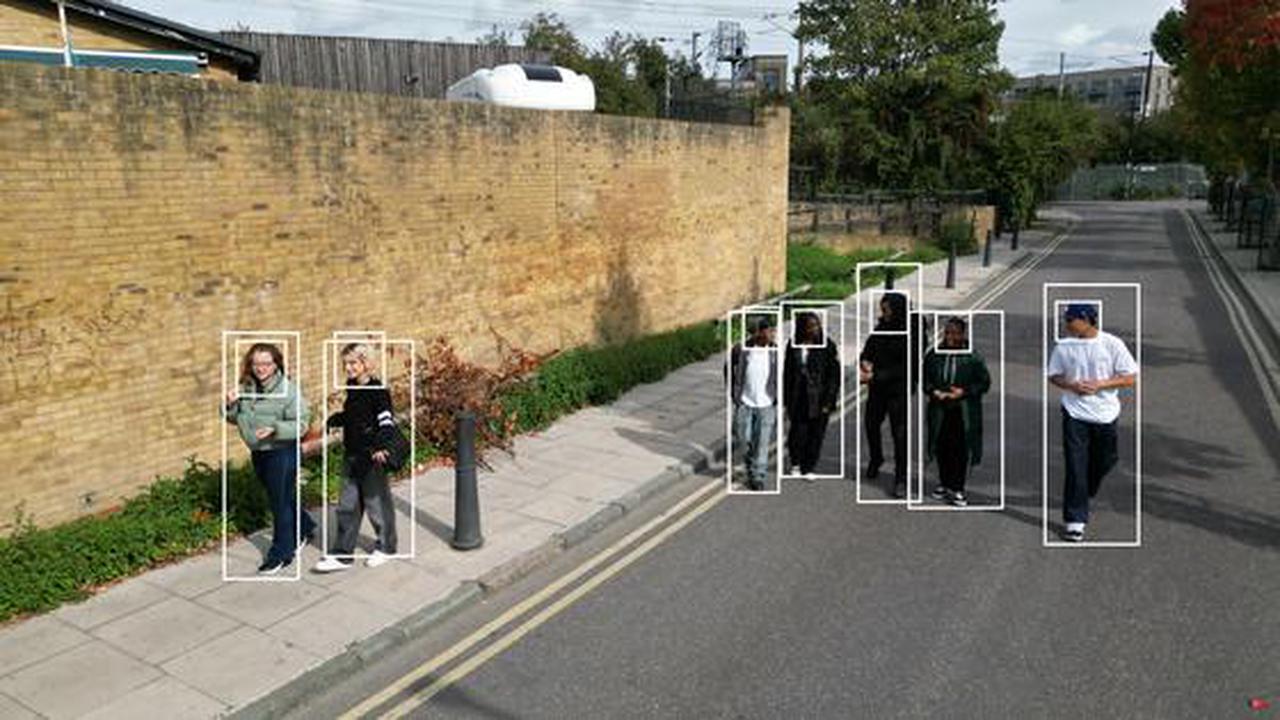
Comuzi/ ‘’SurveillanceView’’ / https://betterimagesofai.org / © BBC / https://creativecommons.org/licenses/by/4.0/

In recent years, more substantial contributions have been made within sociology. For example, there was a special issue of Socius last year on “Sociology of Artificial Intelligence”, and another one is forthcoming in Social Science Computer Review, entitled “What is Sociological About AI?. I’ll mention a non-exhaustive selection of topics and findings. First, sociologists have recognized the hype – or how financial, political, and other interests have boosted the circulation of (often) exaggerated claims. This means shifting the gaze from AI as an intellectual endeavor, to see AI as a market – where bubbles can, well, form. This also means recognizing the political dimensions of AI development, with many states using public funding as a crucial engine for innovation.

Second, AI practitioners engage in a form of social construction of morality to legitimate their approaches to AI. For example, some distance themselves from Big Tech capitalism, some insist on the benefits of some AI applications, most prominently in healthcare. These efforts ultimately shape which technologies gain visibility and attract capital investments. This is also a way through which they produce and sustain the AI bubble itself – a culturally embedded market phenomenon. Third, sociological analysis can move beyond the technological determinism of early AI critics to emphasize the social and institutional contexts within which such algorithmic decision-making systems are deployed. This brings to light forms of negotiation, adaptation, and resistance, which have more subtle effects on inequalities.

Nacho Kamenov & Humans in the Loop : “Data annotators labeling data” / https://betterimagesofai.org / https://creativecommons.org/licenses/by/4.0/

Fourth, there is labor. Beyond fears of job losses due to AI, sociological research has unveiled a growing labor demand to produce AI itself. This does not only include the work of elite engineers and computer scientists, but also the lower-level contributions of data annotators, content moderators, voice actors, transcriptors, translators, image labelers, prompt testers, and even very basic clickworkers. This work is typically outsourced and offshored, resulting in precarious working arrangements and low pay. The above photograph represents two workers who use this job as a means of livelihoods. Overall, there is no drop in employment levels, but a steady deterioration of working conditions and an accelarated shift of the power balance from labor to capital. AI affects the very labor that produces it.  

In sum, sociologists increasingly contribute to these conversations, although these topics are not prominent in the discipline’s flagship conferences and journals, and important knowledge gaps remain. The guest-editors of the forthcoming Social Science Computer Review special issue on “What is sociological about AI?” claim that “A sociological lens can render AI’s hidden processes legible, just as sociologists have done with complex and taken for granted social forces since the discipline’s inception”. They nevertheless note that “we neither have a robust concept of AI as a social phenomenon nor a holistic sociological discourse around it, despite vibrant and dynamic work in the area.” In passing, most extant studies rely on traditional methods, primarily surveys and fieldwork. This is not an issue in itself, but it highlights a disconnection with the sub-topic I’ll highlight in my next post – Sociology using AI as instrument.

Embeddedness in digital platform labour

Starting from Granovetter’s seminal 1985 article, the concept of embeddedness has given new life to economic sociology. With it, it has finally been possible to operationalize the idea that factors other than individual, under-socialized choices drive the economy. In addition to people’s own interests and motivations, the social environments of which they are part contribute to shaping their action. With this idea, economic sociology could claim legitimacy as a valid approach to study the market and the firm – beyond the exclusive pretensions of much economics.

The idea of embeddedness and its operationalization were not without their critics, though. After all, one may say that economic sociology has performed better in its analysis of the firm, than of the market. The very meaning of the embeddedness concept has been stretched a lot over time – also getting back, on occasion, to the quite different nuances that Polanyi attached to it back in the 1940s.

In a just-published article, I go back to this concept and challenge it against digital platforms – recently emerged economic coordination devices that, in the view of many, defy the traditional firm/market boundaries. This helps uncover a new idea: extends the economic-sociological concept of embeddedness to encompass not only social networks of, for example, friendship or kinship ties, but also economic networks of ownership and control relationships.

Applying these ideas to the case of digital platform labour pinpoints two possible scenarios. When platforms take the role of market intermediaries, economic ties are thin and workers are left to their own devices, in a form of ‘disembeddedness’. In this sense, I confirm the results obtained by a group of Oxford scholars in a similar setting. But when platforms partake in intricate inter-firm outsourcing structures, economic ties envelop workers in a ‘deep embeddedness’ which involves both stronger constraints and higher rewards.

I show that with this added dimension, the notion of embeddedness becomes a compelling tool to describe the social structures that frame economic action, including the power imbalances that characterize digital labour in the global economy. Granovetter’s original idea can still provide a lot of insight to help us understand the transformations of today’s economy.

The article is available here.

A preliminary version of this article was presented in a seminar in September 2020.

First seminar of the year!

Next Thursday, 17 September, I have been invited to give a talk as part of the cycle of seminars organized by the quantitative sociology research group at CREST-ENSAE, Palaiseau (Paris area). Although the health situation is still bleak, I am glad to return to almost-normal functioning by giving an in-person talk. Hopefully there won’t be any new lockdown before that.

I will present an in-progress paper provisionally entitled:

«Disembedded or deeply embedded? A multi-level network analysis of the online platform economy»

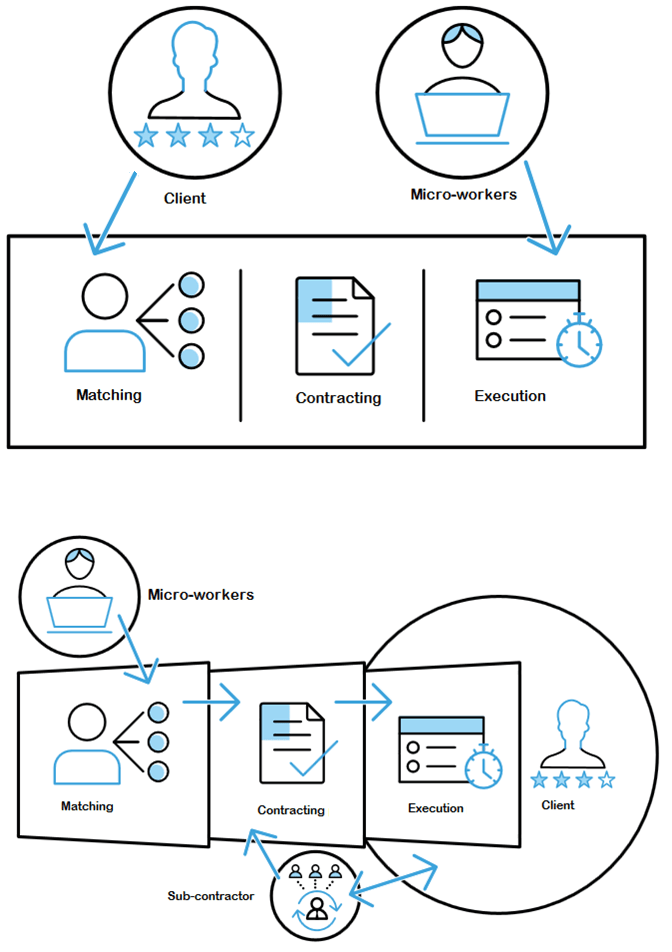
The two types of platform labour analyzed in the paper.

In this paper, I extend the economic-sociological concept of embeddedness to encompass not only social networks of, for example, friendship or kinship ties, but also economic networks of ownership and control relationships. Applying these ideas to the case of digital platform labour pinpoints two possible scenarios. When platforms take the role of market intermediaries, economic ties are thin and workers are left to their own devices, in a form of ‘disembeddedness’. When platforms partake in intricate inter-firm outsourcing structures, economic ties envelop workers in a ‘deep embeddedness’ which involves both stronger constraints and higher rewards. With this added dimension, the notion of embeddedness becomes a compelling tool to describe the social structures that frame economic action, including the power imbalances that characterize digital labour in the global economy.

Digital inequalities in time of pandemic

Just published a new, collective paper on new kinds of risk that are emerging with the COVID-19 virus, arguing that these risks are unequally distributed. Digital inequalities and social inequalities are rendering certain subgroups significantly more vulnerable to exposure to COVID-19. Populations bearing disproportionate risks include the social isolated, older adults, penal system subjects, digitally disadvantaged students, gig workers, and last-mile workers. We map out the intersection between COVID-19 risk factors and digital inequalities on each of these populations in order to examine how the digitally resourced have additional tools to mitigate some of the risks associated with the pandemic. We shed light on how the ongoing pandemic is deepening key axes of social differentiation, which were previously occluded from view.

These newly manifested forms of social differentiation can be conceived along several related dimensions. At their most general and abstract, these risks have to do with the capacity individuals have to control the risk of pathogen exposure. In order to fully manage exposure risk, individuals must control their physical environment to the greatest extent possible in order to prevent contact with potentially compromised physical spaces. In addition, they must control their social interactional environment to the greatest extent possible in order to minimize their contacts with potentially infected individuals. All else equal, those individuals who exercise more control over their exposure risk — on the basis of their control over their physical and social interactional environments — stand a better chance of staying healthy than those individuals who cannot manage exposure risk. Individuals therefore vary in terms of what we call their COVID-19 exposure risk profile (CERPs).

CERPs hinge on pre-existing forms of social differentiation such as socioeconomic status, as individuals with more economic resources at their disposal can better insulate themselves from exposure risk. Alongside socioeconomic status, one of the key forms of social differentiation connected with CERPs is digital (dis)advantage. Ceteris paribus, individuals who can more effectively digitize key parts of their lives enjoy better CERPs than individuals who cannot digitize these life realms. Therefore we believe that digital inequalities are directly and increasingly related to both life-or-death exposure to COVID-19, as well as excess deaths attributable to the larger conditions generated by the pandemic.

The article has been published in First Monday and is available here.

In the same special issue of First Monday, I co-published two reference articles:

Digital inequalities 2.0: Legacy inequalities in the information age

Digital inequalities 3.0: Emergent inequalities in the information age

HDR Paola Tubaro

(English version below)

J’ai le plaisir d’annoncer la soutenance de mon habilitation à diriger des recherches en sociologie intitulée :

Décrypter la société des plateformes: Organisations, marchés et réseaux dans l’économie numérique.

Cette soutenance aura lieu le mercredi 11 décembre 2019 à Sciences Po Paris, 9 rue de la chaise, salle 931, à 10h00.

Si vous souhaitez venir, merci de confirmer votre présence grâce à ce lien car les personnes externes à Sciences Po ne pourront pas accéder à la salle si elles ne sont pas annoncées.


Le jury sera composé de :

  • M. Gilles Bastin, Professeur des universités, IEP de Grenoble (rapporteur)
  • M. Rodolphe Durand, Professeur, HEC Paris
  • M. Emmanuel Lazega, Professeur des universités, IEP de Paris (garant et rapporteur)
  • Mme Béatrice Milard, Professeure des universités, Université de Toulouse Jean Jaurès (rapporteure)
  • M. José Luís Molina González, Professeur, Universitat Autònoma de Barcelona
  • M. Tom A.B. Snijders, Professeur, Rijksuniversiteit Groningen

La soutenance sera suivie d’un pot. 

Résumé

Le manuscrit original conceptualise la récente montée en puissance des platesformes numériques selon trois dimensions principales : leur nature de dispositifs de coordination alimentés par les données, les transformations du travail qui en découlent, et les promesses d’innovation sociétale qui les accompagnent. L’ambition globale est de décortiquer le rôle de coordination de la plateforme et sa position à l’horizon de la dualité classique entreprise – marché. Il s’agit aussi de comprendre précisément comment elle utilise les données pour ce faire, où elle amène le travail, et comment elle gère des projets d’innovation sociale. Je prolonge cette analyse pour faire apparaître la continuité entre la société actuelle dominée par les plateformes et la « société organisationnelle », montrant que les plateformes sont des structures organisées qui distribuent les ressources, produisent des asymétries de richesse et de pouvoir, et repoussent l’innovation sociale vers la périphérie du système. Je discute des implications de ces tendances pour les politiques publiques, et propose des pistes pour la recherche future. 


I am pleased to announce the defense of my habilitation to direct research in sociology entitled:


Decoding the platform society: Organizations, markets and networks in the digital economy


This defense will take place on Wednesday, 11 December 2019 at Sciences Po Paris, 9 rue de la chaise, room 931, at 10am.


If you wish to attend, please confirm your presence through this link because people who are external to Sciences Po will be denied access to the room if they are not announced.

Members of the jury are:

  • Prof. Gilles Bastin, IEP de Grenoble (referee)
  • Prof. Rodolphe Durand, HEC Paris
  • Prof. Emmanuel Lazega, IEP de Paris (advisor and referee)
  • Prof. Béatrice Milard, Université de Toulouse Jean Jaurès (referee)
  • Prof. José Luís Molina González, Universitat Autònoma de Barcelona
  • Prof. Tom A.B. Snijders, Rijksuniversiteit Groningen

There will be drinks after the defense.


Abstract

The original manuscript conceptualizes the recent rise of digital platforms along three main dimensions: their nature of coordination devices fueled by data, the ensuing transformations of labor, and the accompanying promises of societal innovation. The overall ambition is to unpack the coordination role of the platform and where it stands in the horizon of the classical firm – market duality. It is also to precisely understand how it uses data to do so, where it drives labor, and how it accommodates socially innovative projects. I extend this analysis to show continuity between today’s society dominated by platforms and the “organizational society”, claiming that platforms are organized structures that distribute resources, produce asymmetries of wealth and power, and push social innovation to the periphery of the system. I discuss the policy implications of these tendencies and propose avenues for follow-up research.

Work, Employment & Society

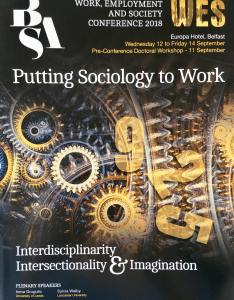
BSA_WES2018Just came back from the Work, Employment and Society (WES) conference 2018, that British Sociological Association (BSA) organizes every other year. Perhaps more intimate and newbie-friendly than the main BSA event, this year’s WES in Belfast was also a positive surprise in terms of its academic content. There were several sessions on the so-called ‘gig economy’ (or as one speaker put it, ‘gig economies‘), the effects of digital business models that often go under the name of ‘uberization’, and atypical forms of work.

Some lessons I am taking home:

  • A growing number of researchers are studying platform work – not just the most visible forms of it such as Uber drivers and Deliveroo couriers, but also those who are hidden at home: freelancers and to a lesser extent, micro-workers;
  • The question of how platform workers self-organize, and what can be done to improve their organization capacity, is attracting a lot of attention;
  • Efforts at establishing standards, fairness criteria and forms of social protection for atypical platform workers are gaining momentum;
  • There is a lot we can learn from research in neighboring areas: for example the distinction between employee-friendly and employer-friendly flexible work, initially developed for people in employment, is also helpful here.

What is still missing from the picture is information on the ‘long tail’ of smaller, often national rather than international, platforms, and on the workers (especially micro-workers) who use them. Besides, clients and requesters are little known – on all platforms. Estimating the size of the platform worker population remains an unresolved issue – whether at local, national or international level. A common grievance by researchers is difficulty to access crucial data from commercial platforms that use them as their private property.

SPS seminar, second edition

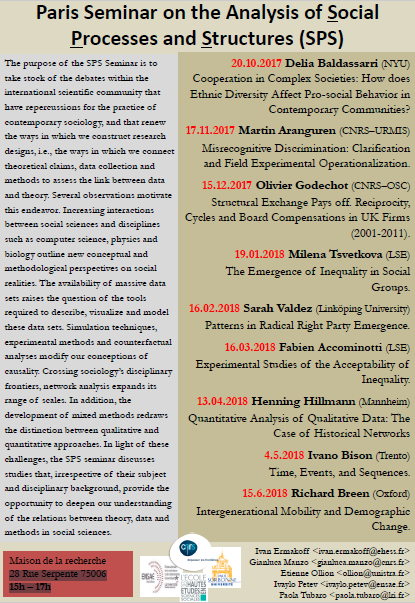
Our inter-disciplinary, inter-institutional SPS seminar (Paris Seminar on the Analysis of Social Processes and Structures) has just started its second edition! Its purpose is to take stock of the debates within the international scientific community that have repercussions on the practice of contemporary sociology, and that renew the ways in which we construct research designs, i.e., the ways in which we connect theoretical claims, data collection and methods to assess the link between data and theory. Several observations motivate this endeavor. Increasing interactions between social sciences and disciplines such as computer science, physics and biology outline new conceptual and methodological perspectives on social realities. The availability of massive data sets raises the question of the tools required to describe, visualize and model these data sets. Simulation techniques, experimental methods and counterfactual analyses modify our conceptions of causality. Crossing sociology’s disciplinary frontiers, network analysis expands its range of scales. In addition, the development of mixed methods redraws the distinction between qualitative and quantitative approaches. In light of these challenges, the SPS seminar discusses studies that, irrespective of their subject and disciplinary background, provide the opportunity to deepen our understanding of the relations between theory, data and methods in social sciences.

Continue reading “SPS seminar, second edition”