When we created ENDL (the European Network on Digital Labour), back in 2017, we booked a room with 17 places. A few days ago, the last conference of the network (which in the meantime has become INDL, replacing ‘European’ with ‘International’) hosted about 200 participants. Internationalisation has not only meant numerical growth, but also inclusion of a diverse range of voices: every year, we see more participants from countries that are often under-represented on the scientific scene, from India and South Africa to Argentina and Brazil. Participants have also diversified in another sense, too: if the majority have always been academics, it is a pleasure to see more and more workers, as well as labour organisers. This year, we could for example benefit from the presence of associations of data workers from Kenya, freelancers from France, and content moderators from Spain.
Participants to the INDL-8 conference, Saint-Cristina cloister, Bologna, IT, 10 September 2025.
A conference like this one is meant to give hope – hope of mutual understanding across countries and cultures, hope of dialogue across disciplines and fields, hope of connections between academic research and action. We worked together to ensure a welcoming environment for all, for instance by encouraging constructive comments, rather than sheer criticism, after each paper presentation. We also strived to keep costs down in order to make the conference free of charge, and with the DiPLab research programme, we could give a few small scholarships to promising presenters who might not have been able to travel otherwise.
Two speakers (M Francesco Sinopoli, Fondazione Di Vittorio, and Ms Kauna Malgwi, Uniglobal) at the plenary panel ‘Plenary panel: New Unionism, towards global alliances’, part of the INDL-8 Conference, DAMA Tecnopolo, Bologna, IT, 11 September 2025
Surely, problems remain. A couple potential participants had visa issues, while others had to cancel due to lack of funding. These problems weigh especially hard on people from emerging and lower-income countries outside Europe and North America. The future is also uncertain, as funding sources become increasingly dryer, and visa restrictions tighter. For this reason, the main INDL-9 conference next year (Geneva, ILO, 9-11 September 2026) will be accompanied by the growth of local chapters. The Middle-East and Africa area is preparing its second conference, this time online only, on 25-26 November. In the US, a one-day event will take place at Yale University on 29 April 2026. Colleagues in Chile and Argentina are launching a series of online events.
Closing keynote (Prof. Sandro Mezzadra, chair: Prof. Marco Marrone), Saint-Cristina Aula Magna, Bologna, IT, 12 September 2025
More information on the INDL-8 conference (including the full programme) is available here.
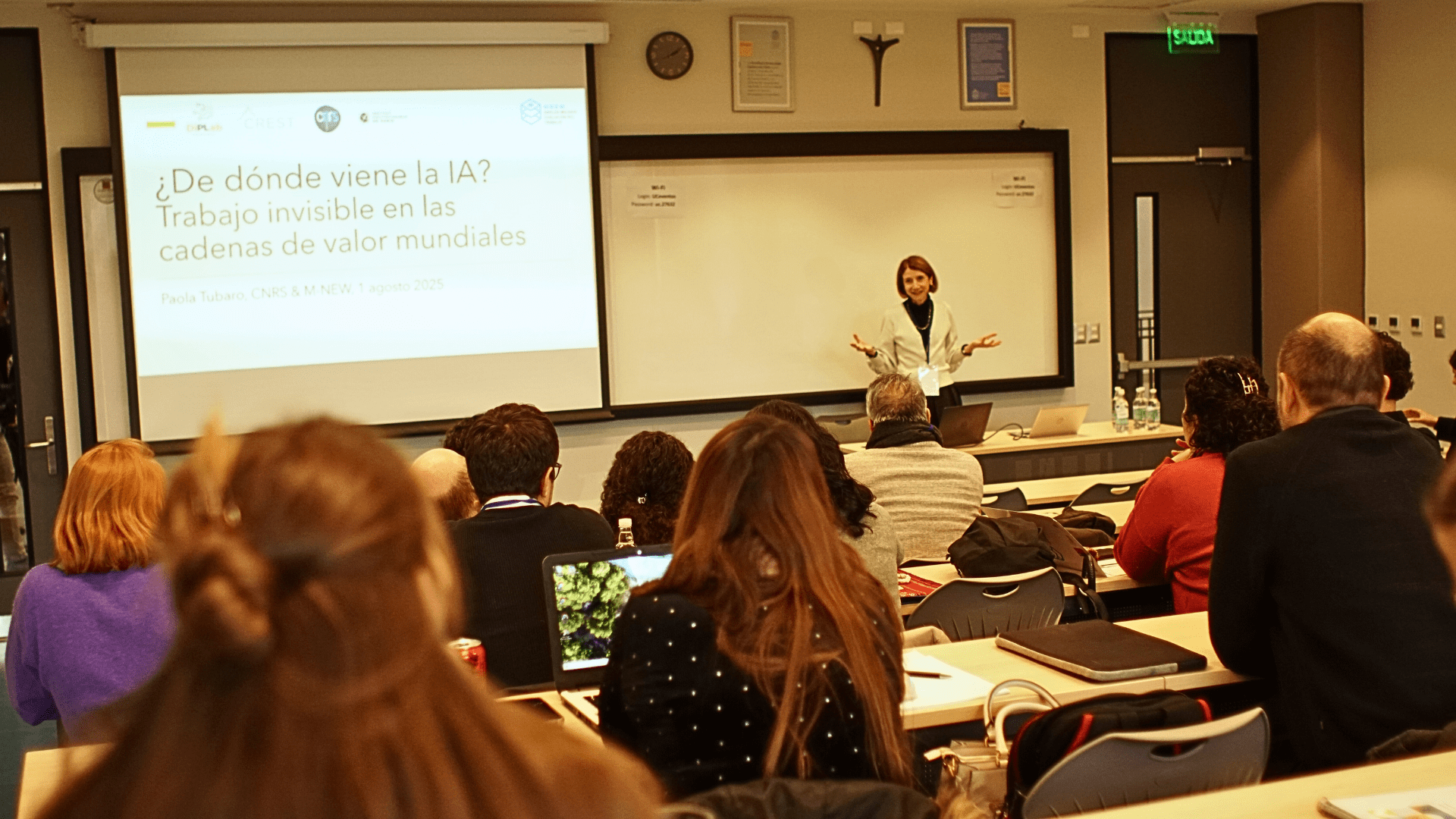
Last week in Santiago, Chile, I had the tremendous opportunity to give a keynote speech at the 4th annual workshop of the Millennium Nucleus on the Evolution of Work (M-NEW), of which I am also a senior international member. This interdisciplinary workshop brought together labour scholars from various parts of Latin America and beyond. I really liked the inspiring talks and the friendly and stimulating interactions with colleagues.
Credits: M-NEW
My own talk drew on my multi-year research programme on the crucial yet invisible human labor behind the global production of artificial intelligence. I first examined the evolution of this form of work over the last two decades, demonstrating that while its core functions in the development of smart systems have remained consistent, the scope and volume of such tasks have expanded significantly. I then analyzed the organization of this labour at the intersection of three trends in recent globalization: outsourcing, offshoring, and digitalization. These dynamics account for the marginalization of these workers within the tech industry and the relocation of their labor to lower-wage countries. Based on these insights, I described four cases—Venezuela, Argentina, Brazil, and Chile—highlighting the diverse effects of local conditions. I concluded by identifying emerging scientific and policy challenges, particularly concerning the recognition of skills, and the place of the informal economy.
Credits: M-NEW
The following week, still in Santiago, I was excited to participate in the kick-off meeting of the new research project SEED (“Social and Environmental Effects of Data connectivity: Hybrid ecologies of transoceanic cables and data centers in Chile and France”), a collaboration between my research group DiPLab and another Millennium Nucleus, FAIR (“Futures of Artificial Intelligence Research”). SEED received joint funding from the ECOS-SUD programme (France) and ANID (Chile) to analyse the AI value chain, from its production and development to its impact on employment, use and environmental consequences, by studying the Valparaíso-Santiago de Chile and Marseille-Paris axes.
Credits: FAIR
My presentation introduced the concept of the ‘dual footprint’ as a heuristic device to capture the commonalities and interdependencies between the different impacts of AI on the natural and social surroundings that supply resources for its production and use. I framed the AI industry as a value chain that spans national boundaries and perpetuates inherited global inequalities. The countries that drive AI development generate a massive demand for inputs and trigger social costs that, through the value chain, largely fall on more peripheral actors. The arrangements in place distribute the costs and benefits of AI unequally, resulting in unsustainable practices and preventing the upward mobility of more disadvantaged countries. The dual footprint grasps how the environmental and social dimensions of AI emanate from similar underlying socio-economic processes and geographical trajectories.
Acabo de regresar de un viaje muy lindo a Argentina, donde fui invitada por el Instituto francés para participar en varios eventos.
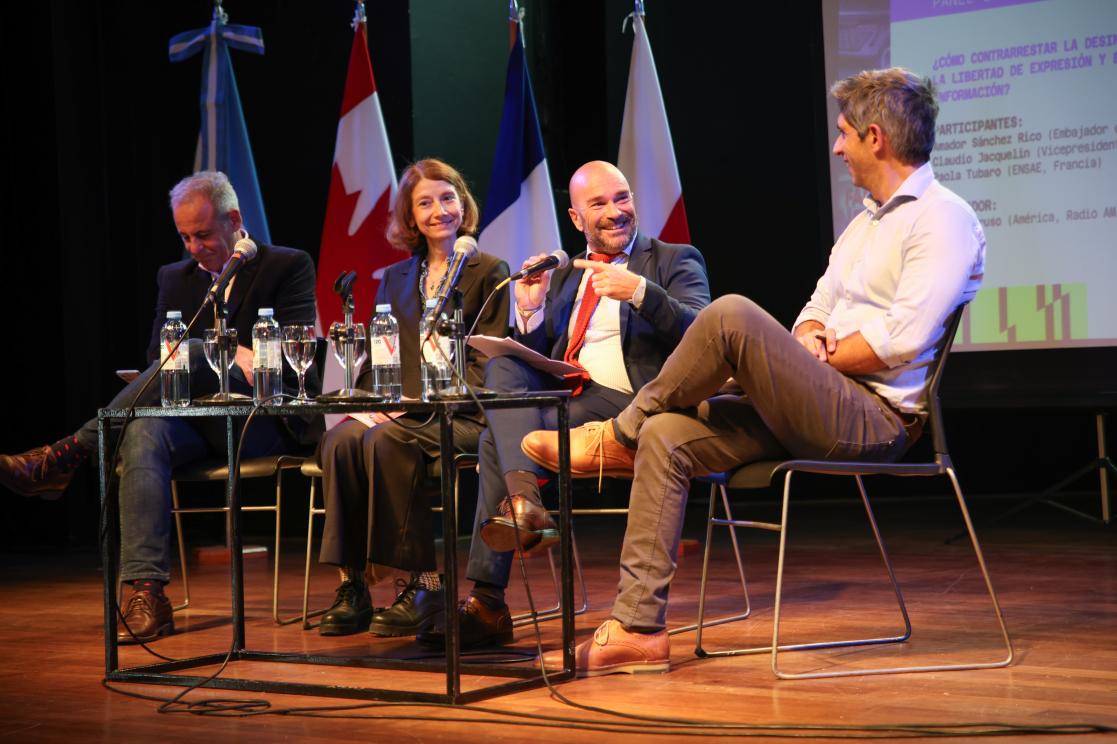
El 12 de mayo, participé en la conferencia “Manipulación Informativa e Injerencia Extranjera: Desafíos Globales y Respuestas Democráticas”, organizada por la Delegación de la Unión Europea en Argentina y por varias embajadas (como la de Francia). En el panel “Cómo contrarrestar la desinformación respetando la libertad de expresión y el derecho a la información”, hablé de cómo la desinformación se financia a través del mercado publicitario que sustenta toda la web, y de la necesidad de regular este mercado. También destaqué la importancia de fortalecer la investigación científica sobre este tema – como en el proyecto AI4TRUST, financiado por la propia UE.
Al día siguiente, tuve dos encuentros con estudiantes de periodismo, en la Universidad Nacional de Avellaneda y en la Universidad Abierta Interamericana, también sobre temas relacionados con la desinformación en internet. Fue un honor y un placer ver, en cada caso, la sala llena y mucho interés. Los/as estudiantes hicieron muchas preguntas y demostraron una gran disposición a aprender y progresar.
Los días 16 y 17 de mayo participé en tres paneles organizados en el marco de la Noche de las Ideas, una iniciativa del Instituto francés que se organiza todos los años y esta vez tuvo lugar en el famoso Teatro Colón de Buenos Aires. Fui en la sesión inaugural sobre el tema de este año, “El poder de actuar”. Además, participé como ponente en un debate muy interesante sobre el trabajo en plataformas digitales que se titulaba provocativamente ¿Nuevas servidumbres voluntarias? Jóvenes y precariedad y en otro sobre la inteligencia artificial: “In A.I. we trust?”. Actuar con y en contra de las nuevas tecnologías.
El 20 de mayo, di una charla sobre “El futuro del trabajo y la IA” como parte del ciclo UBA Digital, en la Universidad de Buenos Aires. Presenté algunos resultados de mi investigación sobre el trabajo digital y su papel en la producción de IA, desarrollada en el marco del programa de investigación DiPLab. Una vez más, me alegró ver a muchos participantes con preguntas muy interesantes. Fuimos acogidos por la facultad de odontología y también tuvimos la extraordinaria oportunidad de visitar la clínica.
The conference reaches Italy this year. It will take place in the most ancient University in the western world, Bologna, on 10-12 September 2025.
The overarching topic of this year’s conference is ‘Contesting Digital Labor: Resistance, counteruses, and new directions for research’. The goal is to explore how platform workers navigate, challenge, and reshape algorithmic management systems while forging innovative forms of solidarity and collective action. We also aim to explore the perspectives that technological developments open for workers in order to escape everyday surveillance, to resist top-down control and to organise to defend their rights.
In addition to presentations that directly address these questions, we welcome proposals that analyse a broader range of issues related to digital labour.
My great regret is that I always have very little time to write posts, and the emptiness of this blog does not reflect the numerous, great and stimulating scientific events and opportunities that I have enjoyed throughout 2024. As a last-minute remedy (with a promise to do better next year…hopefully), I try to summarize the landmarks here, month by month.
In January, I launched the Voices from Online Labour (VOLI) project, which I coordinate with a grant of about €570,000 from the French National Agency for Research. This four-year initiative brings together expertise from sociology, linguistics, and AI technology across multiple institutions, including four French research centres, a speech technology company, and three international partners.
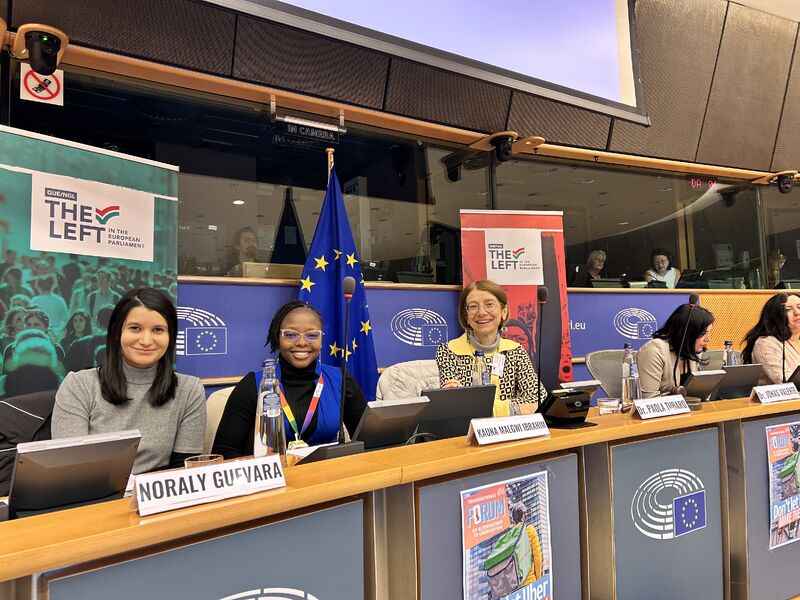
In February with the Diplab team, I spent two exciting days at the European Parliament in Brussels, engaging in profound discussions with and about platform workers as part of the 4th edition of the Transnational Forum on Alternatives to Uberization. I chaired a panel with data workers and content moderators from Europe and beyond, aiming to raise awareness about the difficult working conditions of those who fuel artificial intelligence and ensure safe participation to social media.
In March, three publications saw the light. One is a solo-authored chapter, in French, on ‘Algorithmes, inégalités, et les humains dans la boucle‘ (Algorithms, inequalities, and the humans in the loop) in a collective book entitled ‘Ce qui échappe à l’intelligence artificielle‘ (What AI cannot do). The other two are journal articles that may seem a little less close to my ‘usual’ topics, but they are important because they constitute experiments in research-informed teaching. One is a study of the 15-minute city concept applied to Paris, realized in collaboration with a colleague, S. Berkemer of Ecole Polytechnique, and a team of brilliant ENSAE students. The other is an analysis of the penetration of AI into a specific field of research, neuroscience, showing that for all its alleged potential, it created a confined subfield but did not entirely disrupt the discipline. The study, part of a larger project on AI in science, was part of the PhD research of S. Fontaine (who has now got his degree!), also co-authored with his co-supervisors F. Gargiulo and M. Dubois.
In April, I co-published the final report from the study realized for the European Parliament, ‘Who Trains the Data for European Artificial Intelligence?‘. Despite massive offshoring of data tasks to lower-income countries in the Global South, we find that there are still data workers in Europe. They often live in countries where standard labour markets are weaker, like Portugal, Italy and Spain; in more dynamic countries like Germany and France, they are often immigrants. They do data work because they lack sufficiently good alternative opportunities, although most of them are young and highly educated.
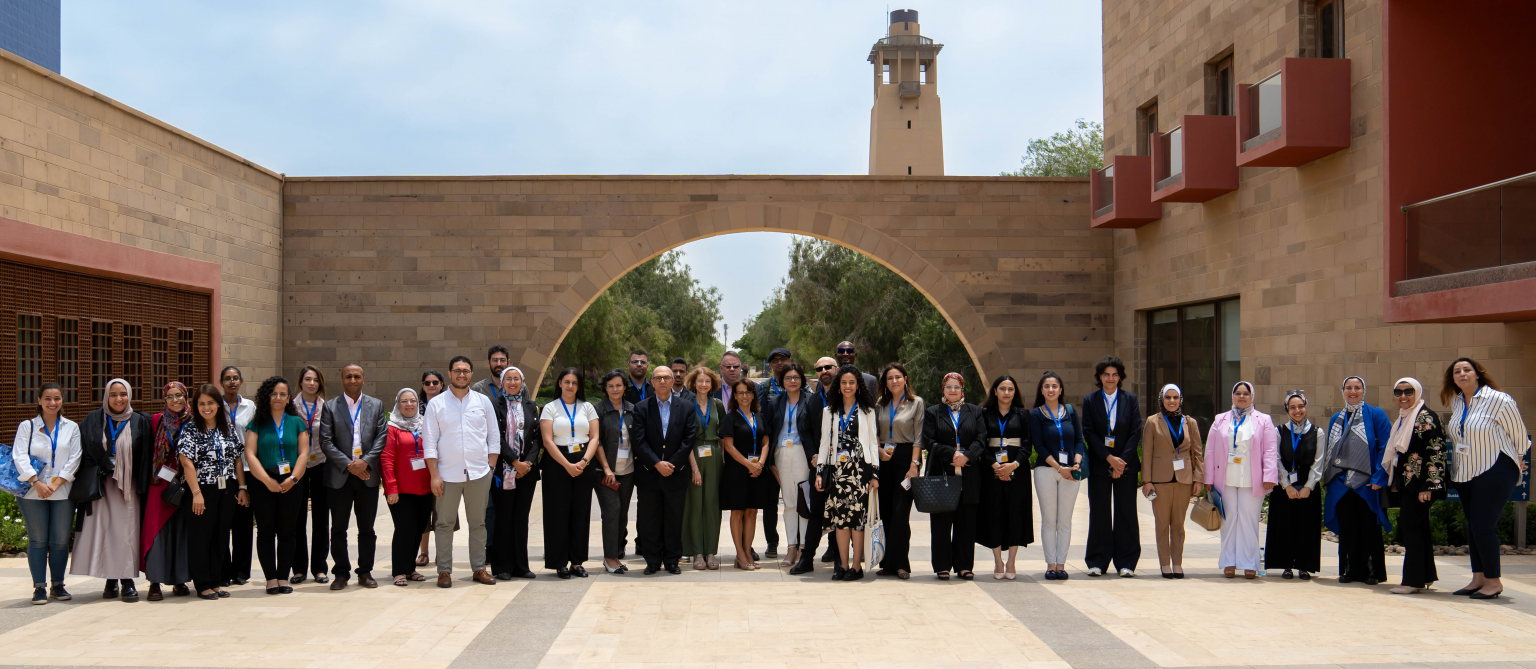
I then attended two very relevant events. On 30 April-1 May, I was at a Workshop on Driving Adoption of Worker-Centric Data Enrichment Guidelines and Principles, organised by Partnership on AI (PAI) and Fairwork in New York city to bring together representatives of AI companies, data vendors and platforms, and researchers. The goal was to discuss options to improve working conditions from the side of the employers and intermediaries. On 28 May, I was in Cairo, Egypt, to attend the very first conference of the Middle East and Africa chapter of INDL (International Network on Digital Labour), the research network I co-founded. It was a fantastic opportunity to start opening the network to countries that were less present before, and whose voices we would like to hear more.
August is a quieter month (but I greatly enjoyed a session at the Paralympics in Paris!), so I’ll jump to September. Lots of activities: a trip to Cambridge, UK, and a workshop on disinformation at the Minderoo Centre for Technology and Democracy; a workshop on Invisible Labour at Copenhagen Business School in Denmark; and a one-day conference on gender in the platform economy in Paris. Another publication came out: a journal article, in Spanish, on Argentinean platform data workers.
At the end of October, and until mid-November, I travelled to Chile for the seventh conference of the International Network on Digital Labour (INDL-7), which I co-organised. It was an immensely rewarding experience. I took the opportunity to strengthen my linkages and collaborations with colleagues there. It was a very intense, and super-exciting, time: after INDL-7 (28-30 October), I spent a week in Buenos Aires, Argentina, where I co-presented work in progress at the XV Jornadas de Estudios Sociales de la Economía, UNSAM. I then returned to Chile where I gave a keynote at the XI COES International Conference in Viña del Mar, Chile, on 8 November, and another at the ENEFA conference in Valdivia (Chile) on 14 November. I also gave a talk as part of the ChiSocNet series of seminars in Santiago, 11 November.
Last week with the Diplab team, we spent two exciting days at the European Parliament in Brussels, engaging in profound discussions with and about platform workers as part of the 4th edition of the Transnational Forum on Alternatives to Uberization.
Together, we delved into the intricacies of the human labor that fuels artificial intelligence and ensures safe participation to social media. Together, we discussed workers’ expectations, concerns and common struggles to move forward toward a world in which where technology serves all humans equally and responsibly.
Digital labor is at the heart of our evolving economies. To address the specific challenges and developments in the Middle East and Africa (MEA), we are launching a dedicated chapter of INDL for the region.
This conference provides a unique platform to present research related to the MEA region, both ongoing and/or burgeoning. The conference offers opportunities for scholars and practitioners to engage with topics such as platformization, automation, gig economy dynamics, and technology-mediated labor.
INDL-MEA will feature three tracks: one in Arabic, one in English, and one in French, reflecting the linguistic diversity of the region.
Topics
Submissions must be in reference to the MEA region, for instance: in perspective, case studies, or focus.
Submission topics may include but are not limited to
Case studies examining platforms, gig economy workers, and online digital labor in MEA
Exploring algorithmic management practices in work processes, recruiting, and HR in MEA
Issues of digital platform labor on gender and inclusion in the MEA region
Consequences of the shift to digital labor on workers, businesses, economies, and labor markets in MEA
Effects of remote work and digital labor on employee well-being and productivity in MEA
Policy responses to the rise of digital labor and automation in MEA, including regulatory measures and government intervention
Strategies for organizing digital workers and managing geographically distributed workforces in MEA
Intersectional perspectives on digital labor in MEA
Exploring AI and digital labor through a decolonial lens in MEA
Challenges posed by Generative AI to human labor in MEA
Submissions
We invite submissions of anonymized abstracts for papers, case studies, and policy briefs related to these topics. Abstracts, up to 500 words, can be submitted in Arabic, English, or French through our website INDL-MEA.
Important Dates
Deadline for submissions: January 31, 2024
Acceptance notification: February 15, 2024
Registration opens: TBA
INDL-MEA conference date: May 28, 2024
Together, let’s foster a thought-provoking dialogue and contribute to shaping the future of digital labor in the Middle East and Africa.
For more information, please see the INDL website.
I’m sooo glad to be in Berlin for the 6th edition of this beloved INDL-6 conference, which is taking place at Weizenbaum Institut!
INDL started as a small-scale, informal, little-funded project, aiming to create linkages between academics and students interested in the transformations of labour brought about by digital technologies. We first met in Paris in Spring 2017, then in Louvain-la-Neuve (Belgium) a few months later, and in both cases, a smallish 20-people room was enough for all. Back then, we called ourselves ENDL (where E stood for “European”).
But in 2019, we partnered with Toronto-based colleagues and upgraded to INDL, moving from European to International level. We started a cycle of conferences which initially remained rather small-scaled, and for two years had to take place online owing to the pandemic crisis. Things started to change in 2022, when colleagues from Greece proposed to restart an in-person version of the conference which eventually took place in Athens. It was also the first time that we launched a call for papers, rather than just limiting ourselves to invited speakers, and the conference was a huge success, with almost a hundred participants and sessions running in parallel.
This year edition’s follows the same format, and I’m so happy to see that a large community is forming around this topic. It’s good to see some people who already attended last year or even before, together with many new faces, and numbers continuing to grow (this year, we have three instead of just two parallel sessions!).
Together with the parallel sessions, this year’s event includes three keynotes, an arts-meets-science session, and a regulation-oriented debate on due diligence processes and the technology supply chain. Weizenbaum Institut is a wonderful place and has made available funding, support, and an incredibly committed team of colleagues, students, and volunteers who are making this conference a success.
For the programme, link to the livestreaming of plenaries and main sessions, and further information, please see indl.network.
Estoy muy emocionada y feliz de empezar un ciclo de charlas en Chile, principalmente en Santiago y Talca, con Antonio A. Casilli este mes de enero. Agradezco mucho a la Embajada de Francia en Chile, al Instituto Francés de Chile, y a la Fundación Teatro a Mil por esta oportunidad maravillosa. Gracias también a Juana Torres Cierpe y a Francisca Ortiz Ruiz por su ayuda en contactar con colegas, amigos y estudiantes de Chile.
Empezaremos por una charla titulada “Plataformas digitales, trabajo en línea y automatización tras la crisis sanitaria”, que tendrá lugar el día lunes 16 de enero a las 12:00 hrs en la sede de la CUT (1 oriente # 809, Talca). En esta charla presentaremos nuestras investigaciones sobre el fenómeno del micro-trabajo fuertemente precarizado que se desarrolla en las plataformas digitales. Agradezco mucho a la profesora Claudia Jordana Contreras y a la Escuela de Sociología de la Universidad Católica del Maule por la organización de este evento.
El martes 17 enero 2023, 11:00, hablaré de “Inteligencia artificial, transformaciones laborales y desigualdades: El trabajo de las mujeres en las plataformas digitales de ‘microtareas” en el Instituto de Sociología de la Universidad Católica y con el Quantitative and Computational Social Science Research Group. Gracias a Mauricio Bucca que ha organizado este evento. Estaremos en la Pontificia Universidad Católica de Chile, Campus San Joaquín.
El martes 17 por la tarde (a las 17:000 hrs), hablaré de “Ética de la inteligencia artificial y otros desafíos para la investigación sobre redes sociales” como parte de la Escuela de Verano del Centro de Investigación en Complejidad Social, Universidad del Desarrollo. Agradezco a Jorge Fábrega Lacoa y sus colegas para la organización.
El viernes 20 de enero 2023, a las 10:00 hrs, Antonio y yo hablaremos juntos de “El trabajo detrás de la inteligencia artificial y la automatización en América Latina” en un taller internacional organizado por la Universidad de Chile – con Pablo Pérez (gracias por la organización!) y Francisca Gutiérrez, sala 129, FASCO, Av. Ignacio Carrera Pinto 1045, Ñuñoa.
Sigue un evento organizado por el Instituto Francés, “La noche de las ideas”:
This week, I was pleased and honoured to give a keynote speech at wonderful EUSN2021 (European Social Networks 2021) conference. The event was originally planned in beautiful Naples, but was unfortunately moved online because of pandemic-induced uncertainties.
In my talk, I endeavoured to reconcile the tradition of research on social and organizational network analysis – in which I have been trained, and which constitutes the specialism of most participants to EUSN conferences – with the nascent literature on digital platform labour. Indeed, organizational network studies have shaped my (and many other colleagues’) understanding of how social ties and structures drive collective action and shape its outcomes. However, contemporary computing technologies breed novel sociabilities and organizational modes that disrupt established practices and knowledge. In particular, the emergence of digital platforms as market intermediaries constitutes a puzzle for network researchers. These emerging organizational structures loosen individual-organization links, fragment production processes, individualize sub-contracting, extend competition beyond the local level, and threaten jobs with AI-fuelled automation. My question then is: in these environments where isolation dominates and collaboration fades, how do social networks operate, if at all? And how can we, as researchers, apprehend them?
In my talk, I discussed how digital platforms, and the transformations of work processes they trigger, challenge some of the key tenets of organizational network analysis. Yet there is still much to learn from this tradition, and the limited overlaps with the nascent literature on platforms reveal facets that neither of them, alone, could capture. This analysis also confirms that overall, technology-enabled platform intermediation restrains sociability and limits interactions, but specific cases where networking has been possible highlight the fundamental advantages it brings to workers.
On this basis, I outlined directions for future research and policy action.
Many thanks to the organizers who still did a wonderful job despite the online-only mode, and to all attendees for inspiring questions and feedback.



 El 12 de mayo, participé en la conferencia “

 Los días 16 y 17 de mayo participé en tres paneles organizados en el marco de la
  El 20 de mayo, di una charla sobre “






 Data Big and Small