Sunbelt 2025 in Paris: inequalities, weak ties, and networked markets

I am attending a faboulous Sunbelt conference, taking place this year in Paris. I am deeply grateful to Emmanuel Lazega who made gigantic efforts to bring this important conference to France, after a failed attempt in 2020 when the Covid-19 pandemic brought everything online.

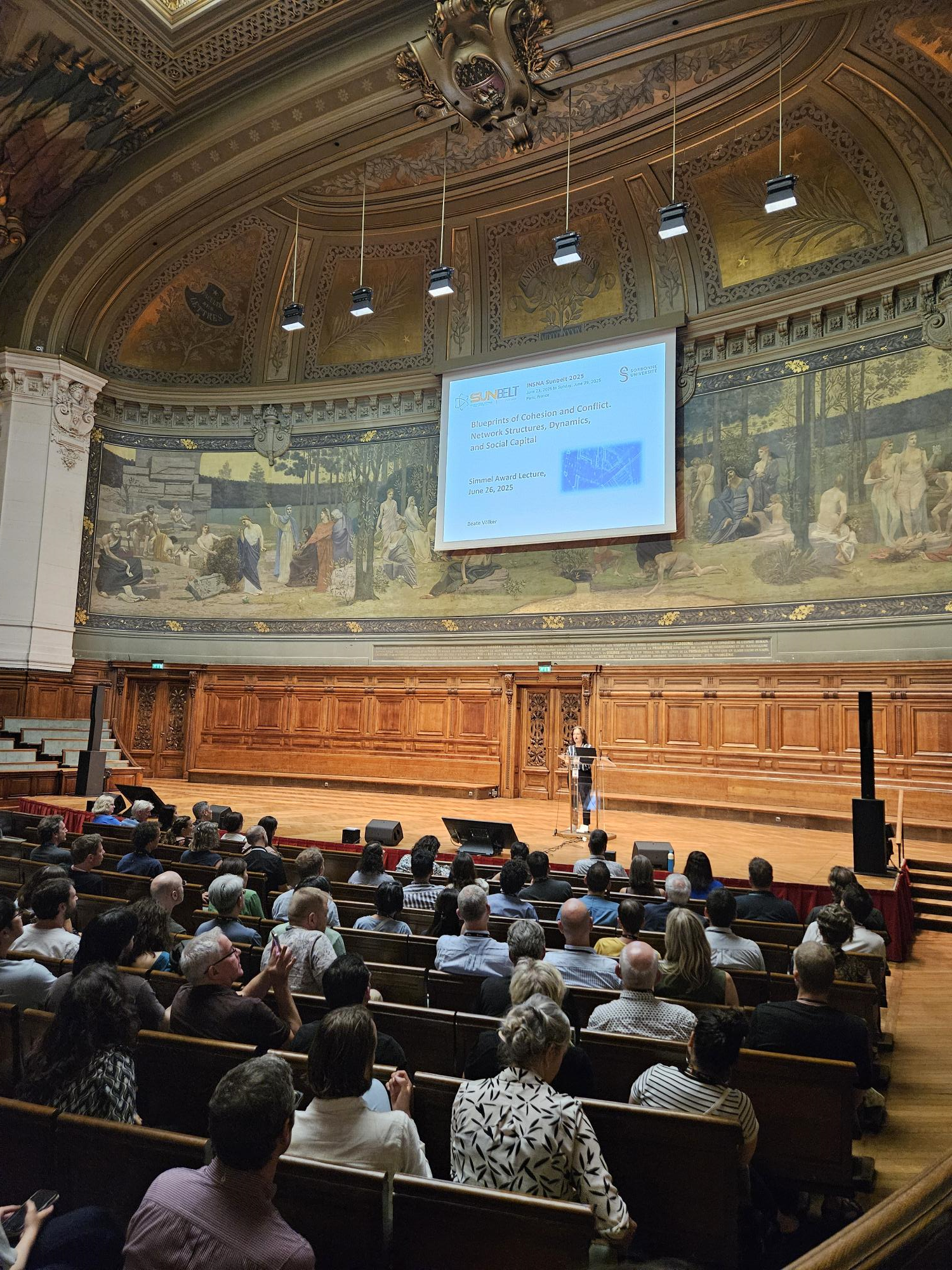
Yesterday, a very inspiring keynote by Beate Völker reminded us of the importance of weak ties and even absent ties – not only to smoothen the functioning of job markets but also, more surprisingly, to achieve social cohesion. The keynote took place in the historical Grand Amphithéâtre de la Sorbonne.
I am pleased to have contributed to a set of initiatives in honour of great network sociologist Harrison White, one year after his death. With Elise Penalva-Icher and Fabien Eloire, we presented a paper on digital platforms in White-like producer markets shaped by networks (more on it soon!). The paper was part of a dedicated session on the legacy of Harrison White. There was also a plenary in memoriam, where his former students and friends shared thoughts and stories. (Another plenary honoured Barry Wellman).

I was also honoured to be invited, today, to join a plenary panel on social networks and the study of social inequalities, organized by Gianluca Manzo. While most research on inequalities is attribute-based, social network approaches provide a powerful alternative (or perhaps, complement), highlighting how interpersonal, relational mechanisms generate patterns that over time, lock categorical differences into durable gaps in wealth, status, or other outcomes. We discussed complementarities and differences between these two approaches, the advantages of a network-oriented perspective, but also the methodological challenges that come with it.

On Sunday, I’ll present a paper that also deals with inequalities, in the specific case of online platform workers. We define an index of ‘vulnerability’ to unveil inequalities within this worker population in two countries, France and Spain. The paper develops and deeps results of a previous work, whose first outputs served to inform policy decisions in France.

Another paper to which I have contributed, and which will be presented at this Sunbelt, is more methodological and is the result of a collective effort. We analyze over 20 years of publications in the journal REDES and highlight how researchers have reported relational data from both personal and complete networks. We identify key challenges in the consistency and transparency of reporting and propose 7 practical recommendations to improve clarity, comparability, and replicability in social network research. This paper is already published in REDES.

Uninvited protagonists: the social networks of Venezuelan AI data workers

After years of work, the long-awaited good news: my article ‘Uninvited Protagonists: The Networked Agency of Venezuelan Platform Data Workers‘, co-authored with Juana Torres-Cierpe, has just been published in New Technology, Work and Employment!

Workers in Venezuela are powering AI production, often under tough conditions. Sanctions and a deep political-economic crisis have pushed them to work for platforms that pay in US dollars, albeit at low rates. They constitute a large reservoir for technology producers from rich countries. But they are not passive players.

They build resilience, rework their environment, and sometimes engage in acts of resistance, with support from different segments of their personal networks. From strong local ties to loose online connections, these informal webs help them cope, adapt, and occasionally push back. Their diversified relationships comprise an unofficial and often hidden, albeit largely digitised relational infrastructure that sustains their work and shapes collective action.

These findings invite to rethink agency as embedded in workers’ personal networks. To respond to adversities, one must liaise with equally affected peers, with family and friends who offer support, etc. Social ties ultimately determine who is enabled to respond, and who is not; whether any benefits and costs are shared, and with whom; whether any solution will be conflictual or peaceful. Social networks are not accessory but constitute the very channel through which Venezuelan data workers cope with hardship.

Not all relationships play the same role, though. Venezuelans discover online data work through their strong ties with family, close friends, and neighbours. To convert their online earnings into local currency, they rely on their broader social networks of relatives and friends living abroad and indirect relationships with intermediaries. For managing their day-to-day activities, Venezuelans expand their social networks through online services like Facebook, WhatsApp, and Telegram, connecting with diverse and less-close peers within and outside the country. Different social ties affect the various stages of the data working experience.

Overall, no Venezuelan could work alone – and the networked interactions that sustain each of them against hardship have made them massively present, as ‘uninvited protagonists,’ in international platforms. Their massive presence in the planetary data-tasking market is a supply rather than demand-driven phenomenon.

This analysis also sheds light on the reasons why mobilisation is uncommon among platform data workers. Other studies noted diverging orientations of workers, unclear goals, lack of focus, and insufficient leadership. Another powerful reason hinges upon the predominance of weak ties in building up online group membership: indeed, distant acquaintances are insufficient to prompt people to action if their intrinsic motivations are low.

The article is available in open access here.

Ciclo de charlas en Chile sobre inteligencia artificial, trabajo y redes sociales

Estoy muy emocionada y feliz de empezar un ciclo de charlas en Chile, principalmente en Santiago y Talca, con Antonio A. Casilli este mes de enero. Agradezco mucho a la Embajada de Francia en Chile, al Instituto Francés de Chile, y a la Fundación Teatro a Mil por esta oportunidad maravillosa. Gracias también a Juana Torres Cierpe y a Francisca Ortiz Ruiz por su ayuda en contactar con colegas, amigos y estudiantes de Chile.

Empezaremos por una charla titulada “Plataformas digitales, trabajo en línea y automatización tras la crisis sanitaria”, que tendrá lugar el día lunes 16 de enero a las 12:00 hrs en la sede de la CUT (1 oriente # 809, Talca). En esta charla presentaremos nuestras investigaciones sobre el fenómeno del micro-trabajo fuertemente precarizado que se desarrolla en las plataformas digitales. Agradezco mucho a la profesora Claudia Jordana Contreras y a la Escuela de Sociología de la Universidad Católica del Maule por la organización de este evento.

El martes 17 enero 2023, 11:00, hablaré de “Inteligencia artificial, transformaciones laborales y desigualdades: El trabajo de las mujeres en las plataformas digitales de ‘microtareas” en el Instituto de Sociología de la Universidad Católica y con el Quantitative and Computational Social Science Research Group. Gracias a Mauricio Bucca que ha organizado este evento. Estaremos en la Pontificia Universidad Católica de Chile, Campus San Joaquín.

El martes 17 por la tarde (a las 17:000 hrs), hablaré de “Ética de la inteligencia artificial y otros desafíos para la investigación sobre redes sociales” como parte de la Escuela de Verano del Centro de Investigación en Complejidad Social, Universidad del Desarrollo. Agradezco a Jorge Fábrega Lacoa y sus colegas para la organización.

El martes 17 a las 10:000 hrs, también habrá una ponencia de Antonio Casilli en el evento Congreso Futuro: “Trabajo global y inteligencia artificial. Los ‘ingredientes humanos’ ed la automatización” (Teatro Oriente, Pedro de Valdivia 099, Providencia).

El viernes 20 de enero 2023, a las 10:00 hrs, Antonio y yo hablaremos juntos de “El trabajo detrás de la inteligencia artificial y la automatización en América Latina” en un taller internacional organizado por la Universidad de Chile – con Pablo Pérez (gracias por la organización!) y Francisca Gutiérrez, sala 129, FASCO, Av. Ignacio Carrera Pinto 1045, Ñuñoa.

Sigue un evento organizado por el Instituto Francés, “La noche de las ideas”:

Viernes 20 enero 2023, 20:00 hrs, Centro cultural La Moneda, Noche de las Ideas, Santiago — Paola Tubaro “Automatización: ¿El fin del humano?” (con con Denis Parra y Javier Ibacache, Plaza de la Ciudadanía 26, Santiago).

Sabado 21 enero 2021, 16:00 hrs, Centro cultural La Moneda, Noche de las Ideas, Santiago — Antonio Casilli “¿Qué esconde la inteligencia artificial?” (con José Ulloa, Constanza Michelson y Paula Escobar, Plaza de la Ciudadanía 26, Santiago).

El miércoles 26 de enero 2023, a las 18:30 hrs en Santiago, habrá la presentación del libro de Antonio Casilli, “Esperando a los robots. Investigación sobre el trabajo del clic” (LOM, 2021) (con Paulo Slachevsky, Librería del Ulises Lastarria, José Victorino Lastarria 70, local 2, Paseo Barrio Lastarria).

Todos los eventos son gratuitos. Para la Noche de las Ideas y el Congreso Futuro, es necesario inscribirse online.

Pathways in Network Science

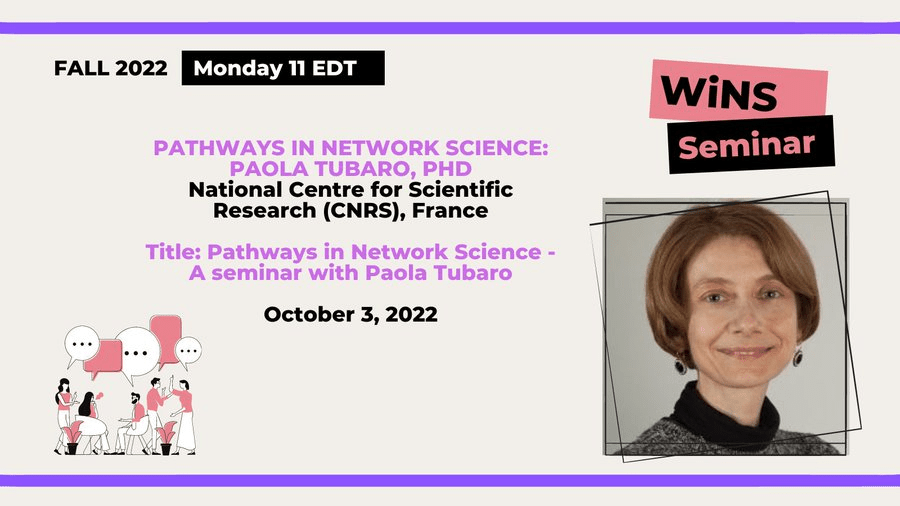
I’m happy and honoured to speak today at the “Pathways in Network Science” online seminar of the Women in Network Science (WiNS) group.

Pathways in Network Science aims to give the stage to women and nonbinary researchers in network science to share their career paths or some pertinent aspects of it. Presentations can be a summary of the research topics explored along a speaker’s career path or even an autobiographical presentation about how opportunities and challenges influenced her aspirations and impacted her career path. It can also include discussing gender-related challenges and experience with individual strategies and/or systemic changes.

I’ll talk about myself in terms of mobility – both geographic and disciplinary – and the challenges and opportunities it represented. I’ll also talk about resilience – or how network science helped me to make true my dream of devoting my life to research. I’ll mention impact – or how to think of the place of science in society, and how network research can lead to positive change. I’ll conclude with the challenges ahead – and how they are not only scientific, but also deeply human and social.

The visualization of personal networks

I am pleased to co-organize with Vincent Lorant of UCLouvain a special session on “The visualization of personal networks” at the forthcoming INSNA Sunbelt conference (12-16 July 2022, Cairns, Australia, and online).

Personal network data collection methods allow describing the composition and the structure of an individual’s (hereafter ego) social network. This method has been implemented in different domains such as migration, drug use, mental health, aging, education, and social welfare. Over the last years, these data have also been used to provide respondents with visualizations of their personal network, using different algorithms and customizing results through computer assisted data collection. Visualization gives valuable feedback to the respondent, improves data validity and may trigger positive behavioural changes, notably in vulnerable individuals or groups. Yet, visualization is not a free lunch. Recent research has evidenced the ethical dilemmas of providing such feedback to individuals: ego’s social life is being exposed, the researcher may be exposed as well, and such feedback may imply some contractual exchanges or therapeutic implications that require attention.

This session aims to describe the stakes of different visualization approaches to personal networks with different populations. We welcome qualitative and quantitative papers addressing issues related to the implementation of visualization or reports of personal networks in terms of techniques, levels of respondent’s satisfaction with visualization, conditions under which visualization is recommended or discouraged, and effects of the personal network visualization for the respondent.

More information on the conference and the submission process is available here.

Networks in the digital organization

This week, I was pleased and honoured to give a keynote speech at wonderful EUSN2021 (European Social Networks 2021) conference. The event was originally planned in beautiful Naples, but was unfortunately moved online because of pandemic-induced uncertainties.

In my talk, I endeavoured to reconcile the tradition of research on social and organizational network analysis – in which I have been trained, and which constitutes the specialism of most participants to EUSN conferences – with the nascent literature on digital platform labour. Indeed, organizational network studies have shaped my (and many other colleagues’) understanding of how social ties and structures drive collective action and shape its outcomes. However, contemporary computing technologies breed novel sociabilities and organizational modes that disrupt established practices and knowledge. In particular, the emergence of digital platforms as market intermediaries constitutes a puzzle for network researchers. These emerging organizational structures loosen individual-organization links, fragment production processes, individualize sub-contracting, extend competition beyond the local level, and threaten jobs with AI-fuelled automation. My question then is: in these environments where isolation dominates and collaboration fades, how do social networks operate, if at all? And how can we, as researchers, apprehend them?

In my talk, I discussed how digital platforms, and the transformations of work processes they trigger, challenge some of the key tenets of organizational network analysis. Yet there is still much to learn from this tradition, and the limited overlaps with the nascent literature on platforms reveal facets that neither of them, alone, could capture. This analysis also confirms that overall, technology-enabled platform intermediation restrains sociability and limits interactions, but specific cases where networking has been possible highlight the fundamental advantages it brings to workers.

On this basis, I outlined directions for future research and policy action.

Many thanks to the organizers who still did a wonderful job despite the online-only mode, and to all attendees for inspiring questions and feedback.

HDR Paola Tubaro

(English version below)

J’ai le plaisir d’annoncer la soutenance de mon habilitation à diriger des recherches en sociologie intitulée :

Décrypter la société des plateformes: Organisations, marchés et réseaux dans l’économie numérique.

Cette soutenance aura lieu le mercredi 11 décembre 2019 à Sciences Po Paris, 9 rue de la chaise, salle 931, à 10h00.

Si vous souhaitez venir, merci de confirmer votre présence grâce à ce lien car les personnes externes à Sciences Po ne pourront pas accéder à la salle si elles ne sont pas annoncées.


Le jury sera composé de :

  • M. Gilles Bastin, Professeur des universités, IEP de Grenoble (rapporteur)
  • M. Rodolphe Durand, Professeur, HEC Paris
  • M. Emmanuel Lazega, Professeur des universités, IEP de Paris (garant et rapporteur)
  • Mme Béatrice Milard, Professeure des universités, Université de Toulouse Jean Jaurès (rapporteure)
  • M. José Luís Molina González, Professeur, Universitat Autònoma de Barcelona
  • M. Tom A.B. Snijders, Professeur, Rijksuniversiteit Groningen

La soutenance sera suivie d’un pot. 

Résumé

Le manuscrit original conceptualise la récente montée en puissance des platesformes numériques selon trois dimensions principales : leur nature de dispositifs de coordination alimentés par les données, les transformations du travail qui en découlent, et les promesses d’innovation sociétale qui les accompagnent. L’ambition globale est de décortiquer le rôle de coordination de la plateforme et sa position à l’horizon de la dualité classique entreprise – marché. Il s’agit aussi de comprendre précisément comment elle utilise les données pour ce faire, où elle amène le travail, et comment elle gère des projets d’innovation sociale. Je prolonge cette analyse pour faire apparaître la continuité entre la société actuelle dominée par les plateformes et la « société organisationnelle », montrant que les plateformes sont des structures organisées qui distribuent les ressources, produisent des asymétries de richesse et de pouvoir, et repoussent l’innovation sociale vers la périphérie du système. Je discute des implications de ces tendances pour les politiques publiques, et propose des pistes pour la recherche future. 


I am pleased to announce the defense of my habilitation to direct research in sociology entitled:


Decoding the platform society: Organizations, markets and networks in the digital economy


This defense will take place on Wednesday, 11 December 2019 at Sciences Po Paris, 9 rue de la chaise, room 931, at 10am.


If you wish to attend, please confirm your presence through this link because people who are external to Sciences Po will be denied access to the room if they are not announced.

Members of the jury are:

  • Prof. Gilles Bastin, IEP de Grenoble (referee)
  • Prof. Rodolphe Durand, HEC Paris
  • Prof. Emmanuel Lazega, IEP de Paris (advisor and referee)
  • Prof. Béatrice Milard, Université de Toulouse Jean Jaurès (referee)
  • Prof. José Luís Molina González, Universitat Autònoma de Barcelona
  • Prof. Tom A.B. Snijders, Rijksuniversiteit Groningen

There will be drinks after the defense.


Abstract

The original manuscript conceptualizes the recent rise of digital platforms along three main dimensions: their nature of coordination devices fueled by data, the ensuing transformations of labor, and the accompanying promises of societal innovation. The overall ambition is to unpack the coordination role of the platform and where it stands in the horizon of the classical firm – market duality. It is also to precisely understand how it uses data to do so, where it drives labor, and how it accommodates socially innovative projects. I extend this analysis to show continuity between today’s society dominated by platforms and the “organizational society”, claiming that platforms are organized structures that distribute resources, produce asymmetries of wealth and power, and push social innovation to the periphery of the system. I discuss the policy implications of these tendencies and propose avenues for follow-up research.

Call for papers: “Recent Ethical Challenges in Social Network Analysis”

Submissions are now invited for a special section of the journal Social Networks on “Recent Ethical Challenges in Social Network Analysis” (guest-edited by myself with Antonio A. Casilli, Alessio D’Angelo, and Louise Ryan).

Research on social networks raises formidable ethical issues that often fall outside existing regulations and guidelines. State-of-the-art tools to collect, handle, and store personal data expose both researchers and participants to new risks. Political, military and corporate interests interfere with scientific priorities and practices, while legal and social ramifications of studies of personal ties and human networks come to the surface.

The proposed special section aims to critically engage with ethics in research related to social networks, specifically addressing the challenges that recent technological, scientific, legal and political transformations trigger.

Following a successful workshop on this topic that was held in December 2017 in Paris, we welcome submissions that critically engage with ethics in research related to social networks, possibly based on reflective accounts of first-hand experiences or case studies, taken as concrete illustrations of the general principles at stake, the attitudes and behaviors of stakeholders, or the legal and institutional constraints. We are particularly interested in novel, original answers to some unprecedented ethical challenges, or the need to re­interpret norms in ambiguous situations.

The full Call for Papers is available here.