Sociology of AI, Sociology with AI (1)

There are two main ways in which a discipline like sociology engages with artificial intelligence (AI) and is affected by it. The sociology of AI understands technology as embedded in socio-economic systems and takes it as an object for research. Sociology with AI indicates that the discipline is also integrating AI into its methodological toolbox. Based on a talk that I gave at this year’s annual meeting of the European Academy of Sociology, I’ll give in what follows a brief overview of both. As a disclaimer, I have no pretention to be exhaustive. To narrow down the topic, I have chosen to focus on sociology specifically (rather than neighboring fields), and to rely only on already published, peer-reviewed research.

Anne Fehres and Luke Conroy & AI4Media, “Data is a Mirror of Us”/ https://betterimagesofai.org / https://creativecommons.org/licenses/by/4.0/

Let’s start with the sociology of AI, which I’ll illustrate with the help of the above artwork. Its aim is to demonstrate that even if there is a sense of magic in looking at the outputs of an AI system, the data on which it is based has a human origin. This work explores this idea through the symbolism of the mirror and reflection: beyond the magic, these outputs are a reflection of society. Sociological perspectives matter because they can help bring these social and human origins to the fore. In 2021, Kelly Joyce and her coauthors called for more engagement of sociologists in outlining a research agenda around these topics. Compared to other disciplines, we have a thicker understanding of the intersectional inequalities and social structures that interact with AI.

However, it was not sociology that initiated the conversation on these issues. Disciplines like computer science itself, communication, philosophy, and the arts shaped the debate. Landmark contributions were, among other things, a 2016 influential journalistic report about discrimination in predictive police applications, a 2018 computer science article on gender and race discrimination in face recognition, and an artistic project which, also in 2018, described Amazon Echo as an anatomical map of human labor, data and planetary resources. Conferences like ACM’s FaccT have become reference venues for these analyses. For clarity, some of the contributors to these debates are indeed sociologists but the discipline’s infrastructure of conferences, journals and institutions, has been less responsive.

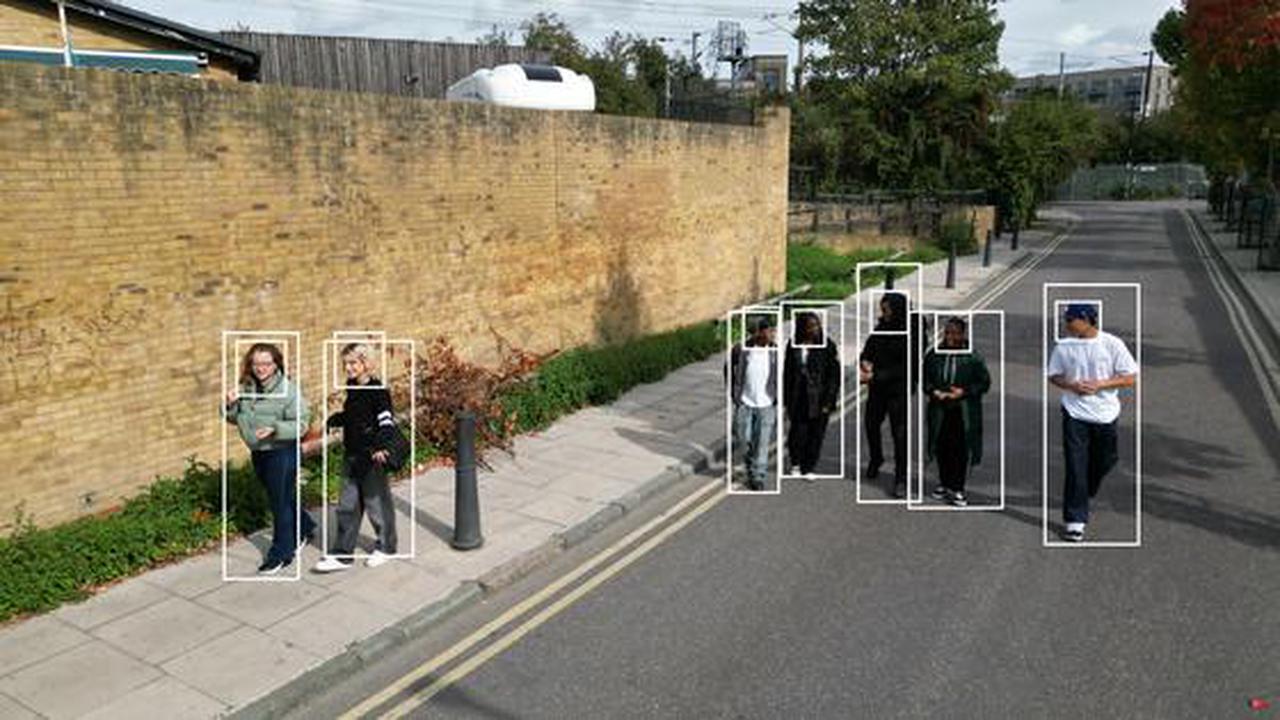
Why does the quasi-absence of sociology matter? I’ll answer this question through a 2022 paper, written by two sociologists but published in a computer science conference. The starting point is that early studies framed AI-related societal problems in terms of bias. For example, the above-mentioned report on predictive policing was entitled “machine bias”. This language points to technical corrections as remedy, but it cannot account for the social processes underway that comprise, among other things, increasing surveillance and privacy intrusion to collect more and more data (see image below). De-biasing may thus be insufficient to prevent injustice or inequality. A sociologically informed approach reveals that key questions are about power: who owns data and systems, whose worldviews are being imposed, whose biases we are trying to mitigate.

Comuzi/ ‘’SurveillanceView’’ / https://betterimagesofai.org / © BBC / https://creativecommons.org/licenses/by/4.0/

In recent years, more substantial contributions have been made within sociology. For example, there was a special issue of Socius last year on “Sociology of Artificial Intelligence”, and another one is forthcoming in Social Science Computer Review, entitled “What is Sociological About AI?. I’ll mention a non-exhaustive selection of topics and findings. First, sociologists have recognized the hype – or how financial, political, and other interests have boosted the circulation of (often) exaggerated claims. This means shifting the gaze from AI as an intellectual endeavor, to see AI as a market – where bubbles can, well, form. This also means recognizing the political dimensions of AI development, with many states using public funding as a crucial engine for innovation.

Second, AI practitioners engage in a form of social construction of morality to legitimate their approaches to AI. For example, some distance themselves from Big Tech capitalism, some insist on the benefits of some AI applications, most prominently in healthcare. These efforts ultimately shape which technologies gain visibility and attract capital investments. This is also a way through which they produce and sustain the AI bubble itself – a culturally embedded market phenomenon. Third, sociological analysis can move beyond the technological determinism of early AI critics to emphasize the social and institutional contexts within which such algorithmic decision-making systems are deployed. This brings to light forms of negotiation, adaptation, and resistance, which have more subtle effects on inequalities.

Nacho Kamenov & Humans in the Loop : “Data annotators labeling data” / https://betterimagesofai.org / https://creativecommons.org/licenses/by/4.0/

Fourth, there is labor. Beyond fears of job losses due to AI, sociological research has unveiled a growing labor demand to produce AI itself. This does not only include the work of elite engineers and computer scientists, but also the lower-level contributions of data annotators, content moderators, voice actors, transcriptors, translators, image labelers, prompt testers, and even very basic clickworkers. This work is typically outsourced and offshored, resulting in precarious working arrangements and low pay. The above photograph represents two workers who use this job as a means of livelihoods. Overall, there is no drop in employment levels, but a steady deterioration of working conditions and an accelarated shift of the power balance from labor to capital. AI affects the very labor that produces it.  

In sum, sociologists increasingly contribute to these conversations, although these topics are not prominent in the discipline’s flagship conferences and journals, and important knowledge gaps remain. The guest-editors of the forthcoming Social Science Computer Review special issue on “What is sociological about AI?” claim that “A sociological lens can render AI’s hidden processes legible, just as sociologists have done with complex and taken for granted social forces since the discipline’s inception”. They nevertheless note that “we neither have a robust concept of AI as a social phenomenon nor a holistic sociological discourse around it, despite vibrant and dynamic work in the area.” In passing, most extant studies rely on traditional methods, primarily surveys and fieldwork. This is not an issue in itself, but it highlights a disconnection with the sub-topic I’ll highlight in my next post – Sociology using AI as instrument.

A successful INDL-8 conference in Bologna

When we created ENDL (the European Network on Digital Labour), back in 2017, we booked a room with 17 places. A few days ago, the last conference of the network (which in the meantime has become INDL, replacing ‘European’ with ‘International’) hosted about 200 participants. Internationalisation has not only meant numerical growth, but also inclusion of a diverse range of voices: every year, we see more participants from countries that are often under-represented on the scientific scene, from India and South Africa to Argentina and Brazil. Participants have also diversified in another sense, too: if the majority have always been academics, it is a pleasure to see more and more workers, as well as labour organisers. This year, we could for example benefit from the presence of associations of data workers from Kenya, freelancers from France, and content moderators from Spain.

Participants to the INDL-8 conference, Saint-Cristina cloister, Bologna, IT, 10 September 2025.

A conference like this one is meant to give hope – hope of mutual understanding across countries and cultures, hope of dialogue across disciplines and fields, hope of connections between academic research and action. We worked together to ensure a welcoming environment for all, for instance by encouraging constructive comments, rather than sheer criticism, after each paper presentation. We also strived to keep costs down in order to make the conference free of charge, and with the DiPLab research programme, we could give a few small scholarships to promising presenters who might not have been able to travel otherwise.

Two speakers (M Francesco Sinopoli, Fondazione Di Vittorio, and Ms Kauna Malgwi, Uniglobal) at the plenary panel ‘Plenary panel: New Unionism, towards global alliances’, part of the INDL-8 Conference, DAMA Tecnopolo, Bologna, IT, 11 September 2025

Surely, problems remain. A couple potential participants had visa issues, while others had to cancel due to lack of funding. These problems weigh especially hard on people from emerging and lower-income countries outside Europe and North America. The future is also uncertain, as funding sources become increasingly dryer, and visa restrictions tighter. For this reason, the main INDL-9 conference next year (Geneva, ILO, 9-11 September 2026) will be accompanied by the growth of local chapters. The Middle-East and Africa area is preparing its second conference, this time online only, on 25-26 November. In the US, a one-day event will take place at Yale University on 29 April 2026. Colleagues in Chile and Argentina are launching a series of online events.

Closing keynote (Prof. Sandro Mezzadra, chair: Prof. Marco Marrone), Saint-Cristina Aula Magna, Bologna, IT, 12 September 2025

More information on the INDL-8 conference (including the full programme) is available here.

Sunbelt 2025 in Paris: inequalities, weak ties, and networked markets

I am attending a faboulous Sunbelt conference, taking place this year in Paris. I am deeply grateful to Emmanuel Lazega who made gigantic efforts to bring this important conference to France, after a failed attempt in 2020 when the Covid-19 pandemic brought everything online.

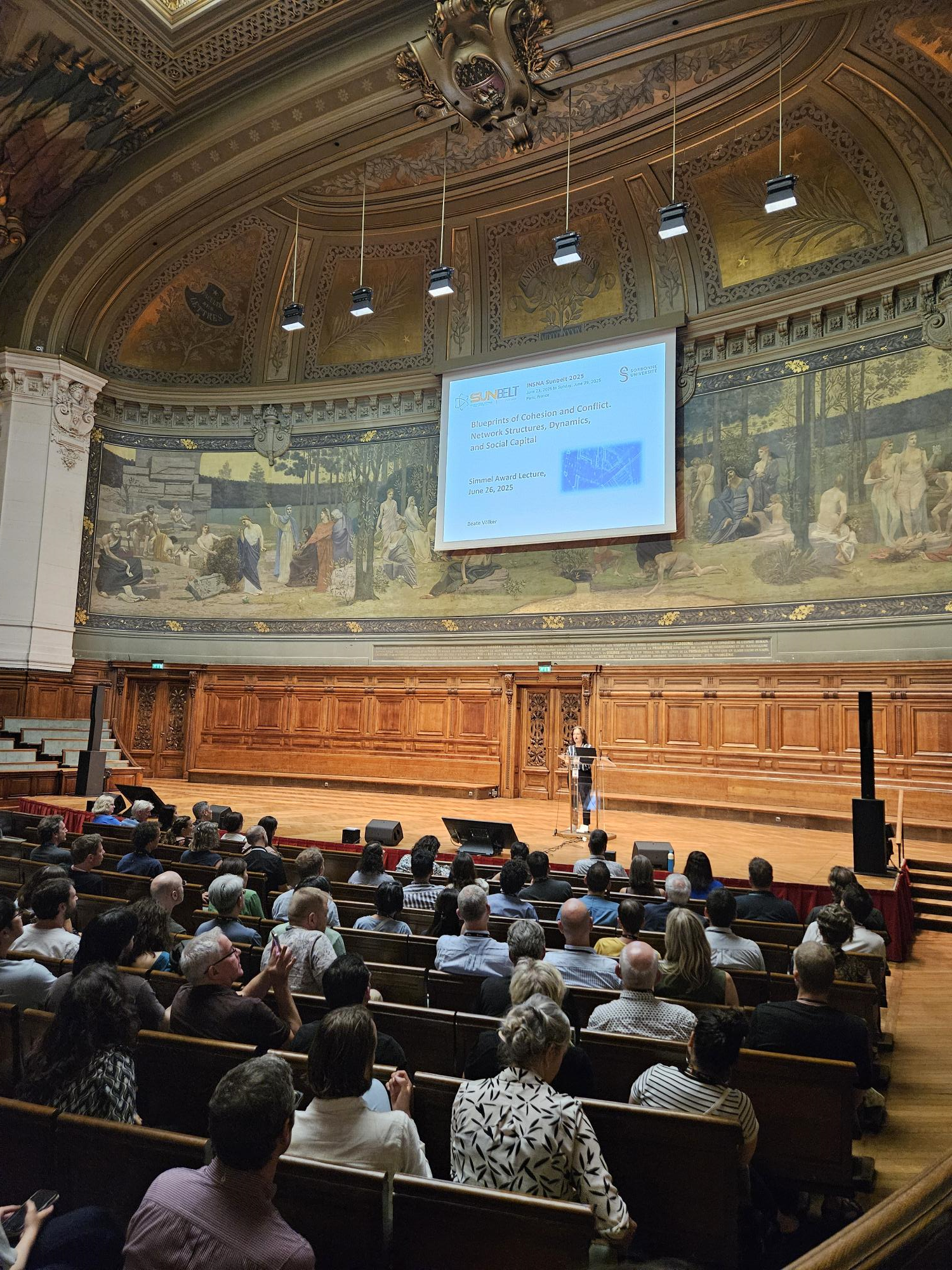
Yesterday, a very inspiring keynote by Beate Völker reminded us of the importance of weak ties and even absent ties – not only to smoothen the functioning of job markets but also, more surprisingly, to achieve social cohesion. The keynote took place in the historical Grand Amphithéâtre de la Sorbonne.

I am pleased to have contributed to a set of initiatives in honour of great network sociologist Harrison White, one year after his death. With Elise Penalva-Icher and Fabien Eloire, we presented a paper on digital platforms in White-like producer markets shaped by networks (more on it soon!). The paper was part of a dedicated session on the legacy of Harrison White. There was also a plenary in memoriam, where his former students and friends shared thoughts and stories. (Another plenary honoured Barry Wellman).

I was also honoured to be invited, today, to join a plenary panel on social networks and the study of social inequalities, organized by Gianluca Manzo. While most research on inequalities is attribute-based, social network approaches provide a powerful alternative (or perhaps, complement), highlighting how interpersonal, relational mechanisms generate patterns that over time, lock categorical differences into durable gaps in wealth, status, or other outcomes. We discussed complementarities and differences between these two approaches, the advantages of a network-oriented perspective, but also the methodological challenges that come with it.

On Sunday, I’ll present a paper that also deals with inequalities, in the specific case of online platform workers. We define an index of ‘vulnerability’ to unveil inequalities within this worker population in two countries, France and Spain. The paper develops and deeps results of a previous work, whose first outputs served to inform policy decisions in France.

Another paper to which I have contributed, and which will be presented at this Sunbelt, is more methodological and is the result of a collective effort. We analyze over 20 years of publications in the journal REDES and highlight how researchers have reported relational data from both personal and complete networks. We identify key challenges in the consistency and transparency of reporting and propose 7 practical recommendations to improve clarity, comparability, and replicability in social network research. This paper is already published in REDES.

Call for Abstracts: INDL-8 Conference in Bologna

It is my pleasure to announce that the call for abstracts for the upcoming INDL-8 conference is now open.

The conference reaches Italy this year. It will take place in the most ancient University in the western world, Bologna, on 10-12 September 2025.

The overarching topic of this year’s conference is ‘Contesting Digital Labor: Resistance, counteruses, and new directions for research’. The goal is to explore how platform workers navigate, challenge, and reshape algorithmic management systems while forging innovative forms of solidarity and collective action. We also aim to explore the perspectives that technological developments open for workers in order to escape everyday surveillance, to resist top-down control and to organise to defend their rights.

In addition to presentations that directly address these questions, we welcome proposals that analyse a broader range of issues related to digital labour.

To read the full Call and submit your abstract, please visit the conference management website.

The deadline is 27 April 2025.

NB: A small number of scholarships to partly cover travel/subsistence costs will be made available – stay tuned for more information.

NB2: The keynotes and plenaries will be announced very soon.

Please feel free to share with any scholars and postgraduate students who might be interested.

Cambridge

Today, I end my 3-month-and-half visit to Churchill College, University of Cambridge where I am a By-Fellow. It has been an amazingly enriching experience and I gratefully acknowledge financial support from the French Embassy in the United Kingdom. Colleges are special places where traditional elitism mixes with more modern tendencies toward openness and diversity. I think the great value of colleges rests in their deeply interdisciplinary culture – way beyond what one may find in university departments and research centres. In my short stay, I have had lots of mind-opening conversations with scholars from all domains (often while enjoying a nice meal together), always with the feeling that people listen and learn from each other rather than that sense of constant competition that I have often perceived when crossing disciplinary boundaries.


My by-fellowship would not have been possible without the support of Gina Neff and her colleagues at Minderoo Centre for Technology and Democracy who hosted me. They are doing extremely valuable work to rethink the social and environmental impact of technologies and to promote innovative and more sustainable ways forward. I was also honoured to collaborate with the team of Cambridge Digital Humanities, especially Anne Alexander who directs the Learning programme and invited me to give two sessions on social network analysis at the Social data School last June. Finally, I thank the director and the members of the CRASSH research centre (where Minderoo is based) who kindly welcomed me at their offices and gave me the opportunity to attend some of their recent events.

Research ethics in the age of digital platforms

I am thrilled to announce the (open access) publication of ‘Research ethics in the age of digital platforms‘ in Science and Engineering Ethics, co-authored with José Luis Molina, Antonio A. Casilli & Antonio Santos Ortega.


We examine the implications of the use of digital micro-working platforms for scientific research. Although these platforms offer ways to make a living or to earn extra income, micro-workers lack fundamental labour rights and ‘decent’ working conditions, especially in the Global South. We argue that scientific research currently fails to treat micro-workers in the same way as in-person human participants, producing de facto a double morality: one applied to people with rights acknowledged by states and international bodies (e.g. Helsinki Declaration), the other to ‘guest workers of digital autocracies’ who have almost no rights at all.

Ciclo de charlas en Chile sobre inteligencia artificial, trabajo y redes sociales

Estoy muy emocionada y feliz de empezar un ciclo de charlas en Chile, principalmente en Santiago y Talca, con Antonio A. Casilli este mes de enero. Agradezco mucho a la Embajada de Francia en Chile, al Instituto Francés de Chile, y a la Fundación Teatro a Mil por esta oportunidad maravillosa. Gracias también a Juana Torres Cierpe y a Francisca Ortiz Ruiz por su ayuda en contactar con colegas, amigos y estudiantes de Chile.

Empezaremos por una charla titulada “Plataformas digitales, trabajo en línea y automatización tras la crisis sanitaria”, que tendrá lugar el día lunes 16 de enero a las 12:00 hrs en la sede de la CUT (1 oriente # 809, Talca). En esta charla presentaremos nuestras investigaciones sobre el fenómeno del micro-trabajo fuertemente precarizado que se desarrolla en las plataformas digitales. Agradezco mucho a la profesora Claudia Jordana Contreras y a la Escuela de Sociología de la Universidad Católica del Maule por la organización de este evento.

El martes 17 enero 2023, 11:00, hablaré de “Inteligencia artificial, transformaciones laborales y desigualdades: El trabajo de las mujeres en las plataformas digitales de ‘microtareas” en el Instituto de Sociología de la Universidad Católica y con el Quantitative and Computational Social Science Research Group. Gracias a Mauricio Bucca que ha organizado este evento. Estaremos en la Pontificia Universidad Católica de Chile, Campus San Joaquín.

El martes 17 por la tarde (a las 17:000 hrs), hablaré de “Ética de la inteligencia artificial y otros desafíos para la investigación sobre redes sociales” como parte de la Escuela de Verano del Centro de Investigación en Complejidad Social, Universidad del Desarrollo. Agradezco a Jorge Fábrega Lacoa y sus colegas para la organización.

El martes 17 a las 10:000 hrs, también habrá una ponencia de Antonio Casilli en el evento Congreso Futuro: “Trabajo global y inteligencia artificial. Los ‘ingredientes humanos’ ed la automatización” (Teatro Oriente, Pedro de Valdivia 099, Providencia).

El viernes 20 de enero 2023, a las 10:00 hrs, Antonio y yo hablaremos juntos de “El trabajo detrás de la inteligencia artificial y la automatización en América Latina” en un taller internacional organizado por la Universidad de Chile – con Pablo Pérez (gracias por la organización!) y Francisca Gutiérrez, sala 129, FASCO, Av. Ignacio Carrera Pinto 1045, Ñuñoa.

Sigue un evento organizado por el Instituto Francés, “La noche de las ideas”:

Viernes 20 enero 2023, 20:00 hrs, Centro cultural La Moneda, Noche de las Ideas, Santiago — Paola Tubaro “Automatización: ¿El fin del humano?” (con con Denis Parra y Javier Ibacache, Plaza de la Ciudadanía 26, Santiago).

Sabado 21 enero 2021, 16:00 hrs, Centro cultural La Moneda, Noche de las Ideas, Santiago — Antonio Casilli “¿Qué esconde la inteligencia artificial?” (con José Ulloa, Constanza Michelson y Paula Escobar, Plaza de la Ciudadanía 26, Santiago).

El miércoles 26 de enero 2023, a las 18:30 hrs en Santiago, habrá la presentación del libro de Antonio Casilli, “Esperando a los robots. Investigación sobre el trabajo del clic” (LOM, 2021) (con Paulo Slachevsky, Librería del Ulises Lastarria, José Victorino Lastarria 70, local 2, Paseo Barrio Lastarria).

Todos los eventos son gratuitos. Para la Noche de las Ideas y el Congreso Futuro, es necesario inscribirse online.