Hierarchy, market or network? The disruptive world of the digital platform

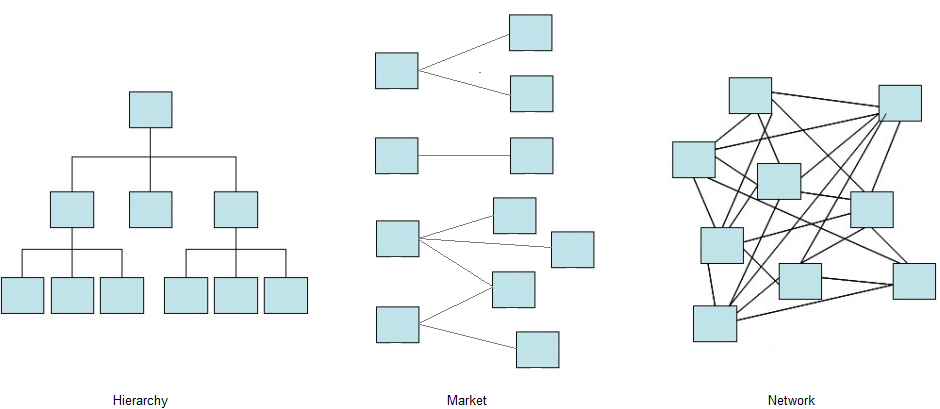
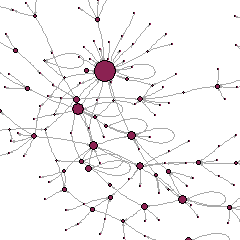
Economics traditionally considered firms and markets as two alternative ways of coordinating economic activities. Nobel prize winner Ronald H. Coase (1937) demonstrated that it all hinges on “transaction costs”, such as the need to search for a trade partner, the time needed to negotiate a contract, the legal expenses to draw it up and if necessary, to enforce it. When these costs are high, then hiring people in a firm is the right solution. When they are low, then a harmonious state will emerge spontaneously from the choices of independent, self-employed individuals. The difference, further emphasized by the work of Oliver Williamson, another Nobel, is between the world of bureaucracy, hierarchy and salaried work, and the world of the market and myriad micro-entrepreneurs.

This dichotomous description seemed reductive to economic sociologists, and Mark Granovetter (1985) pointed to social networks as coordination devices. Networks enable circulation of knowledge, formation of trust, emergence of shared norms in informal ways, thereby lowering costs and smoothing economic transactions. Walter W. Powell (1990) saw networks as an alternative to market and hierarchy, while others thought of it as a complement rather than a substitute. In some cases, the relevance of networks is flagrant: think of “collegial“, horizontal organizations such as legal partnerships, which are clearly not markets, and which have no vertical hierarchy either.

HierarchyMktNetwork

The rise of online platforms challenges these older views today. Powered by digital data and matching algorithms, platforms are meeting places for actors on the two sides of a market: riders and drivers (Uber, Lyft, BlaBlaCar), guests and hosts (Airbnb), buyers and sellers (eBay), and so on. Officially, platforms are intermediaries only, able to put in touch, say, those who need a lift and those who have a car, so that they can share the ride. Platforms don’t employ drivers and don’t own cars.

Platform

Continue reading “Hierarchy, market or network? The disruptive world of the digital platform”

Second European Social Networks Conference (EUSN 2016)

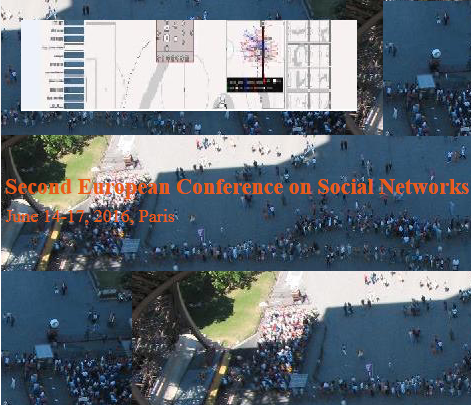
I am lucky enough to be part of the organizing committee of the second European Social Networks Conference, which will take place at Sciences Po Paris on 14-17 June 2016. The EUSN conferences have been created to offer a single place for the European community of social networks researchers to gather, in place of previous national annual conferences; and has been endorsed as a regional conference by INSNA, the international association of network researchers. A first, successful EUSN conference was held in Barcelona in 2014.

eusn2016_new

Somehow, the European social networks crowd seems more diverse than the US-based core of scholars who gave life to INSNA and drove its development over time. While remaining affectionate to the INSNA format and philosophy (for example, by selecting proposals only on the basis of an abstract, to be maximally inclusive), the European conferences can afford exploring new ideas, and variants on classical schemes. In particular, this year, we are trying to enlarge patricipation and attract delegates from a wider variety of disciplines, beyond those traditionally most represented – the social sciences, mathematics, and more recently statistics. Hence for example, the keynote speakers will give a sense of continuity – we will have social anthropologists Miranda Lubbers and José Luis Molina, the organisers of the first EUSN in Barcelona, on “Ethnography and multilevel networks in the study of migration and transnationalism”. But the plenary speech is an opening to recent, relevant developments in computer science: Jean-Daniel Fekete of INRIA will talk about “Challenges in social network visualization: bigger, dynamic, multivariate”.

Submissions are now invited for paper and poster proposals (abstract only – deadline 16 February 2016). There are special thematic sessions and general sessions, and all fields are welcome. A prize will be awarded for the best poster – where all participants will be able to vote.

The day before the conference, 15 training workshops are offered into the theory, data collection, methods of analysis and visualization of social networks.

IMPORTANT DATES:
16 February: Deadline for abstract/poster proposals, and pre-registration opening
1 March: Registration opening
16 March: Notification to authors
18 April: Early registration closure
14 June: Workshops
15-17 June: Conference

New year, new job, new life…

keep-calm-you-start-a-new-job-mondayYes I must admit it: I didn’t keep my new-year-2015 promise of posting more often on my blog… and the annual report I received yesterday from WordPress, showing a couple of peaks of activity and frigthening silence the rest of the year, isn’t something I would be proud to share… but I have a justification! Seriously, it’s not just an excuse – it’s that I’ve been busy trying to change life… and yes, I managed. On Monday 4 January, I’ll start an exciting new position as senior research scientist at the National Center of Scientific Research (CNRS, or in French, Centre national de la recherche scientifique) in Paris. CNRS can be loosely compared to what is, in other countries, a National Research Council, but there’s more to it than international comparisons might vaguely suggest: this is probably the single most desired job in French academia, with a mission “to contribute to the development of knowledge… in all fields that contribute to the advancement of society“. In plain words, that’s basically pure research with almost no teaching apart from some PhD supervision… a dream that would hardly be possible in the UK, where I was before.

I’ll be at the Lab for Computer Science (LRI, Laboratoire de Recherche en Informatique, UMR8623) on the Saclay Computer+sciencecampus, and I’ll work with the A&O (Learning and Optimization) research team. The interesting thing is that mine is an interdisciplinary position, designed to facilitate dialogue and collaboration between the social sciences and computer science around big data and their use for the advancement of knowledge, policy, and more generally society. I have been especially selected by the sociology section of CNRS to work in a computer science research centre. There, I am asked to develop my personal, long-term research project on the “sharing economy” of digital platforms and how they create value from the social ties in which economic action is embedded: this will require blending my research on data, social networks and the digital economy with machine learning and optimization approaches (more on this later … yes on this blog! promise!).

eusn2016What else will I do this year at LRI? I am in the organising committee of the Second European Social Networks Conference which will take place in Paris next June, I am finishing a book on so-called “pro-anorexia” websites as the conclusion of my past project ANAMIA, and I am in the Editorial Board of Revue Française de Sociologie.

I won’t entirely forget England though… I’ll keep my doctoral students at Greenwich and continue my engagement at UCL’s Institute of Education as external examiner. Come on, you can’t just disappear after six years! Indeed, I’ll always remember those six years as most productive and fulfilling ones. And however happy I am now to join CNRS, I’ll never forget the expressions of love, sympathy and friendliness I received from colleagues and students when I left Greenwich in December. The cards, the presents, the parties… all beyond any expectations I might have had before! Thank you Greenwich. And well, yes, a big thank you to all those who made it possible – both those in London who made me have a great time far from home for so long, and those in Paris who helped me come back, not without effort, and have welcomed me now.

A great new year is about to start, and I promise I’ll document it more… 😉

Discussing platform cooperativism

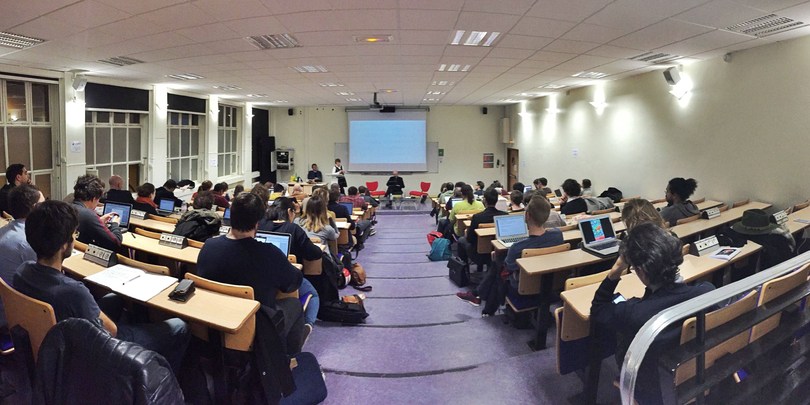
On Monday, 7 December 2015 at Telecom ParisTech, I was discussant at a seminar by New School scholar Trebor Scholz on “Unpacking Platform Cooperativism“.

ECN1

Internet platforms carry an unprecedented potential of value creation, exploiting the extraordinary power of data and algorithms to extract and distribute information to an extent never seen before. Information, we know since Hayek’s times, is the fuel that keeps markets going, that eliminates “lemons” and ensures an ever-better coordination between buyers and sellers, borrowers and lenders, or landlords and tenants. At the same time, the internet has channeled the dream of a viable non-market society, since Rheingold’s 1993 revival of the “community” and Barbrook’s 1998 “hi-tech gift economy“. So, can we put this informational efficiency to the service of a more humane economy, based on relationships, solidarity and reciprocation, rather than on the sheer market system?

The so-called “sharing economy” suggests answers, but also displays a tension: the efforts of myriad grassroots associations to develop collaboration as a value and a practice, sharply contrasts the spectacular growth of firms like Airbnb and Uber, now large multinationals, and their alleged cavalier attitude to anti-trust regulations and workers’ rights. If some say Uber is not really about sharing and collaboration, it is difficult to draw the line.

This ambiguity is fostered by a public discourse that focuses on the sharing of assets – the spare room in your home, or a sit in your car – that digital platforms enable. Asset-sharing has economic and social appeal: it increases efficiency by preventing assets from lying idle, while reducing waste, shifting emphasis away from consumerist values (“access is better than ownership“), and facilitating sociality beyond mere consumption.

But it is often forgotten that asset-sharing does not produce value by itself: it involves extra labour. In economic jargon, capital and labour and complementary production factors. In practice, if you want to put your spare room on Airbnb, you must produce an ad, monitor your message inbox and reply swiftly. You must clean the room and do the laundry before and after a guest’s visit. You must show your guests around when they arrive.

More importantly, the very opportunity of asset-sharing changes the incentives that shape labour supply – people’s willingness to sell their time and effort against a payment. Because of the expected compensation, some people will renounce use of a (non-spare) room to accommodate visitors instead, and others will do more journeys to drive passengers around – so it’s not really about sharing unused assets, it is about self-employment and starting a micro-business. A work opportunity as a complement to (and sometimes a substitute for) a main job.

This is where debates on internet platforms and the sharing economy rejoin the growing literature on digital labour — and where the contribution of Trebor Scholz is illuminating. Where others see assets (ie, capital), he sees labour. He shows us that the bottlenecks here are about labour, not capital, and that the success — be it economic or social– of the sharing economy is closely tied to the destiny of labour. Whether it appears on the surface as self-employment, micro-entrepreneurship or salaried work, doesn’t really matter. Trebor reminds us of Marx’s fundamental principle that production relations are central to our (capitalist) society, and value generation rests ultimately on labor. If this very crucial part of the human experience goes wrong, even the best side of the sharing economy – the one that endorses trust, reciprocity, and zero-waste – may fail to perform any transformative effects on society.

ECN2

Continue reading “Discussing platform cooperativism”

International Program in Survey and Data Science

A new, master’s level programme of study in Survey and Data Science is to be offered jointly by the University of Mannheim, the University of Maryland, the University of Michigan, and Westat. Applications for the first delivery are accepted until 3 January, for a start in Spring 2016. Prospective students are professionals with a first degree, at least one year of work experience, and some background in statistics or applied mathematics. All courses are delivered in English, fully online, to small classes (it’s not a MOOC!). Tuition is free, thank to support from German public funds at least for the first few cohorts.

What is most interesting about this master is its twofold core, involving both more classical survey methodology and today’s trendy data science. Fundamental changes in the nature of data, their availability, the way in which they are collected, integrated, and disseminated, have found many professionals unprepared. These changes are partly due to “big” data from the internet and digital devices becoming increasingly predominant relative to “small” data from surveys. Big data offer the benefit of fast, low-cost access to an unprecedented wealth of informational resources, but also bring challenges as these are “found” rather than “designed” data: less structured, less representative, less well documented (if at all…). In part, these changes are also due to the world of surveys changing internally, with new technical challenges (regarding for example data preservation, in a world of pre-programmed digital obsolescence), legislative issues (such as those triggered by greater awareness of privacy protection), increased demand by multiple users, and a growing need to merge surveys and data from other (such as business and administrative) sources. It is therefore necessary, as the promoters of this new study programme rightly recognize, to prepare students for the challenges of working both with designed data from surveys and with big data.

It will be interesting to see how data science, statistics, and social science / survey methodology feed into each other and support each other (or fail to do so…). There is still work to be done to develop techniques for analyzing data that allow us to gain insights more thoroughly, not just more quickly, and help us develop solid theories, rather than just uncovering new relationships that might eventually turn out to be spurious.

Read more

Databeers now in London

In the midst of the chaos and sadness of the past week, a more leisurely note: the first of a new “Databeers” series of events in London yesterday evening, following a format that has been experiencing a huge success in Spain, Italy and other countries. The event is very informal, and getting to know other data enthusiasts is the main goal. There are a few flash talks with free beers and networking time.

databeers

The next Data Beers London event is on 25 February 2016.


World Statistics Day 2015

This week was World Statistics Day, celebrated at the UN and in individual countries around the world. While celebWSD2rating the successes of official statistics throughout its history of producing vital information for governments and citizens, this time much of the debate focused on its – more uncertain – future. The landscape is rapidly changing, swiftly shifting from a data-scarce to a data-rich world, from structured to unstructured data, from the quasi-monopoly of official statisticians on the production of information to fier competition, from pure statistics to multi-disciplinarity and the rise of so-called “data science”. There are obvious opportunities, but also formidable challenges, and it is always difficult for large organisations (such as statistical institutes) to adapt.

The President of the IAOS urged official statisticians to stick to the UN-backed Fundamental Principles of Official Statistics as a guide. She focused on the efficiency and ethics of engaging with users and the private sector, combined with the rigour of methods, to deliver “better data for better lives” (the slogan of the day).

Continue reading “World Statistics Day 2015”

Research ethics in secondary data: what issues?

It is often believed that use of secondary data relieves the researcher from the burden of applying for ethical approval – and sometimes, from thinking about ethics altogether. But the whole process of research involves ethical considerations, whether or not any primary data collection is involved. This starts from the initial design of the study, which should aim at the public good (and at the very least should do no harm) and continues until communication of results, which should ensure transparency, publicness and replicability. More specifically, what ethical issues will the data collection and analysis stages involve, when secondary data are used?

Secondary data are usually defined as those that were collected as part of a different research, with purposes other than those of the present study. They may be official statistical data (census for example, but also, increasingly, administrative data), data gathered by commercial operators (time series of stock prices for example), and researchers’ data from past projects. They are more often quantitative, although secondary analysis of qualitative data is becoming more and more common.

Weighing risks and benefits

Use of secondary data is in itself, a highly ethical practice: it maximizes the value of any (public) investment in data collection, it reduces the burden on respondents, it ensures replicability of study findings and therefore, greater transparency of research procedures and integrity of research work. But the value of secondary data is only fully realized if these benefits outweigh the risks, notably in terms of re-identification of individuals and disclosure of sensitive information.

For this to happen, use of secondary data must meet some key ethical conditions:

  • Data must be de-identified before release to the researcher
  • Consent of study subjects can be reasonably presumed
  • Outcomes of the analysis must not allow re-identifying participants
  • Use of the data must not result in any damage or distress

Continue reading “Research ethics in secondary data: what issues?”

Big data and history

archive_pic
A paper archive – more and more often replaced by digitised versions today.

Yesterday at Biblithèque Nationale de France, I took part in a panel discussion  on longue durée in history, organised by the Revue Annales – Histoire et Sciences Sociales. Of course I am not a historian, and I wouldn’t be able to tell whether one interpretation of longue durée is better than another. But historians are now raising questions that are common to the social sciences and humanities more generally: how to benefit from big data and how to re-think the political engagement of the researcher. So I was there to talk about big data and how they change not just research practices and methods, but also researchers’ position relative to power, politics, and industry. This questions cross disciplinary boundaries, and all may benefit from dialogue.

BellinghamCB001
Collection of older sources is now often online and enables application of new methods.

What ignited the historians’ debate was an attempt by two leading scholars, David Armitage and Jo Guldi, to restore history’s place as a critical social science, based on (among other things) increased availability of large amounts of historical data and the digital tools necessary to analyze them. Before their article in Annales, they published a full book in open access, the History Manifesto, where they develop their argument in more detail. Their writing is deliberately provocative, and indeed triggered strong (and sometimes very negative) reactions. Yet the sheer fact that so many people took the trouble to reply, proves that they stroke a chord.

What do they say about big data? They highlight the opportunity of accessing large and rich archives and to expand research beyond any previous limitations. Their enthusiasm may seem excessive but it is entirely understandable insofar as their goal is to shake up their colleagues. My approach was to take their suggestion seriously and ask: what opportunities and challenges do data bring about? How would they affect research, especially for historians?

Continue reading “Big data and history”

“Data for Humanity”: a simple message, but so necessary

The recent VW emissions scandal says it all: even a large company can’t get away with behaviours that disrespect key societal values. Protection of the  environment is among these values today, so much so that not only public authorities step in to defend it, but even markets punish the transgressors.

Data protection is not (yet) such a value. Admittedly, some associations, individuals, and government officials fight for it, but the larger public is still unsure. It’s not that people don’t care, but that uncertainty as to what data are actually collected, for what usages, and by whom, is overwhelming; and it becomes difficult to identify the best course of action.

In this context, a new initiative is most welcome: an open letter on “Data for Humanity“, initiated by two scholars of the University of Frankfurt, pleads for a more responsible use of data. The message is simple: Do no harm. And if you can, on top of it, do something good. It’s so simple, and so necessary.

Sure, the world won’t change after this letter, but it will be a first step. Even the promotion of environmental protection started with simple, basic declarations, 30-40 years ago; and it was by insisting and perseverating, that it finally gained the conscience of everybody.