Our new book Against the Hypothesis of the End of Privacy is out now! It has been published by Springer and co-authored with Antonio A. Casilli (Telecom ParisTech) and Yasaman Sarabi (University of Greenwich). Please check here for regular updates about the book.
Author Archives: paolatubaro
I am an economist and economic sociologist, interested in social networks and their impact on markets, organisations, and communities.
I am also a methodologist and I am interested in matching classical social theories and state-of-the-art statistical and computing methods.
I teach sociology of social networks, research design, and data ethics.
Network data, new and old: from informal ties to formal networks
 Network data are among those that are changing fastest these days. When I say I study social networks, people almost automatically think of Facebook or Twitter –without necessarily realizing that networks have been around for, well, the whole history of humanity, long before the internet. Networks are just systems of social relationships, and as such, they can exist in any social context — the family, school, workplace, village, church, leisure club, and so forth. Social scientists started mapping and analysing networks as early as the 1930s. But people didn’t think of their social relationships as “networks” and didn’t always see themselves as “networkers” even if they did invest a lot in their relationships, were aware of them, and cared about them. The term, and the systemic configuration, were just not familiar. There was something inherently informal and implicit about social ties.
What has changed with Facebook and its homologues, is that the network metaphor has become explicit. People are now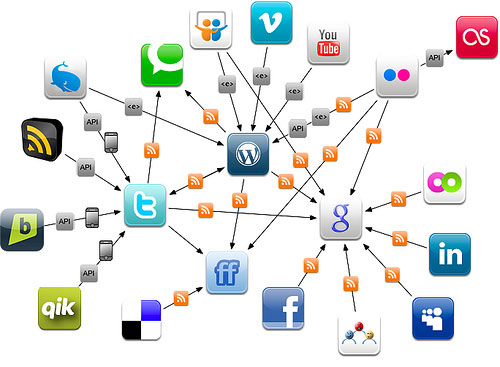 accustomed to talking about “networks”, and think in systemic terms, seeing their own relationships as part of a more global structure. Network ties have become formal — you have to make a clear choice and action when you add a “friend” on Facebook, or “follow” someone on Twitter; you will have a list of your friends/followers/followees (whatever the specific terminology is) and monitor changes in this list. You know who the friends of your friends are, and can keep track of how many people viewed your profile /included you in their “lists” / mentioned you in their Tweets. Now, everyone knows what networks are –so if you are a social network researcher and conduct a survey like in the old days, you won’t fear your respondents may misunderstand. In fact, you may not even need to do a survey at all –the formal nature of online ties, digitally recorded and stored, makes it possible to retrieve your network information automatically. You can just mine network tie data from Facebook, Twitter, or whatever service your target populations happen to be using.
Continue reading “Network data, new and old: from informal ties to formal networks”
Training in European data: EU-SILC
Official statistical surveys are still the best sources of data in terms of quality. Practically, they are the only ones that apply random sampling and the legal obligation to respond makes the actual sample very close to the targeted one. No other approach to data collection can hope to do as well.
The European Union Statistics on Income and Living Conditions (EU-SILC) is an instrument aiming at collecting timely and  comparable cross-sectional and longitudinal multidimensional microdata on income, poverty, social exclusion and living conditions. It started in 2003 with a small group of participant countries, and was enlarged in 2004. It is one of the richest sources of information on the daily life conditions of Europeans.
EU-SILC data are available for research use, but many barriers exist and these data are actually underutilized. On the one hand, the fact that access is legally authorised does not make it practically straightforward – the application process can be lengthy and costly. On the other hand, the very handling of data requires some specific knowledge and skills.
The Data without Boundaries European initiative, aimed at moving forward research access to official data, organises a training programme on EU‐SILC with a specific focus on the longitudinal component. Local organization lies with Réseau Quetelet, host of the training course is GENES ‐ Groupe des Écoles Nationales d’Économie et Statistique both in Paris (France).
Small Data to study the Web: The ANAMIA project
We have just published the results of our research project ANAMIA, studying the personal networks and online interactions of persons with eating disorders (“ana” and “mia” in web jargon). The report has just come out:
Documents
Infographic: results and recommendations of the ANAMIA project (pdf, in French)
The ana-mia webosphere had remained opaque for long, with little data available for a science-based understanding of it. As a result, misconceptions proliferated and policy-makers hesitated — threatening censorship but without devising solutions to reach out and support a population in distress. Our study has been the first to overcome these limitations and reveal the social environment, actual eating practices and digital usages of persons with eating disorders in the English and French web.
Continue reading “Small Data to study the Web: The ANAMIA project”
#bigdataBL
On Friday last week, the British Sociological Association (BSA) held an event on “The Challenge of Big Data” at the British Library. It was interesting, stimulating and relevant – I was particularly impressed by the involvement of participants and the very intense live-tweeting, never so lively at a BSA event! And people were particularly friendly and talkative both on their keyboards and at the coffee tables… so in honour of all this, I am choosing the hashtag of the day #bigdataBL as title here.
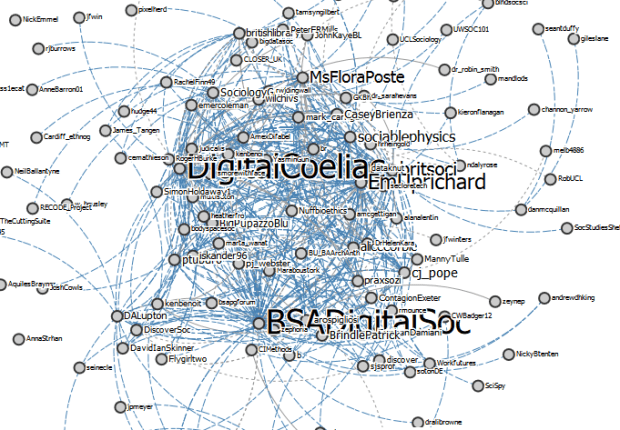 (Visualisation: http://www.digitalcoeliac.com/)
Some highlights:
- The designation of “big data” is from industry, not (social) science, said a speaker at the very beginning. And it is known to be fuzzy. Yet it becomes a relevant object of scientific inquiry in that it is bound to affect society, democracy, the economy and, well, social science.
- Big-data practices change people’s perception of data production and use. Ordinary people are now increasingly aware that a growing range of their actions and activities are being digitally recorded and stored. Data are now a recognized social object.
- Big data needs to be understood in the context of new forms of value production.
- So, social scientists need to take note (and this was the intended motivation of the whole event). The complication is that Big Data matter for social science in two different ways. First, they are an object of study in themselves – what are their implications for, say, inequalities, democratic participation, the distribution of wealth. Second, they offer new methods to be exploited to gain insight into a wide range of (traditional and new) social phenomena, such as consumer behaviours (think of Tesco supermarket sales data).
- Put differently, if you want to understand the world as it is now, you need to understand how information is created, used and stored – that’s what the Big Data business is all about, both for social scientists and for industry actors.
Three tools to visualize personal network data – continued
Yesterday, Antonio Casilli and I gave our promised talk on network data visualization. It was an opportunity to discuss the extension of the tools we developed within a given research project to other network studies, and to reflect on the contribution as well as the limitations of data visualizations. Here are our slides:

Three tools to visualize personal networks
Data visualization techniques are enjoying ever greater popularity, notably thank to the recent boom of Big Data and our increased capacity to handle large datasets. Network data visualization techniques are no exception. in fact, appealing diagrams of social connections (sociograms) have been at the heart of the field of social network analysis since the 1930s, and have contributed a lot to its success. Today, all this is evolving at unprecedented pace.
In line with these tendencies, the research team of the project ANAMIA (a study of the networks and online sociability of persons with eating disorders, funded by the French ANR) of which I was one of the investigators, have developed new software tools for the visualization of personal network data, with different solutions for the three stages of data collection, analysis, and dissemination of results.
Specifically:
– ANAMIA EGOCENTER is a graphical version of a name generator, to be embedded in a computer-based survey to collect personal network data. It has turned out to be a user-friendly, highly effective interface for interacting and engaging with survey respondents;
Continue reading “Three tools to visualize personal networks”
Big Data and social research
Data are not a new ingredient of socio-economic research. Surveys have served the social sciences for long; some of them like the European Social Survey, are (relatively) large-scale initiatives, with multiple waves of observation in several countries; others are much smaller. Some of the data collected were quantitative, other qualitative, or mixed-methods. Data from official and governmental statistics (censuses, surveys, registers) have also been used a lot in social research, owing to their large coverage and good quality. These data are ever more in demand today.
Now, big data are shaking this world. The digital traces of our activities can be retrieved, saved, coded and processed much faster, much more easily and in much larger amounts than surveys and questionnaires. Big data are primarily a business phenomenon, and the hype is about the potential gains they offer to companies (and allegedly to society as a whole). But, as researcher Emma Uprichard says very rightly in a recent post, big data are essentially social data. They are about people, what they do, how they interact together, how they form part of groups and social circles. A social scientist, she says, must necessarily feel concerned.
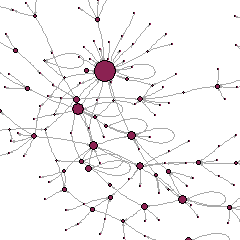
It is good, for example, that the British Sociological Association is organizing a one-day event on The Challenge of Big Data. It is a good point that members must engage with it. This challenge goes beyond the traditional qualitative/quantitative divide and the underrepresentation of the latter in British sociology. Big data, and the techniques to handle them, are not statistics, and professional statisticians have trouble with it too. (The figure below is just anecdotal, but clearly suggests how a simple search on the Internet identifies Statistics and Big Data as unconnected sets of actors and ties). The challenge has more to do with the a-theoretical stance that big data seem to involve.
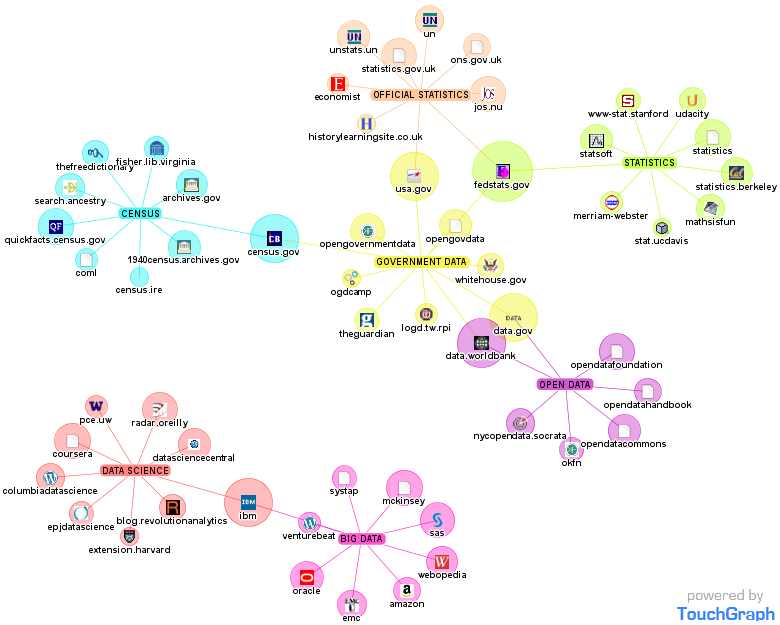
The fuzziness of Big Data
Fascinating as they may be, Big Data are not without posing problems. Size does not eliminate the problem of quality: because of the very way they are collected, Big Data are unstructured and unsystematized, the sampling criteria are fuzzy, and the classical statistical analyses do not apply very well. The more you zoom in (the more detail you have), the more noise you find, so that you need to aggregate data (that is, to reduce a “big” micro-level dataset to a “smaller” macro one) to detect any meaningful tendency. Analyzing Big Data as they are, without any caution, increases the likelihood of finding spurious correlations – a statistician’s nightmare! In short, processing Big Data is problematic: Although we do have sufficient computational capacity today, we still need to refine appropriate analytical techniques to produce reliable results.
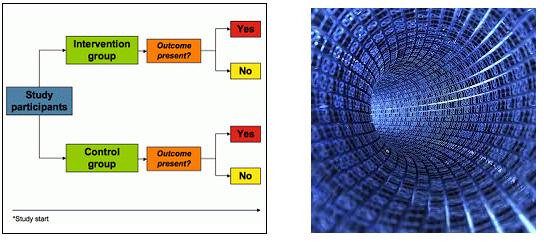
In a sense, the enthusiasm for Big Data is diametrically opposed to another highly fashionable trend in socioeconomic research: that of using randomized controlled trials (RCTs), as in medicine, or at least quasi-experiments (often called “natural experiments”), which enable collecting data under controlled conditions and facilitate detection of causal relationships much more clearly and precisely than in traditional, non-experimental social research. These data have a lot more structure and scientific rigor than old-fashioned surveys – just the opposite of Big Data!
This is just anecdotal evidence, but do a quick Google search for images on RCTs vs. Big Data. Here are the first two examples I came across: on the left are RCTs (from a dentistry course), on the right are Big Data (from a business consultancy website). The former conveys order, structure and control, the latter a sense of being somewhat lost, or of not knowing where all this is heading… Look for other images, I’m sure the great majority won’t be that different from these two.
New data opportunity for socioeconomic research
If you are a researcher in economics, demography, sociology, geography or political science, you may have experienced the frustration of discovering a relevant data resource and being denied access to it — typically on the ground that data release would violate the confidentiality of data subjects. Or you may have heard of fantastic analyses — with all the fancy new statistical and econometrics tools and software that are increasingly in fashion today — done with large amounts of very detailed microdata, but you have no clue how to do anything like that yourself. Maybe you have tried to look at the website of some public administration that likely holds the data you want – like labor market or business data — but could not figure out how to ask for these data in the first place. And f you ever tried to access data from two or more different countries, you probably found the task of even finding out how to apply in different systems daunting.
Now, there is a great opportunity for you to get closer to your goal. The European project “Data without Boundaries” (DwB) offers social scientists from across Europe funding, information and support to access household surveys and business data from public-sector records in special Research Data Centers in France, Germany, the Netherlands and UK. These are microdata at individual level, highly detailed; they cannot be publicly released, but access can be legally given for scientific and statistical research purposes.
Both confirmed researchers and PhD students are welcome to apply, and should do so in a country different from the one where they reside. There is a preference for comparative, cross-country projects. The deadline is 15th October 2013.
For more information, see the call for proposals on the DwB website.
This is part of a broader policy effort to improve researchers’ access to data in Europe, to enhance capacity to produce science-based understanding of society across the continent.
 Data Big and Small