Online health communities: data for doctors, patients and families

Online health communities have been demonstrated to be an important part of the self-empowering experience of today’s patients. While most attention so far has been devoted to self-styled health communities, where patients autonomously share expertise and experience, today policymakers and healthcare providers are harnessing the power of this very idea and are offering similar solutions themselves.

Earlier this week at the OuiShare Fest Barcelona – a major get-together of the Spanish-speaking collaborative economy community in Europe – a few of these initiatives were presented.

keyboard-and-stethoscopeSocial Diabetes is a small company founded by and for patients, that offers a mobile app for online, real-time health monitoring services. Diabete sufferers can use it to optimally adjust their insulin dosage based on their carb count and blood sugar levels; in some cases, they can also track their exercise and patterns of behavior to receive alerts whenever relevant. Patients can share this information with their doctors, also through the app; and can discuss with other patients. This is an example of a user-based innovation where autonomous patients take the initiative, aiming to take control of their health and life. Still, physicians have been allowed in: the platform has a medical advisory board, and individual doctors can register as users to follow their patients.

Continue reading “Online health communities: data for doctors, patients and families”

Are we all data laborers?

autonomyI gave today a talk at AUTONOMY, a major festival of urban mobility in Paris, where new technologies are at center stage, from driverless cars to electric scooters, bike-sharing solutions, and connected infrastructure for the smart city. I had been asked to talk about labor in digital platforms, such as those offering mobility services.

Digital platforms are often thought of in terms of automation, but it islogos clear that there is labor too: we all have in mind the example of the couriers and drivers of the “on-demand” economy. But there’s more: I’ll show how platforms involve the labor of everyone, including passengers and users of all types. By labor, I mean here human activity that produces data and information – the key source of value for platforms. It is often an implicit, invisible activity of which we may not even be aware – as we tend to focus more on consumption aspects as we talk routinely about “car pooling” or “car sharing”, rather than looking at the underlying productive effort. This is what scholars call “digital labor”.

Four eco-systems

Specialist Antonio Casilli distinguishes four forms of digital labor in platforms, and I am now going to briefly outline them.

Continue reading “Are we all data laborers?”

The “pro-ana” phenomenon: Eating disorders and social networks

proanaA new book is just out, co-authored by myself and Antonio A. Casilli: a synthesis of our 5-odd years research on the self-styled internet communities, blogs and forums of persons with eating disorders. For years, lively controversies have surrounded these websites, where users express their distress without filters and go as far as to describe their crises, their vomiting and their desire for an impossibly thin body – thereby earning from the media a reputation for “promoting anorexia” (shortened as “pro-ana”). In France, an attempt to outlaw these online spaces last year was unsuccessful, not least because of our active resistance to it.

The book tells the story of our discovery of these communities, their members, their daily lives and their social networks. Ours was the first study to go beyond just contents, and discover the social environments in which they are embedded. We explored the social networks (not only online relationships, but day-to-day interactions at school or work, in the family, and among friends) of internet users with eating disorders, and related them to their health. The results defy received wisdom – and explain why banning these websites is not the right solution.

Internet deviance or public health budget cuts?

It turns out that “pro-ana” is less a form of internet deviance than a sign of more general problems with health systems. Joining these online communities is a way to address, albeit partially and imperfectly, the perceived shortcomings of healthcare services. Internet presence is all the more remarkable for those who live in “medical deserts” with more than an hour drive to the nearest surgery or hospital. At the time of the survey in France, a number of areas lacked specialist services for eating disorder sufferers.


Availability of specialized services and support for eating disorder sufferers in France in 2012. Source: AFDAS-TCA & FNA-TCA.
Availability of specialized services and support for eating disorder sufferers in France in 2014. Source: AFDAS-TCA & FNA-TCA.

These people do not always aim to refute medical norms. Rather, they seek support for everyday life, after and beyond hospitalisation. These websites offer them an additional space for socialisation, where they form bonds of solidarity and mutual aid. Ultimately, the paradoxical behaviours observed online are the result of underfunded health systems and cuts in public budgets, that impose pressure on patients. The new model of the ‘active patient’, informed and proactive, may have unexpected consequences.


A niche phenomenon with wider repercussions

In this sense, “pro-ana” websites are not just a niche phenomenon, but a prism through which we can read broader societal issues: our present obsession with body image, our changing relationships with medical authorities, the crisis and deficit of our publich health systems, as well as the growing restrictions to our freedom of expression online.

Continue reading “The “pro-ana” phenomenon: Eating disorders and social networks”

Data and theory: substitutes or complements? Lessons from history of economics

EEToday, my chapter on “Formalization and mathematical modelling” is published in a new series of three reference books on History of Economic Analysis (edited by G. Faccarello and H. Kurz, Edward Elgar). The chapter draws heavily on key ideas I developed as part of my thesis on the origins of mathematical economics. But this was a long time ago and reading it again today, I see it in a different light. I notice in particular that economics developed its distinctive mathematical flavour, which makes it neatly stand out relative to the other social sciences, at times in which social research was data-poor – and it did so not despite data paucity, but precisely because of it. William S. Jevons, a 19th-century forefather of the discipline who was clearly aware of the relevance of maths, wrote in 1871:

“The data are almost wholly deficient for the complete solution of any one problem”

yet:

“we have mathematical theory without the data requisite for precise calculation”

Continue reading “Data and theory: substitutes or complements? Lessons from history of economics”

The international conference of French-speaking sociologists

Crédit: @clemenceRmp sur Twitter (#AISLF2016)
Credit: @clemenceRmp on Twitter (#AISLF2016)

Just attended the 20th conference of AISLF, the international association of French-speaking sociologists, in Montréal. Back home yesterday I found a state of fear and madness (again, alas…). But before that, I enjoyed a nice time with fellow researchers from France and (perhaps even more intriguingly, or simply more newly) from the different countries in which French is spoken, ranging from Canada, Belgium and Switzerland to several African countries. It was a good opportunity to get a sense of what research is done around us.

aislf2
Credit: @ArthurRenault on Twitter (#AISLF2016)

Lots of good presentations. Interestingly, digital sociology appears to be on the up, as many researchers investigated topics that had to do with digital technologies, their usages, and the ensuing economic and social transformations. That there was no dedicated stream is not in itself a problem: if digital technologies permeate all our lives, they should not be studied in a separate subfield but as part of the sociology of work, of gender, of education etc.

(On this particular point, I am proud to say I was interviewed, with Antonio Casilli, by ICI – Radio Canada, and our contribution was featured by the French Consulate in Québec, a supporter of the event).

Credit: @ptubaro on Twitter (#AISLF2016)

The other good thing is the emergence of social networks research in two keynote presentations – by Antonio A. Casilli and Michel Grossetti – which is far from a small achievement, considering that the association does not have a dedicated social networks research group (I would love to see one being created sooner or later… like BSA-SNAG, the group I convene for British Sociological Association).

Continue reading “The international conference of French-speaking sociologists”

Visualization in mixed-methods research on social networks

The journal Sociological Research Online has just published (31 May 2016) a special section on “Visualization in Mixed-Methods Research on Social Networks”, guest edited by Alessio D’Angelo, Louise Ryan and myself.
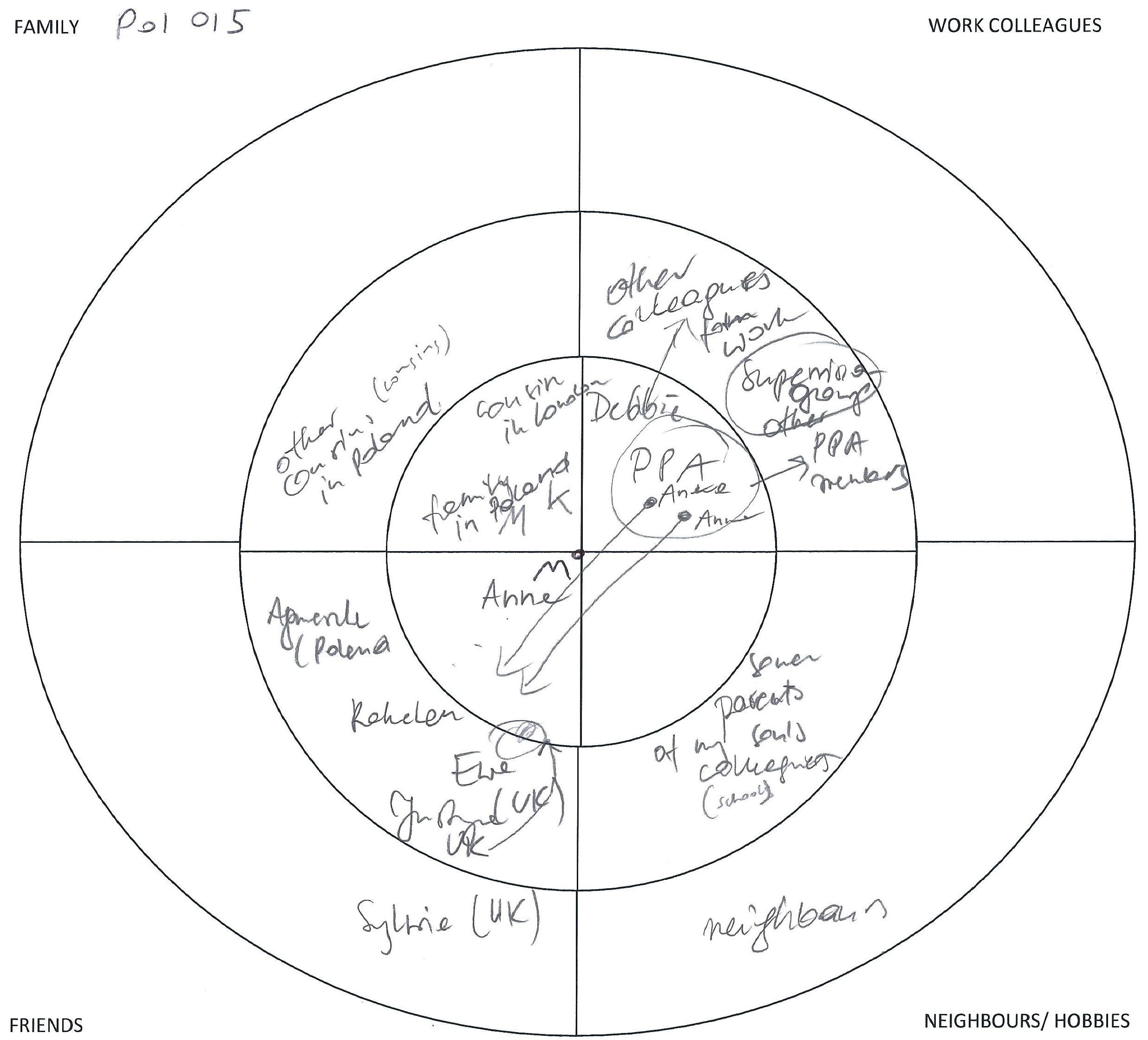
FigureL1
Figure 1 – Tubaro, Ryan & D’Angelo

The five papers in this peer-reviewed special issue explore the potential of visual tools to accompany qualitative and mixed-methods research. Visualization can support data collection, analysis and presentation of results; it can be used for personal or complete networks; it can be paper-and-pencil or computer-based. Overall, visualization helps to jointly understand network contents and network structures.

The special issue is freely accessible from all commercial (non-academic) internet providers.

Continue reading “Visualization in mixed-methods research on social networks”

Twitter networks at the OuiShare Fest 2016

Twitter conversations are one way through which participants in an event engage with the programme, comment and discuss about the talks they attend, prolong questions-and-answers sessions. Twitter feeds have become part of the official communication strategy of major events and serve documentation and information purposes, both for attendees and for outsiders. While tweeting is becoming more an more a prerogative of “official” accounts in charge of event communication, it is also a potential tool in the hands of each participant, allowing anyone to join the conversation at least in principe. Participants may become aware of each other, perhaps using the opportunity of the event to meet face-to-face, start relationships and even collaborations. A Nesta study insisted on the potential for using social media data to attain a quantitative understanding of events and their impacts on participants’ networks.

The OuiShare Fest 2016, a major gathering of the collaborative economy community that took place last week in Paris, was one opportunity to see such mechanisms in place. Tweeting was easy – with an official hashtag, #OSFEST16, although related hashtags were also widely used. I mined a total of 12440 tweets over the four days of the event. Do Twitter conversations related to the Fest bring to light the emergence of a community? While it’s too early for any deep analysis, some descriptive results can already be shown.

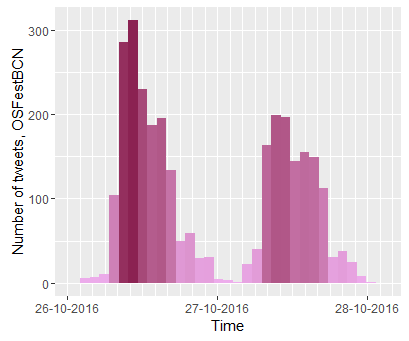
First, when did people tweet? Mostly at the beginning of each day’s programme (9am on the first two days, 2pm on the third day). Tweeting was more intense in the first day and declined over time (Figure 1). The comparatively low participation on the fourth day is due to the fact that the format was different – an open day in French (rather than an international conference in English), whereby local people were free to come and go. Online activity is not independent of what happens on the ground – quite on the contrary, it follows the timings of physical activity.

Tweets_Over_Time_Blog
Figure 1: Tweets over time.

Who tweeted most? Our dataset has a predictable outlier, the official @OuiShareFest Twitter account, who published 727 tweets – twice as many as the second in the ranking. But let’s look at the people who had no obligation to tweet, and still did so: who among them contributed most to documenting the Fest? Figure 2 shows the presence of some other institutional accounts among the top 10, but the most active include a few individual participants. Ironically, one of them was not even physically present at the Fest, and followed the live video streaming from home. In this sense, Twitter served as an interface between event participants and interested people who couldn’t make it to Paris.

OSFest16_Top10_NoOutliers
Figure 2: Ten most active tweeters (excluding @OuiShareFest).

What was the proportion of tweets, replies and retweets? Original tweets are interesting for their unique content (what are people talking about?), while replies and retweets are interesting because they reveal social interactions – dialogue, endorsement or criticism between users. Figure 3 shows that the number of replies is small compared to tweets and retweets.

Tweets_By_Type_blog
Figure 3: Tweets, replies and retweets

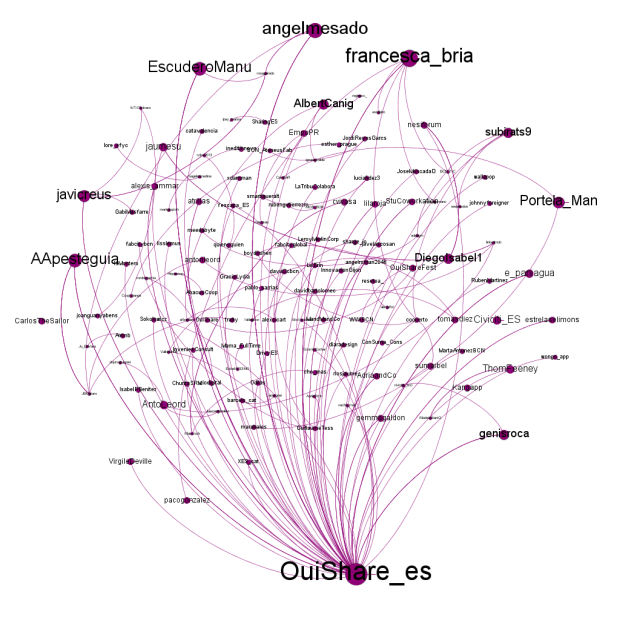
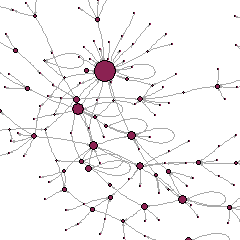
Let’s now look closer at the replies. By taking who replied to whom, we can build a social network of conversations between a group of tweeters. It’s a relatively small network of 311 tweeters (the coloured points in Figure 4), with 321 ties among them (the lines in Figure 4). The size of points depends on the number of their incoming ties, that is, the number of replies received: even if the points haven’t been labelled, I am sure you can tell immediately which one represents the official @OuiShareFest account… the usual suspect! But let’s look at the network structure more closely. Some ties are self-loops, that is, people replying to themselves. (Let’s be clear, it’s not a sign of social isolation, but simply a consequence of the 140-character limit imposed on Twitter: self-replies are meant to deliver longer messages). A lot of other participants are involved in just simple dyads or small chains (A replies to B who replies to C, but then C does not reply to A), unconnected to the rest. There is a larger cluster formed around the most replied-to users: here, some closure becomes apparent (A replies to B who replies to C who replies to A) and enables this sub-network to grow.

Network_replies_OSF16_blog
Figure 4: the network of replies.

Now, my own experience of tweeting at the Fest suggested that tweets were multilingual. Apart from the fourth day, there seemed to be a large number of French-speaking participants. A quick-and-dirty (for now) language detection exercise revealed that roughly 60% of tweets were in English, 25% in French, the rest being split between different languages especially German, Spanish, and Catalan. So, did people reply to each other based on the language of their tweets? It turns out that quite a few tweeters were involved in conversations in multiple languages. Figure 5 is a variant of Figure 4, colouring nodes and ties differently depending on language. A nice mix: interestingly, the central cluster is not monolingual and in fact, is kept together by a few, albeit small, multi-lingual tweeters.

Replies_by_language
Figure 5: the network of replies, by language.

Let’s turn now to mentions: who are the most mentioned tweeters? Again, I’ll take out of the analysis @OuiShareFest, hugely ahead of anyone else with 832 mentions received. Below, Figure 6 ranks the most mentioned: mostly companies (partners or sponsors of the event such as MAIF), speakers (such as Nathan Schneider, Nilofer Merchant), and key OuiShare personalities (such as Antonin Léonard). Mentions follow the programme of the event, and most mentioned are people and organizations that play a role in shaping it.

15MostMentioned_OSF16
Figure 6: Most mentioned tweeters.

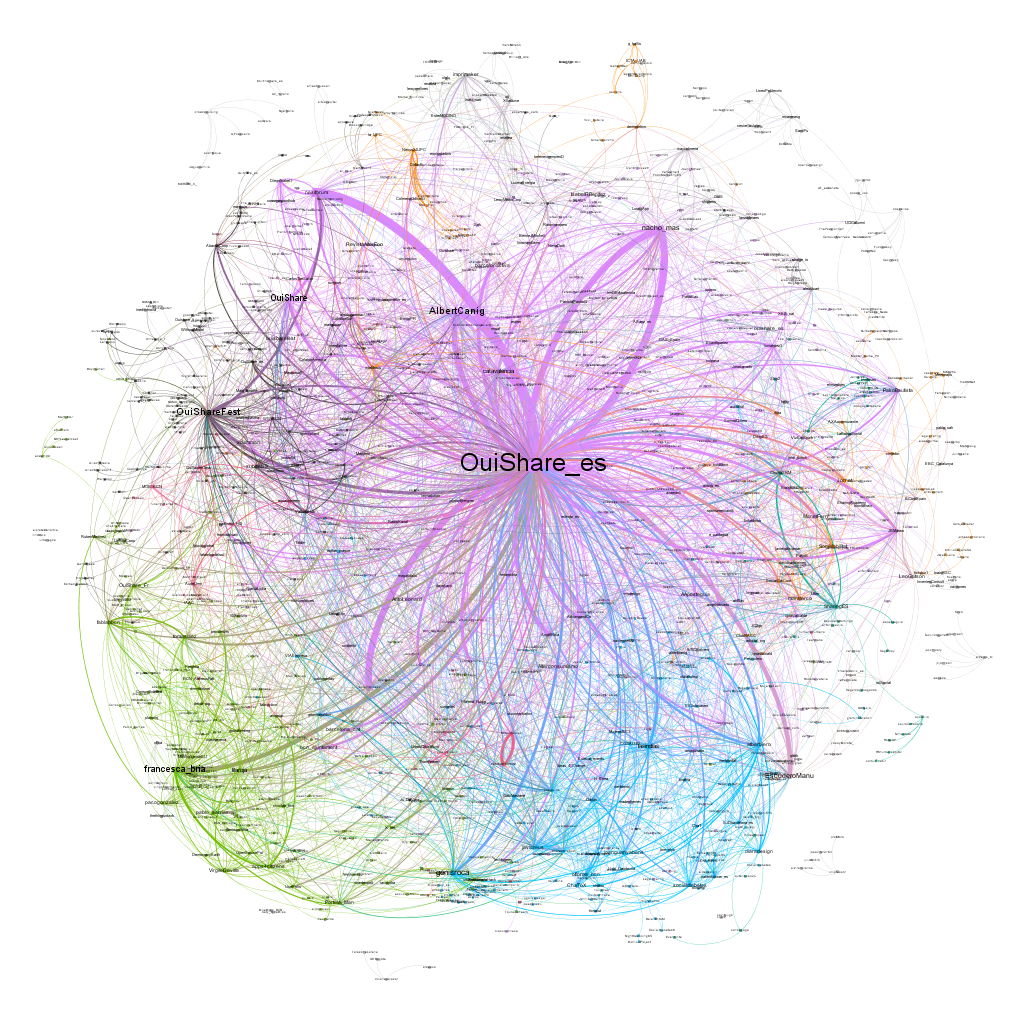
Mentions are also a basis to build another social network – of who mentions whom in a tweet. This will be a larger network compared to the net of replies, as mentions can be of many types and also include retweets (which as we saw above, are very numerous here). There are 17248 mentions (some of which are repeated more than once) in the network. They involve 796 users who mention others and are mentioned in turn; 550 users who are mentioned, but do not mention themselves; and 1680 users who mention others, but are not themselves mentioned.

A large network such as this is more difficult to visualize meaningfully, and I had to introduce some simplifications to do so. I have included only pairs in which one had mentioned the other at least twice: this makes a network of 778 nodes with 2222 ties. The color of nodes depends on their modularity class (a group of nodes that are more connected with one another, than with any other nodes in the network) and their size depends on the number of mentions received. You will clearly recognize at the center of the network, the official @OuiShareFest account, which structures the bulk of the conversations. But even intuitively, other actors seem central as well, and their role deserves being examined more thoroghly (in some future, less preliminary analysis).

Mentions2
Figure 7: Network of Twitter mentions

This analysis is part of a larger research project, “Sharing Networks“, led by Antonio A. Casilli and myself, and dedicated to the study of the emergence of communities of values and interest at the OuiShare Fest 2016. Twitter networks will be combined with other data on networking – including informal networking which we are capturing through a (perhaps old-fashioned, but still useful!) survey.

The analyses and visualizations above were done with the packages TwitteR and igraph in R; Figure 7 was produced with Gephi.

The SHARING NETWORKS study

SN_box2Antonio A. Casilli and I carried out a study during the OuiShare Fest 2016, a major international get-together of the collaborative economy community that took place in Paris on 18-21 May 2016.

Our goal is to look at how people network at this important event and how their meetings, their talking to each other and their informal interactions help shape the community — so as to foster the emergence of new ideas, trends and topics.

If you were a participant, speaker, journalist organizer or teamSN_slide member/volunteer, you were asked to complete a brief questionnaire in paper format that was handed out to you upon arrival at the Fest.

If you didn’t manage to fill in the questionnaire onsite, there is still time to do so online. It takes only about 8 minutes to do so and your contribution will help scientific research as well as the organization of the Fest.

Results will be made available through the OuiShare Magazine and other online outlets.

⇒Read more here

Complete the questionnaire

Thank you for your invaluable contribution!

Ethical issues in research with online data

Some time ago, I wrote a post on ethical issues in research with secondary data – a somewhat grey area, where students and scholars often feel guidance is insufficient. Even more complex is research with internet data – neither primary nor secondary strictly speaking, but “big” data. A recent case fuelled an international debate on how researchers should deal with data that are, apparently, accessible to all on the web: a Danish graduate student published a large dataset of users of the online dating site OkCupid (he apparently did so without any institutional backing, and Aarhus University where he studies, is now on the case). Michael Zimmer, a specialist of information studies and the policy and ethics of online research, properly summarizes the issues in a recent Wired article:

  • Don’t say that “the data are already public”. The fact that OkCupid users knowingly share some personal information, does not mean they consent to it being used for purposes other than interactions with other users on that site. By scrapping data, one may be able to put together the whole history of  users’ presence on that platform, revealing more of their life or personality than they themselves are aware of. More dangerously, data extracted in this way might in some cases be matched with other information, thereby potentially becoming much more disclosive than what the persons concerned ever intended or agreed. And the disclosure may be aggravated by releasing the data outside the platform.

Continue reading “Ethical issues in research with online data”

First steps toward “Data Inclusion”

The concept of “data inclusion” is new and still slowly seeking its way in our linguistical habits, but it is gaining ground in the minds of those who care for disadvantaged, low-income, or otherwise underserved segments of society. A recent report of the US Federal Trade Commission (FTC) does precisely this. Looking at the commercial use of big data analytics, it considers cases in which big data analytics lead companies to make choices that are detrimental to the most vulnerable segments of society, for example by excluding them from credit or from employment opportunities. Instead, it asks how big data may be used in inclusive ways.

A first set of recommendations they make is for companies to be well aware of the regulations: on financial and credit reporting, equal opportunities, consumer protection. The second set of recommendations, though specifically aimed at research done in (or for) companies, is of relevance for public research as well, and consists in asking key questions about the quality of data and models, and about the reliability and validity of results:

  • How representative is your data set? In popular discourse, big data carry a promise of exhaustivity, which however is rarely fulfilled in practice (see this great FT article by Tim Hartford). In fact, big data sets are not necessarily statistically representative of the population they refer to, and  information may be disproportionately missing about specific, possibly disadvantaged, populations.
  • Does your data model account for biases? Selection effects, which occur whenever some members of the population are less likely to be included in the sample than others, must be controlled for in order for results to be generalizable.
  • How accurate are your predictions based on big data? The issue is that most research with big data is predictive without being able to uncover the social or economic mechanisms underlying observed correlations, so that interpretation of results is potentially misleading. The report does not say, though, that recent developments in machine learning that support causality reasoning may alleviate this problem in the not-so-far future.
  • Does your reliance on big data raise ethical or fairness concerns? In all honesty, this is not specifically a question for research on big data, but for research in general. If a company’s analysis of employees’ behavior lead to solutions that involve forms of, say, racial or gender-based behavior, then that analysis shouldn’t be used – whether it’s done with “big” or “small” data.

It is important that major regulators like the FTC are taking notice. Big data open the way to major improvements in our life conditions, but not because data-driven analysis will take the lead over current best practices in research. Regulations, awareness of statistical issues and potential pitfalls, and ethics are ever more necessary for big data to fulfill their potential.