Just published: Big data, societies and social sciences, a special issue of Revue Française de Sociologie, guest-edited by Gilles Bastin and myself.
Read a pre-print of our Introduction here.
English versions will be available soon.
A social scientist's venture into big data, while still learning much from surveys and fieldwork
Just published: Big data, societies and social sciences, a special issue of Revue Française de Sociologie, guest-edited by Gilles Bastin and myself.
Read a pre-print of our Introduction here.
English versions will be available soon.
 Just back from a stimulating summer school on social network analysis and complexity, organised in sunny Cargèse (Corsica). Lots of exciting talks on communities, network dynamics, and complex social structures, with a touch of genuine interdisciplinarity.
There, I gave a talk on agent-based models and simulation, and co-led a workshop on statistical models for social network data.
The summer school was organized by GDR Analyse des réseaux en sciences humaines et sociales and a short report is available here (in French), with a few more blog posts (also in French) here.
 Just came back from the Work, Employment and Society (WES) conference 2018, that British Sociological Association (BSA) organizes every other year. Perhaps more intimate and newbie-friendly than the main BSA event, this year’s WES in Belfast was also a positive surprise in terms of its academic content. There were several sessions on the so-called ‘gig economy’ (or as one speaker put it, ‘gig economies‘), the effects of digital business models that often go under the name of ‘uberization’, and atypical forms of work.
Some lessons I am taking home:
What is still missing from the picture is information on the ‘long tail’ of smaller, often national rather than international, platforms, and on the workers (especially micro-workers) who use them. Besides, clients and requesters are little known – on all platforms. Estimating the size of the platform worker population remains an unresolved issue – whether at local, national or international level. A common grievance by researchers is difficulty to access crucial data from commercial platforms that use them as their private property.
Submissions are now invited for a special section of the journal Social Networks on “Recent Ethical Challenges in Social Network Analysis” (guest-edited by myself with Antonio A. Casilli, Alessio D’Angelo, and Louise Ryan).
Research on social networks raises formidable ethical issues that often fall outside existing regulations and guidelines. State-of-the-art tools to collect, handle, and store personal data expose both researchers and participants to new risks. Political, military and corporate interests interfere with scientific priorities and practices, while legal and social ramifications of studies of personal ties and human networks come to the surface.
The proposed special section aims to critically engage with ethics in research related to social networks, specifically addressing the challenges that recent technological, scientific, legal and political transformations trigger.
Following a successful workshop on this topic that was held in December 2017 in Paris, we welcome submissions that critically engage with ethics in research related to social networks, possibly based on reflective accounts of first-hand experiences or case studies, taken as concrete illustrations of the general principles at stake, the attitudes and behaviors of stakeholders, or the legal and institutional constraints. We are particularly interested in novel, original answers to some unprecedented ethical challenges, or the need to reinterpret norms in ambiguous situations.
The full Call for Papers is available here.
As part of the upcoming NetSci2018 conference in Paris, I co-organize a satellite event that aims to foster interdisciplinary reflection on how methods from social science can be upscaled to large network structures and on how methods from complex systems can be downscaled to deal with small heterogeneous structures.
The idea is to reconcile two traditions of research that have remained separate so far. Sociology typically handles small but rich networks where a wealth of network attributes results from the complexity of the data collection design. Differences across nodes and edges enable to capture the social processes underlying network structures and their dynamics. Instead, the complex systems tradition handles large but poorly-specified networks. Assuming statistical equivalence of graph entities, a mean field treatment suffices to describe the aggregate properties of the network. Today’s network data-sets contain an unprecedented quantity of relational information within and between all possible levels: individuals, social groups, organizations, and macro entities. Such large and rich network structures expose the implicit limitations of the two above-mentioned approaches: classical sociological methods cannot be upscaled because of their heavy algorithms, and those from complex systems lose track of the multi-faceted nature of social actors, their relationships and their processes.
Our satellite event aims to move forwards, inviting an inter-disciplinary reflection and exploring ways in which these limitations can be overcome.
The program of the satellite is now online.
I am most pleased to co-organize this satellite event with Floriana Gargiulo, Sylvie Huet, and Emmanuel Lazega.
We are honored to count, among our invited speakers, Camille Roth, Matthieu Latapy, Fariba Karimi, and Noshir Contractor.
I co-organize this Satellite to the NETSCI2018 Conference in Paris, 12 June 2018. We are now accepting submissions of proposals for presentations.
In traditional research paradigms, sociology handles small but rich networks where the richness of network attributes is derived from the specific buildup of the data collection process. In the sociological approach, differences among nodes and edges are key to describe network properties and the ensuing dynamical social processes. Instead, the complex systems tradition deals with large but poor networks. Assuming statistical equivalence of graph entities, a mean field treatment serves to describe the aggregate properties of the network. Today’s network datasets contain an unprecedented quantity of relational information at all, and between all, the possible levels: individuals, social groups, political structures, economical actors, etc. We finally deal with large and rich network structures that expose the implicit limitations of the two abovementioned approaches: the traditional methods from social science cannot be upscaled because of their algorithmic complexity and those from complex systems lose track of the complex nature of the actors, their relationships and their processes. This workshop has the aim of developing an interdisciplinary reflection on how methods from social science could be upscaled to large network structures and on how methods from complex systems could be downscaled to deal with small heterogeneous structures.
We are proud that five prominent international scholars are our invited speakers: Camille Roth, SciencesPo Paris; Matthieu Latapy, LIP6UPMC Paris; Alessandro Lomi, ETH Zurich; Fariba Karimi, GESIS Cologne; Noshir Contractor, Northwestern University.
We invite abstracts of published or unpublished work for contributed talks to take place at the satellite symposium. We expect a broad range of topics to be covered, across theory, methodology, and application to empirical data, relating to an interdisciplinary reflection on how methods from social science could be upscaled to large network structures and on how methods from complex systems could be downscaled to deal with small heterogeneous structures.
Submission can be made through our website.
Submissions are required to be at most 650 words long and should include the following information: title of the talk, author(s), affiliation(s), email address(es), name of the presenter, abstract. Papers or submissions longer than 1 page will not be accepted.
Abstract submission deadline is March 25, 2018. Notification of acceptance will be no later than April 23, 2018.
All participants and accepted speakers will have to register through the NETSCI2018 website.
Antonio A. Casilli, Télécom ParisTech – Institut Mines-Télécom, Université Paris-Saclay et Paola Tubaro, Centre national de la recherche scientifique (CNRS)
Fueled by increasingly powerful computing and visualization tools, research on social networks is flourishing. However, it raises ethical issues that largely escape existing codes of conduct and regulatory frameworks. The economic power of large data platforms, the active participation of network members, the spectrum of mass surveillance, the effects of networking on health, the place of artificial intelligence: so many questions in search of solutions.
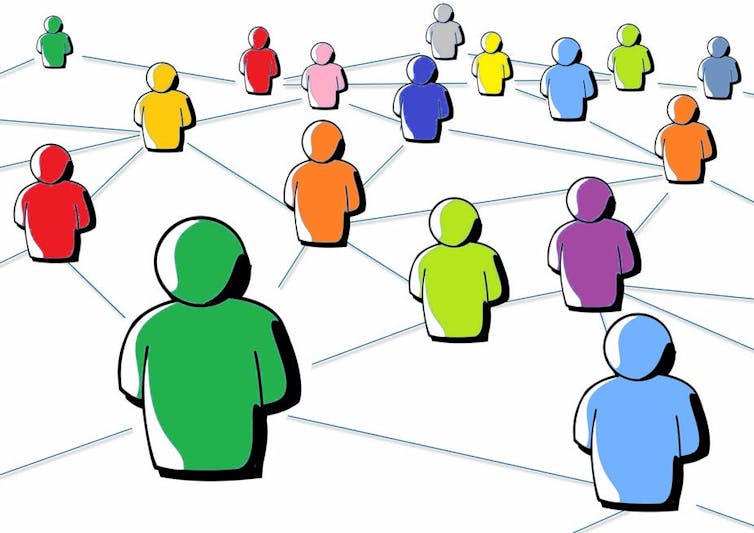
The expression “social network” has become common, but those who use it to refer to social media as Facebook or Instagram often ignore its origin and its true meaning. The study of social networks precedes the advent of digital technologies. Since the 1930s, sociologists have been conducting surveys to describe the structures of relationships that unite individuals and groups: their “networks”. These include, for example, advice relationships between employees of a company, or friendship ties between students in a school. These networks can be represented as points (students) united by lines (links).
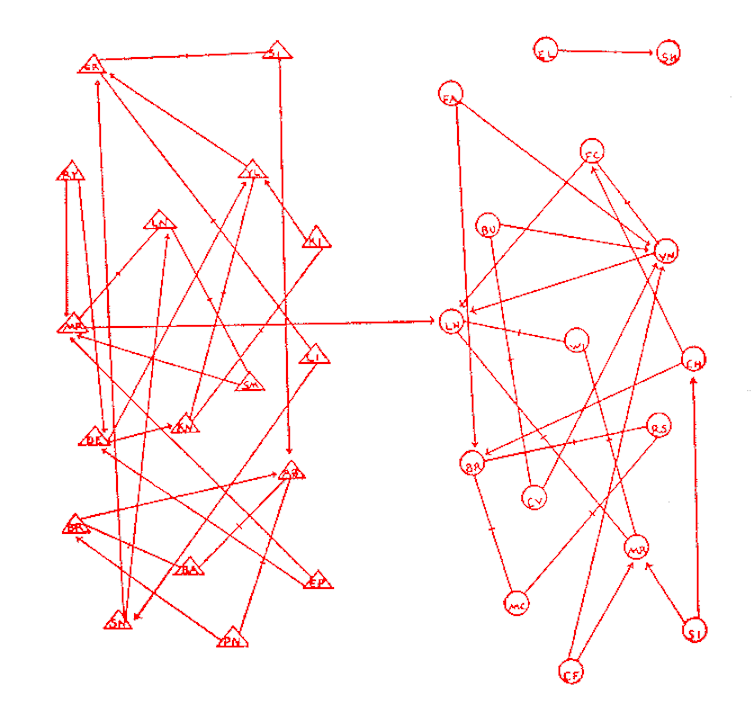
Before any questioning on the social aspects of Facebook and Twitter, this research shed light on, for example, marital role segregation, importance of “weak ties” in job search, informal organization of firms, diffusion of innovations, formation of business elites, social support for the sick or elderly. Designers of digital platforms such as Facebook have picked up some of the analytical principles on which these works were based, developing them with the mathematical theory of graphs (though often with less attention to the social issues involved).
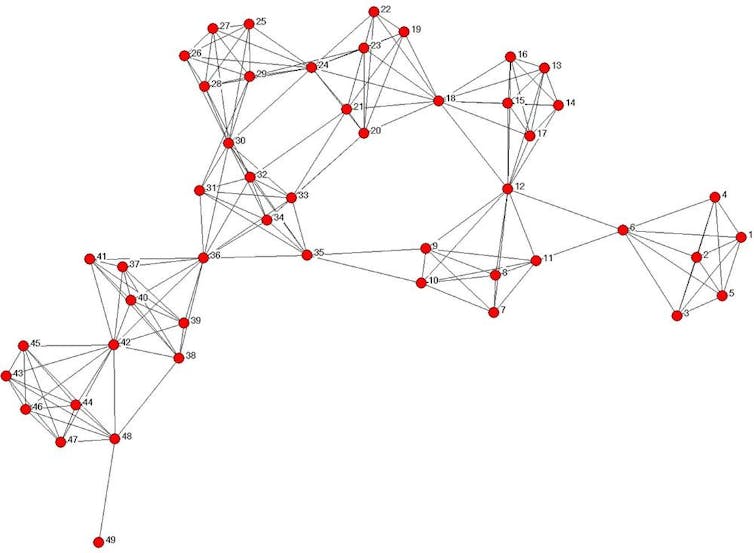
Early on, researchers in this field realized that the traditional principles of research ethics (focusing on informed consent of study participants and anonymization of data) were difficult to ensure. By definition, social networks research is never about a single individual, but about relationships between this individual and others – their friends, relatives, collaborators or professional advisors. If the latter are reported by the respondent but are not themselves included in the study, it is difficult to see how their consent could be obtained. What’s more, results can be difficult to anonymize, in that visuals are sometimes disclosive even in the absence of personal identifiers.
Academics have long been thinking about these ethical difficulties, to which a special issue of the prestigious Social Networks journal was dedicated as far back as 2005. Today, researchers’ dilemmas are exacerbated by the increased availability of relational data collected and exploited by digital giants like Facebook or Google. New problems arise as the boundaries between “public” and “private” spheres become confused. To what extent do we need consent to access messages that digital service users send to their contacts, their “retweets”, or their “likes” on their friends’ walls?
These sources of information are often the property of commercial enterprises, and the algorithms they use likely bias observations. For example, can we interpret in the same way a contact created spontaneously by a user, and a contact created as a result of an automated recommendation system? In short, the data do not speak for themselves, and before thinking about their analysis, we must question the conditions of their use and the methods of their production. They largely depend on the software architectures imposed by platforms as well as their economic and technical choices. There is a real power asymmetry between platforms – often the property of large multinational companies – and researchers – especially those working in the public sector, and whose objectives are misaligned with investors’ priorities. Negotiations (if possible at all) are often difficult, resulting in restrictions to proprietary data access – particularly penalizing for public research.
Other problems arise as a researcher may even use paid crowdsourcing to produce data, using platforms like Amazon Mechanical Turk to ask large numbers of users to complete a questionnaire, or even to download their online contact lists. But these services raise numerous questions in terms of workers’ rights, working conditions and appropriation of the product of work. The resulting uncertainty hinders research that could otherwise have a positive impact on knowledge and on society at large.
Availability of online communication and publication tools, which many researchers are now seizing, increases the likelihood that research results may be diverted for political or business purposes. If the interest of military and police circles for the analysis of social networks is well known (Osama Bin Laden was allegedly located and neutralised following the application of social network analysis principles), these appropriations are more frequent today, and less easily controllable by researchers. A significant risk is the use of these principles to suppress civic and democratic movements.
Restrictions and prohibitions would likely aggravate the constraints that already weigh on researchers, without helping them overcome these obstacles. Rather, it is important to create conditions for trust and enable researchers to explore the full extent and importance of online and offline social networks – allowing them to capture salient economic and social phenomena while remaining respectful of people’s rights. Researchers should take an active role, participating in the co-construction of an adequate ethical framework, grounded in their experience and self-reflective attitude. A bottom-up process involving academics as well as citizens, civil society associations, and representatives of public and private research organizations could then feed these ideas and thoughts back to regulators (such as ethics committees).
Antonio A. Casilli, Associate professor Télécom ParisTech, research fellow Centre Edgar Morin (EHESS)., Télécom ParisTech – Institut Mines-Télécom, Université Paris-Saclay et Paola Tubaro, Chargée de recherche au LRI, Laboratoire de Recherche Informatique du CNRS. Enseignante à l’ENS, Centre national de la recherche scientifique (CNRS)
La version originale de cet article a été publiée sur The Conversation.
Did you attend the OuiShare Fest Barcelona 2017? If you did, and were not interviewed by a member of our team there, please take our survey online!
With a group of colleagues from Universitat Autònoma de Barcelona and in Collaboration with OuiShare, we are studying networking at the event. The OuiShare Fest aims, among other things, to bring people together: we want to see how interactions between participants facilitate circulation of ideas and possibly give rise to future collaborations.
We did the same study at the OuiShare Fest Paris 2016 and 2017.
For more details, see here.

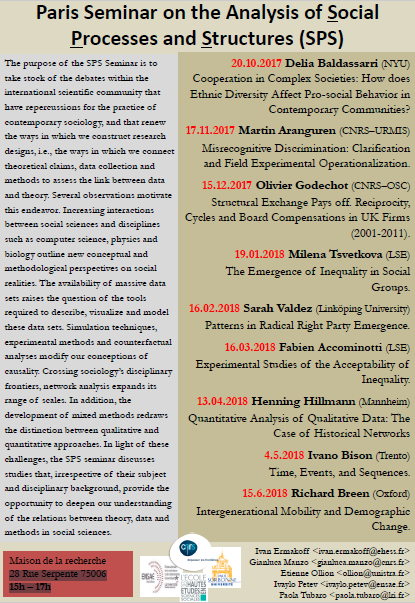
Our inter-disciplinary, inter-institutional SPS seminar (Paris Seminar on the Analysis of Social Processes and Structures) has just started its second edition! Its purpose is to take stock of the debates within the international scientific community that have repercussions on the practice of contemporary sociology, and that renew the ways in which we construct research designs, i.e., the ways in which we connect theoretical claims, data collection and methods to assess the link between data and theory. Several observations motivate this endeavor. Increasing interactions between social sciences and disciplines such as computer science, physics and biology outline new conceptual and methodological perspectives on social realities. The availability of massive data sets raises the question of the tools required to describe, visualize and model these data sets. Simulation techniques, experimental methods and counterfactual analyses modify our conceptions of causality. Crossing sociology’s disciplinary frontiers, network analysis expands its range of scales. In addition, the development of mixed methods redraws the distinction between qualitative and quantitative approaches. In light of these challenges, the SPS seminar discusses studies that, irrespective of their subject and disciplinary background, provide the opportunity to deepen our understanding of the relations between theory, data and methods in social sciences.
Research on social networks is experiencing unprecedented growth, fuelled by the consolidation of network science and the increasing availability of data from digital networking platforms. However, it raises formidable ethical issues that often fall outside existing regulations and guidelines. New tools to collect, treat, store personal data expose both researchers and participants to specific risks. Political use and business capture of scientific results transcend standard research concerns. Legal and social ramifications of studies on personal ties and human networks surface.
We invite contributions from researchers in the social sciences, economics, management, statistics, computer science, law and philosophy, as well as other stakeholders to advance the ethical reflection in the face of new research challenges.
The workshop will take place on 5 December 2017 (full day) at MSH Paris-Saclay, with open keynote sessions to be held on 6 December 2017 (morning) at Hôtel de Lauzun, a 17th century palace in the heart of historic Île de la Cité.

José Luis Molina, Autonomous University of Barcelona, “HyperEthics: A Critical Account”
Bernie Hogan, Oxford Internet Institute, “Privatising the personal network: Ethical challenges for social network site research”
Antonio A. Casilli (Telecom ParisTech, FR), Alessio D’Angelo (Middlesex University, UK), Guillaume Favre (University of Toulouse Jean-Jaurès, FR), Bernie Hogan (Oxford Internet Institute, UK), Elise Penalva-Icher (University of Paris Dauphine, FR), Louise Ryan (University of Sheffield, UK), Paola Tubaro (CNRS, FR).
Email: recsna17@msh-paris-saclay.fr
Webpage: http://recsna17.sciencesconf.org
Twitter: @recsna17

