Sunbelt 2025 in Paris: inequalities, weak ties, and networked markets

I am attending a faboulous Sunbelt conference, taking place this year in Paris. I am deeply grateful to Emmanuel Lazega who made gigantic efforts to bring this important conference to France, after a failed attempt in 2020 when the Covid-19 pandemic brought everything online.

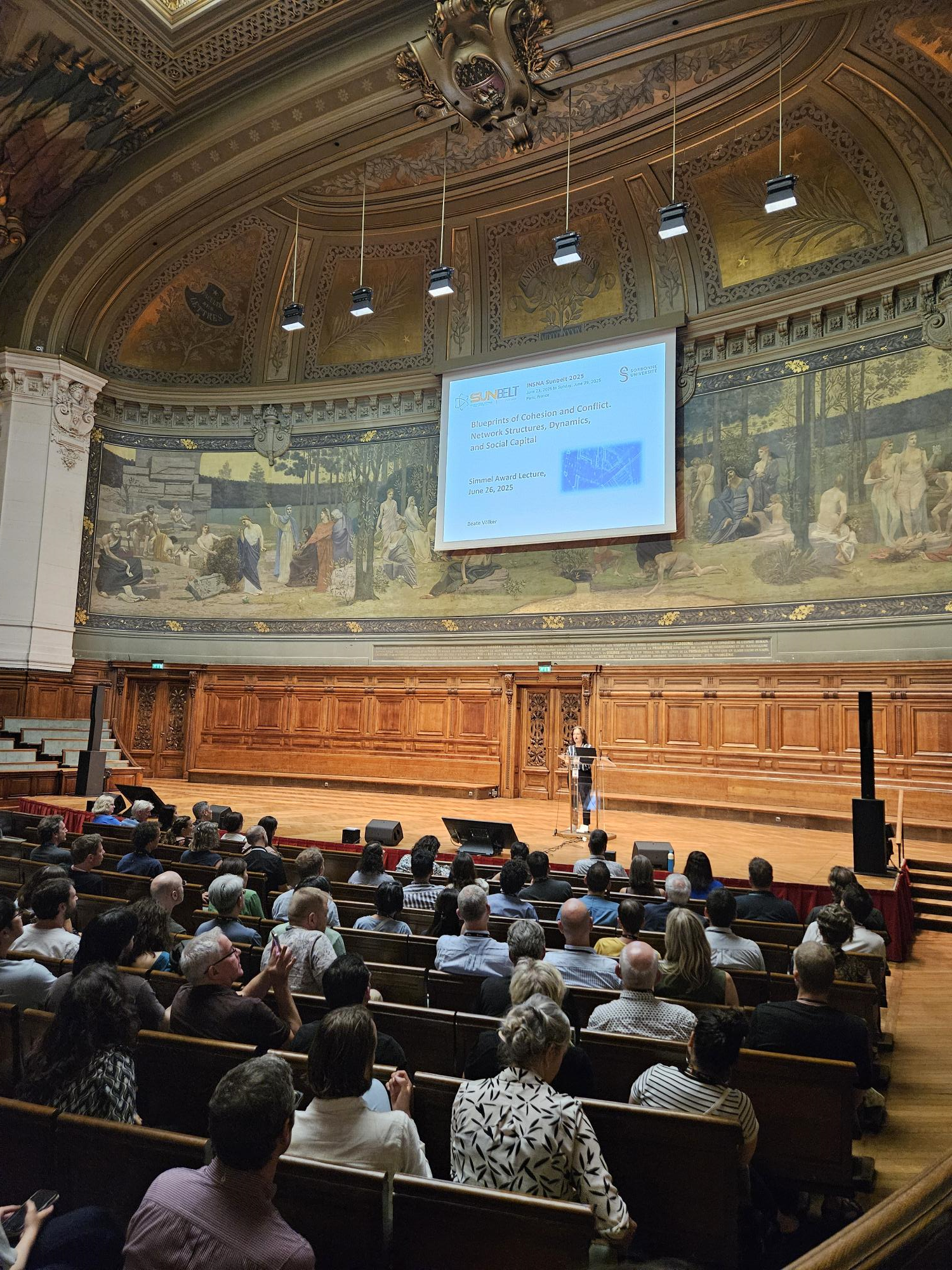
Yesterday, a very inspiring keynote by Beate Völker reminded us of the importance of weak ties and even absent ties – not only to smoothen the functioning of job markets but also, more surprisingly, to achieve social cohesion. The keynote took place in the historical Grand Amphithéâtre de la Sorbonne.
I am pleased to have contributed to a set of initiatives in honour of great network sociologist Harrison White, one year after his death. With Elise Penalva-Icher and Fabien Eloire, we presented a paper on digital platforms in White-like producer markets shaped by networks (more on it soon!). The paper was part of a dedicated session on the legacy of Harrison White. There was also a plenary in memoriam, where his former students and friends shared thoughts and stories. (Another plenary honoured Barry Wellman).

I was also honoured to be invited, today, to join a plenary panel on social networks and the study of social inequalities, organized by Gianluca Manzo. While most research on inequalities is attribute-based, social network approaches provide a powerful alternative (or perhaps, complement), highlighting how interpersonal, relational mechanisms generate patterns that over time, lock categorical differences into durable gaps in wealth, status, or other outcomes. We discussed complementarities and differences between these two approaches, the advantages of a network-oriented perspective, but also the methodological challenges that come with it.

On Sunday, I’ll present a paper that also deals with inequalities, in the specific case of online platform workers. We define an index of ‘vulnerability’ to unveil inequalities within this worker population in two countries, France and Spain. The paper develops and deeps results of a previous work, whose first outputs served to inform policy decisions in France.

Another paper to which I have contributed, and which will be presented at this Sunbelt, is more methodological and is the result of a collective effort. We analyze over 20 years of publications in the journal REDES and highlight how researchers have reported relational data from both personal and complete networks. We identify key challenges in the consistency and transparency of reporting and propose 7 practical recommendations to improve clarity, comparability, and replicability in social network research. This paper is already published in REDES.
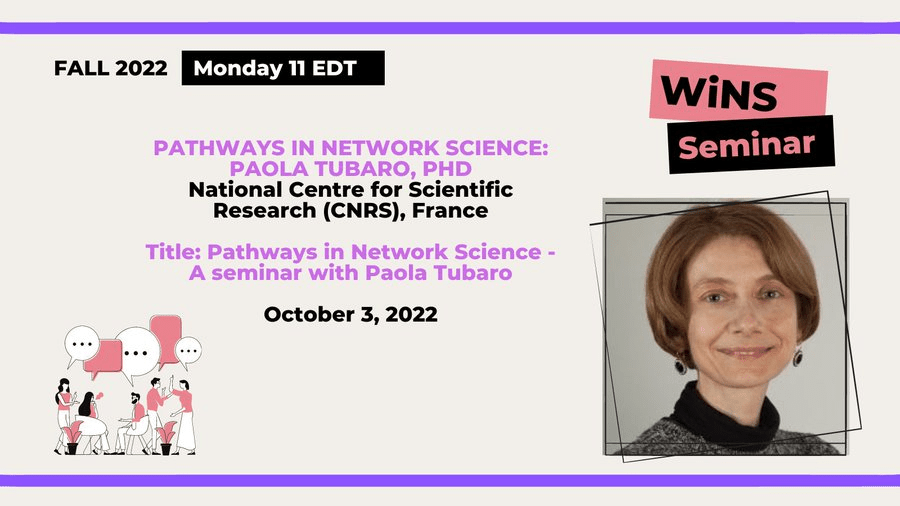
Pathways in Network Science

I’m happy and honoured to speak today at the “Pathways in Network Science” online seminar of the Women in Network Science (WiNS) group.

Pathways in Network Science aims to give the stage to women and nonbinary researchers in network science to share their career paths or some pertinent aspects of it. Presentations can be a summary of the research topics explored along a speaker’s career path or even an autobiographical presentation about how opportunities and challenges influenced her aspirations and impacted her career path. It can also include discussing gender-related challenges and experience with individual strategies and/or systemic changes.

I’ll talk about myself in terms of mobility – both geographic and disciplinary – and the challenges and opportunities it represented. I’ll also talk about resilience – or how network science helped me to make true my dream of devoting my life to research. I’ll mention impact – or how to think of the place of science in society, and how network research can lead to positive change. I’ll conclude with the challenges ahead – and how they are not only scientific, but also deeply human and social.

The visualization of personal networks

I am pleased to co-organize with Vincent Lorant of UCLouvain a special session on “The visualization of personal networks” at the forthcoming INSNA Sunbelt conference (12-16 July 2022, Cairns, Australia, and online).

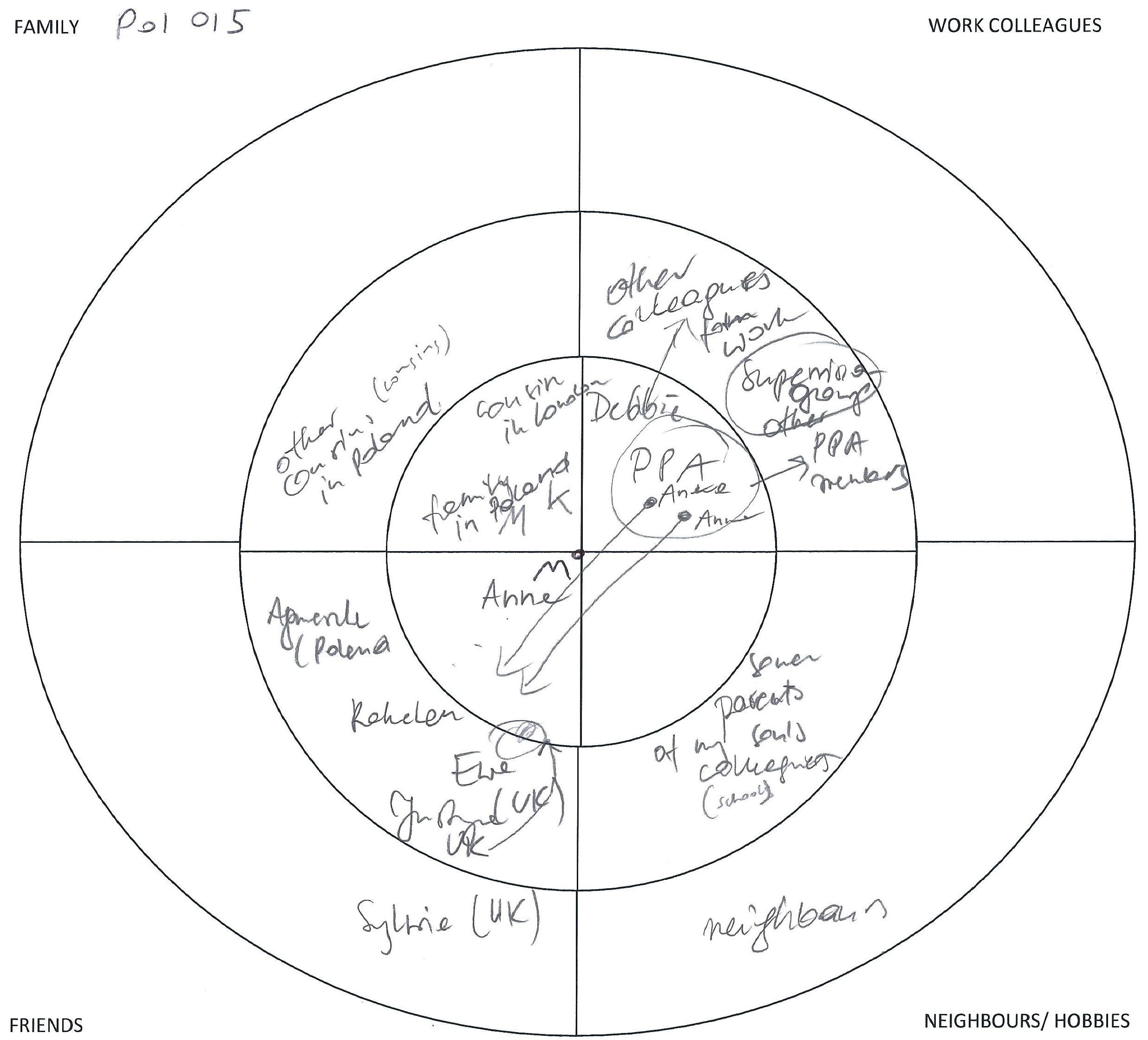
Personal network data collection methods allow describing the composition and the structure of an individual’s (hereafter ego) social network. This method has been implemented in different domains such as migration, drug use, mental health, aging, education, and social welfare. Over the last years, these data have also been used to provide respondents with visualizations of their personal network, using different algorithms and customizing results through computer assisted data collection. Visualization gives valuable feedback to the respondent, improves data validity and may trigger positive behavioural changes, notably in vulnerable individuals or groups. Yet, visualization is not a free lunch. Recent research has evidenced the ethical dilemmas of providing such feedback to individuals: ego’s social life is being exposed, the researcher may be exposed as well, and such feedback may imply some contractual exchanges or therapeutic implications that require attention.

This session aims to describe the stakes of different visualization approaches to personal networks with different populations. We welcome qualitative and quantitative papers addressing issues related to the implementation of visualization or reports of personal networks in terms of techniques, levels of respondent’s satisfaction with visualization, conditions under which visualization is recommended or discouraged, and effects of the personal network visualization for the respondent.

More information on the conference and the submission process is available here.

Call for papers: “Recent Ethical Challenges in Social Network Analysis”

Submissions are now invited for a special section of the journal Social Networks on “Recent Ethical Challenges in Social Network Analysis” (guest-edited by myself with Antonio A. Casilli, Alessio D’Angelo, and Louise Ryan).

Research on social networks raises formidable ethical issues that often fall outside existing regulations and guidelines. State-of-the-art tools to collect, handle, and store personal data expose both researchers and participants to new risks. Political, military and corporate interests interfere with scientific priorities and practices, while legal and social ramifications of studies of personal ties and human networks come to the surface.

The proposed special section aims to critically engage with ethics in research related to social networks, specifically addressing the challenges that recent technological, scientific, legal and political transformations trigger.

Following a successful workshop on this topic that was held in December 2017 in Paris, we welcome submissions that critically engage with ethics in research related to social networks, possibly based on reflective accounts of first-hand experiences or case studies, taken as concrete illustrations of the general principles at stake, the attitudes and behaviors of stakeholders, or the legal and institutional constraints. We are particularly interested in novel, original answers to some unprecedented ethical challenges, or the need to re­interpret norms in ambiguous situations.

The full Call for Papers is available here.

Recent ethical challenges in social network analysis (RECSNA17)

Research on social networks is experiencing unprecedented growth, fuelled by the consolidation of network science and the increasing availability of data from digital networking platforms. However, it raises formidable ethical issues that often fall outside existing regulations and guidelines. New tools to collect, treat, store personal data expose both researchers and participants to specific risks. Political use and business capture of scientific results transcend standard research concerns. Legal and social ramifications of studies on personal ties and human networks surface.

We invite contributions from researchers in the social sciences, economics, management, statistics, computer science, law and philosophy, as well as other stakeholders to advance the ethical reflection in the face of new research challenges.

The workshop will take place on 5 December 2017 (full day) at MSH Paris-Saclay, with open keynote sessions to be held on 6 December 2017 (morning) at Hôtel de Lauzun, a 17th century palace in the heart of historic Île de la Cité.

Calendar:

  • Submit a 300-word abstract by 15 October 2017.
  • Let us know if you wish to be panel discussant or session chair by 20 October 2017 (send to: recsna17@msh-paris-saclay.fr).
  • Acceptance notifications will be sent by 31 October 2017.
  • Registration is free but mandatory: speakers (and discussants and chairs) should register between 15 October and 15 November 2017, other attendees by 30 November 2017.

Keynote Speakers

José Luis Molina, Autonomous University of Barcelona, “HyperEthics: A Critical Account”
Bernie Hogan, Oxford Internet Institute, “Privatising the personal network: Ethical challenges for social network site research”

Scientific Committee

Antonio A. Casilli (Telecom ParisTech, FR), Alessio D’Angelo (Middlesex University, UK), Guillaume Favre (University of Toulouse Jean-Jaurès, FR), Bernie Hogan (Oxford Internet Institute, UK), Elise Penalva-Icher (University of Paris Dauphine, FR), Louise Ryan (University of Sheffield, UK), Paola Tubaro (CNRS, FR).

Contact us

Email: recsna17@msh-paris-saclay.fr
Webpage: http://recsna17.sciencesconf.org
Twitter: @recsna17

Visualisation, mixed methods and social networks: what’s new

This morning, we had a plenary on “Visualisation and social networks in mixed-methods sociological research” at the British Sociological Association conference now going on in Manchester. This session, organized by the BSA study group on social networks that I convene with Alessio D’Angelo (BSA SNAG), builds on a special section of Sociological Research Online that we edited in 2016. Alessio and I chaired and had four top-flying speakers: Nick Crossley, Gemma Edwards (both at the University of Manchester), Bernie Hogan (Oxford Internet Institute) and Louise Ryan (University of Sheffield).

Each speaker briefly presented a case study that involved visualization, and all were great in conveying exciting albeit complex ideas in a short time span. What follows is a short summary of the main insight (as I saw it).

Continue reading “Visualisation, mixed methods and social networks: what’s new”

The “pro-ana” phenomenon: Eating disorders and social networks

proanaA new book is just out, co-authored by myself and Antonio A. Casilli: a synthesis of our 5-odd years research on the self-styled internet communities, blogs and forums of persons with eating disorders. For years, lively controversies have surrounded these websites, where users express their distress without filters and go as far as to describe their crises, their vomiting and their desire for an impossibly thin body – thereby earning from the media a reputation for “promoting anorexia” (shortened as “pro-ana”). In France, an attempt to outlaw these online spaces last year was unsuccessful, not least because of our active resistance to it.

The book tells the story of our discovery of these communities, their members, their daily lives and their social networks. Ours was the first study to go beyond just contents, and discover the social environments in which they are embedded. We explored the social networks (not only online relationships, but day-to-day interactions at school or work, in the family, and among friends) of internet users with eating disorders, and related them to their health. The results defy received wisdom – and explain why banning these websites is not the right solution.

Internet deviance or public health budget cuts?

It turns out that “pro-ana” is less a form of internet deviance than a sign of more general problems with health systems. Joining these online communities is a way to address, albeit partially and imperfectly, the perceived shortcomings of healthcare services. Internet presence is all the more remarkable for those who live in “medical deserts” with more than an hour drive to the nearest surgery or hospital. At the time of the survey in France, a number of areas lacked specialist services for eating disorder sufferers.


Availability of specialized services and support for eating disorder sufferers in France in 2012. Source: AFDAS-TCA & FNA-TCA.
Availability of specialized services and support for eating disorder sufferers in France in 2014. Source: AFDAS-TCA & FNA-TCA.

These people do not always aim to refute medical norms. Rather, they seek support for everyday life, after and beyond hospitalisation. These websites offer them an additional space for socialisation, where they form bonds of solidarity and mutual aid. Ultimately, the paradoxical behaviours observed online are the result of underfunded health systems and cuts in public budgets, that impose pressure on patients. The new model of the ‘active patient’, informed and proactive, may have unexpected consequences.


A niche phenomenon with wider repercussions

In this sense, “pro-ana” websites are not just a niche phenomenon, but a prism through which we can read broader societal issues: our present obsession with body image, our changing relationships with medical authorities, the crisis and deficit of our publich health systems, as well as the growing restrictions to our freedom of expression online.

Continue reading “The “pro-ana” phenomenon: Eating disorders and social networks”

Visualization in mixed-methods research on social networks

The journal Sociological Research Online has just published (31 May 2016) a special section on “Visualization in Mixed-Methods Research on Social Networks”, guest edited by Alessio D’Angelo, Louise Ryan and myself.

FigureL1
Figure 1 – Tubaro, Ryan & D’Angelo

The five papers in this peer-reviewed special issue explore the potential of visual tools to accompany qualitative and mixed-methods research. Visualization can support data collection, analysis and presentation of results; it can be used for personal or complete networks; it can be paper-and-pencil or computer-based. Overall, visualization helps to jointly understand network contents and network structures.

The special issue is freely accessible from all commercial (non-academic) internet providers.

Continue reading “Visualization in mixed-methods research on social networks”

The data of my friend are my data

The rise of digital data, particularly data from the internet, is to be understood in social relational perspective. Online interactions – from email exchanges to use of VOIP services and participation in social media such as Facebook, Twitter and LinkedIn – make people’s social connections explicit and visible. The “social network”, once a metaphor used only in a small sub-field within sociology, is now familiar to everybody as the archetype of computer-mediated social interaction. Digital devices systematically record network structures, so that social ties become an essential part of every individual profile, and users are more and more aware of them.

One consequence of this is the booming popularity of network analysis concepts, which support the algorithms that handle digital data: for example, centrality measures are at the heart of search engine functionalities, and transitivity measures found “friend-of-a-friend” algorithms in social media. In passing, social network analysis itself which had been originally developed for small-sized, non-digital datasets (like surveys about friendship in schools) has undergone a major upgrade to account for social data from the web.

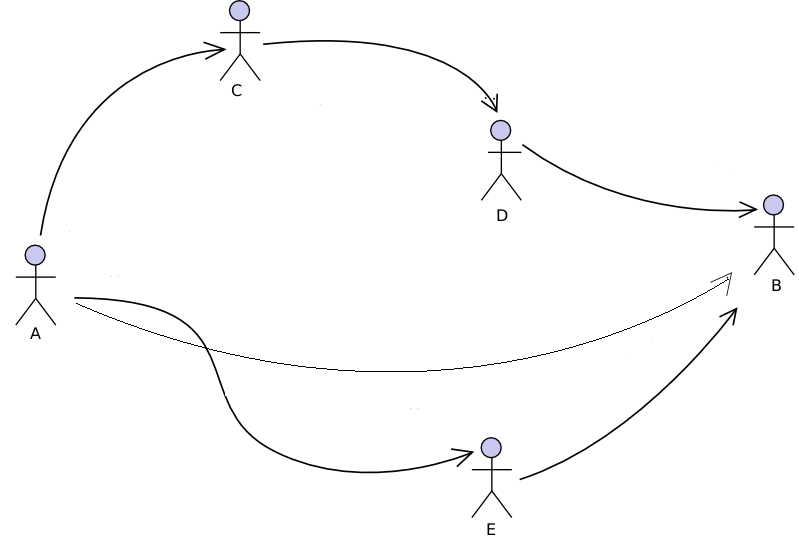
FOAFMore importantly, the relational nature of digital data and the underlying possibilities to use social network analysis, open up new avenues for data collection. If user B publishes a post on, say, their Facebook wall, comments and “likes” received from their friends A, D and E will be connected to the profile of B, accessible and visible from it; in other words, it is possible to retrieve information on A, D or E through the profile of just B. In general social networks, a friend of my friend is my friend; in digital networks, the data of my friends are my data.

Continue reading “The data of my friend are my data”

“Pro” ana? Sociability and support in eating disorder online communities

This article was first published on Discover Society, November 2014.

Last June, a group of Italian MPs proposed jail terms and fines for authors of so-called “pro-ana” (anorexia) and “pro-mia” (bulimia) websites. These are self-styled online communities on eating disorders which are viewed as promoting extreme dieting and unhealthy eating practices. France and the United Kingdom preceded Italy’s attempt to pass restrictive legislation as far back as 2008-9, and many internet service providers also endeavoured to ban these contents.

But the potential spread of health-hazardous behaviours is probably only one side of the coin, and these websites might also channel health-enhancing assistance, advice, and support (Yeshua-Katz & Martins 2013). In fact a closer look reveals that website users carefully manage their online socialisation to address their health challenges. Online social spaces enable discussion around the illness and constitute a complement, albeit an admittedly imperfect one, to formal healthcare services. There is no rejection of standard health norms in the name of some extreme ideal of thinness but rather a need – or perhaps, a cry – for extra support.

A social science approach brings out these results. The effect of web interactions on health does not only depend on website contents, but also on how people actually use them, share them, and access resources through them. The social, rather than just clinical dimension of eating disorders, recognized long before the advent of the web (Bell 1985, Orbach 1978), becomes ever more relevant in the current context and calls for a more comprehensive view of the “ana” and “mia” social universe.

SupportANAMIA(Credit: Roberto Clemente)

Continue reading ““Pro” ana? Sociability and support in eating disorder online communities”